
As a key material supporting the development of strategic emerging industries such as aerospace, new energy, and high-end equipment, the accurate characterization of the mechanical behavior of composite materials has long been the focus of attention in the scientific research and engineering communities.
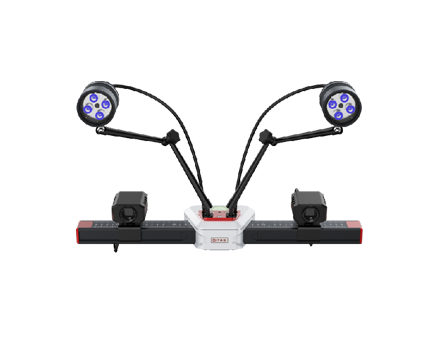
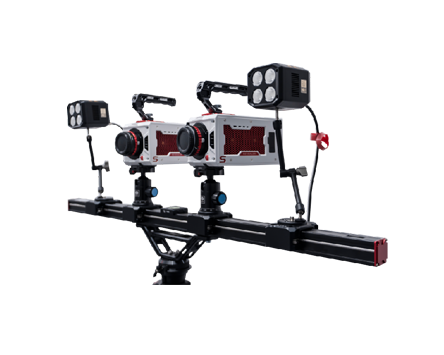
Digital Image Correlation (DIC) technology, as a non-contact, full-field, and high-precision optical measurement method, is becoming an indispensable tool in the research of composite material mechanical properties. At the 2025 International Composite Materials Science and Technology Summit and the 8th International Composite Materials Industry Innovation Achievement Technology Exhibition, Agile Device demonstrated the key applications of DIC technology in the mechanical property testing of composite materials to participating experts and scholars.
The damage evolution process of composite materials under load is complex, involving failure modes such as fiber fracture and matrix cracking. Using DIC technology, the full-field strain distribution on the material surface can be captured in real time, providing image evidence for the research on failure mechanisms.
In a tensile fracture experiment of glass fiber-reinforced composite materials, the Revealer DIC system recorded the evolution process of the strain field on the specimen surface throughout the entire process. By analyzing the Lagrangian strain components, researchers accurately identified the strain concentration phenomenon at the interface between fibers and the matrix, and revealed the damage initiation position and crack propagation path.

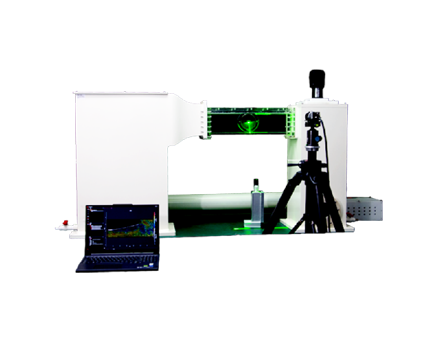
In a high-temperature strain test of a certain type of composite material at 980°C, the Revealer high-temperature DIC system overcame the limitations of traditional contact measurement methods in high-temperature environments. Through the configuration of a high-temperature furnace observation window and a long focal length lens, the system can real-time monitor the deformation behavior of the material under thermo-mechanical coupling, providing an important basis for optimizing the design of anti-oxidation coatings and multi-level thermal protection structures.

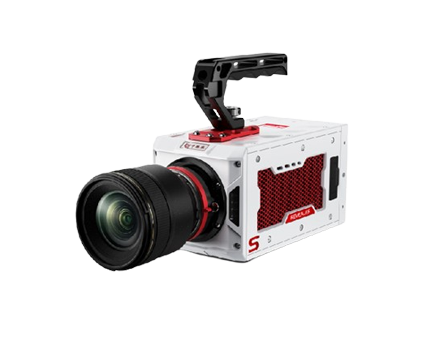
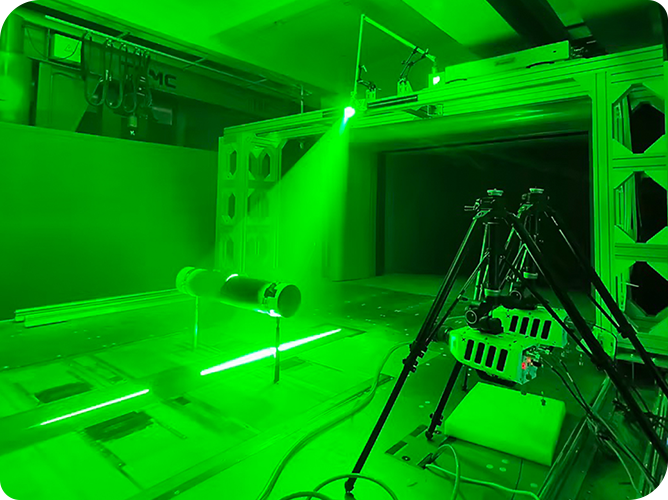
The Revealer high-speed DIC system can capture the dynamic strain field of rotating composite material structures under complex loads. Through the high-speed DIC system, researchers can obtain the vibration modes and stress distribution of blades at different rotational speeds, providing data support for optimizing structural design. This non-contact measurement method is applicable to the mechanical property evaluation of rotating machinery and moving components.

Composite material structures prepared by additive manufacturing technology often have internal defects and anisotropy. In a compression test, the Revealer DIC system successfully captured the interlayer delamination and local buckling behavior of printed layers. The strain cloud map shows that the strain concentration area under compression load is highly correlated with the printing path, indicating that process parameters have a significant impact on the mechanical properties of components.

Digital Image Correlation (DIC) technology has demonstrated irreplaceable value in failure behavior analysis, high-temperature environment testing, structural health monitoring, and manufacturing process optimization. The DIC system can provide strain field data that is difficult to obtain with traditional methods, helping researchers deeply understand the damage mechanisms, failure behaviors, and optimization paths of composite materials.
 English
 Deutsch