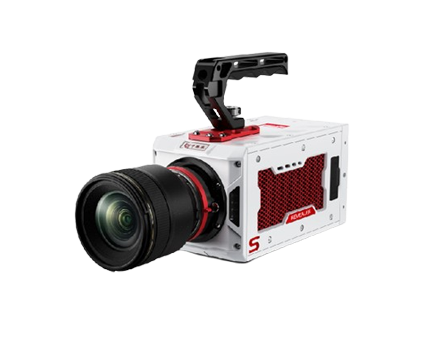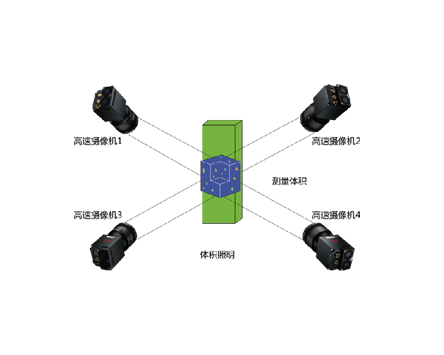
When you’re tackling scientific imaging—whether it’s capturing faint stars in astrophotography or zooming into cells under a microscope—the right camera can make all the difference. sCMOS and EMCCD cameras are top players in the world of high-sensitivity cameras, but they serve different purposes. This guide breaks down their differences, strengths, and ideal use cases to help you pick the best fit. We’ll also tackle common questions, compare sCMOS to CCD, and dive into how these cameras perform in low-light conditions, microscopy, and astrophotography.
Choose sCMOS if: You need high frame rates (>100 fps), large field of view, and high resolution (4.2MP+) for live-cell imaging or wide-field microscopy.
Choose EMCCD if: You are dealing with ultra-low light signals (<10 photons/pixel) where single-photon sensitivity is critical, such as single-molecule detection.
A scientific CMOS (sCMOS) camera is a high-performance imaging tool designed for scientific applications. Unlike standard CMOS sensors, sCMOS cameras are optimized for low noise, high frame rates, and a wide dynamic range, making them perfect for tasks like fluorescence microscopy or high-speed astrophotography. Their parallel readout architecture, where each pixel has its own amplifier, enables rapid data processing and high-resolution imaging.
Insight: sCMOS cameras shine in scenarios needing both speed and a large field of view, such as live-cell imaging, where capturing dynamic processes in real time is key.
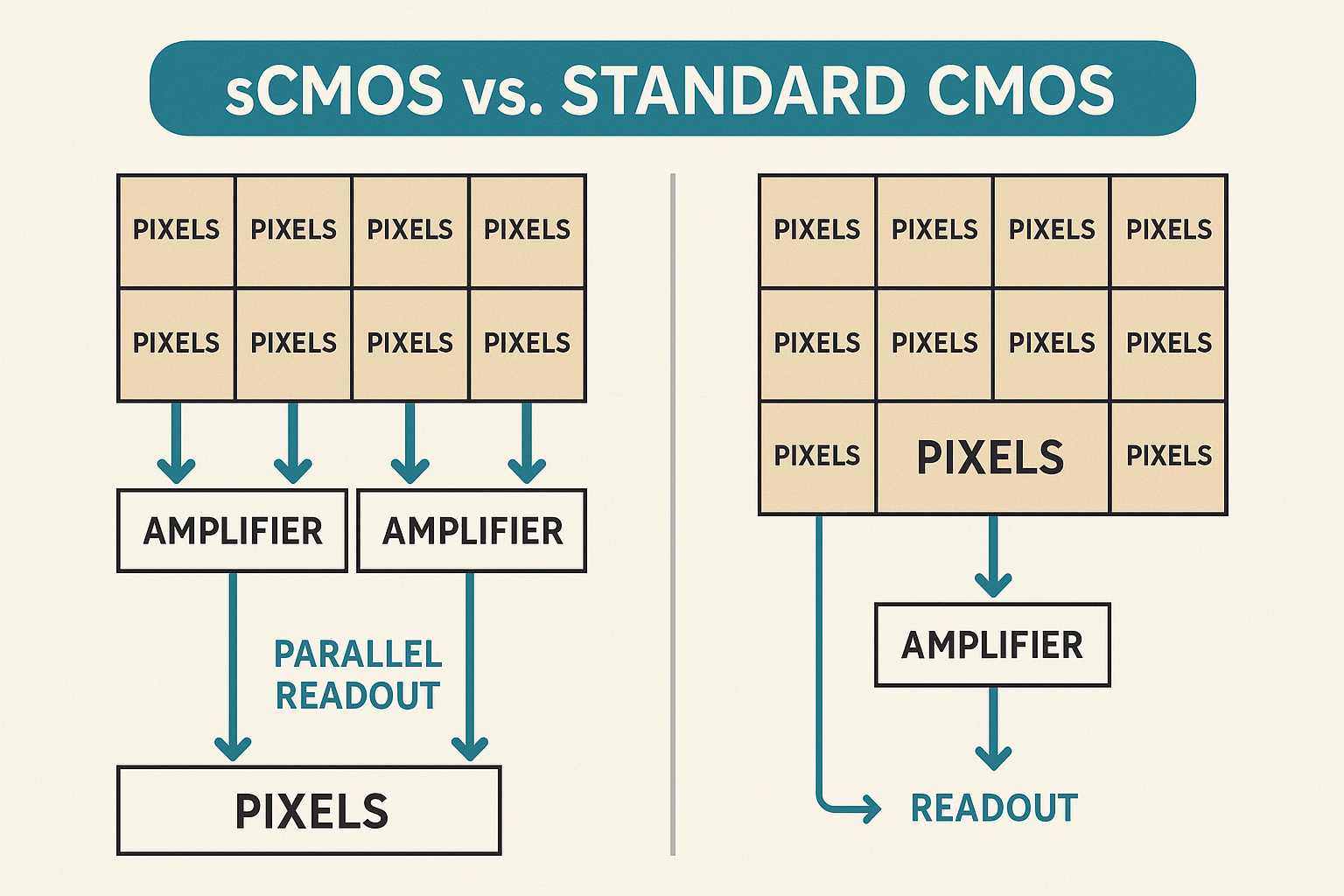
An Electron Multiplying CCD (EMCCD) camera is a specialized CCD with an electron multiplication register that amplifies the signal before readout, achieving single-photon sensitivity. This makes EMCCDs ideal for extremely low-light conditions, like single-molecule detection or deep-space astrophotography. However, the amplification process introduces multiplicative noise, which can affect image quality at higher light levels.
Insight: EMCCDs are the go-to for applications where every photon counts, but their lower resolution and slower speeds may limit their use in high-throughput imaging.
Let’s dive into the core differences between sCMOS and EMCCD cameras across key performance metrics to help you choose.
· sCMOS: Back-illuminated sCMOS cameras achieve quantum efficiencies (QE) up to 95%, with read noise as low as 1-2 electrons. They avoid multiplicative noise since they don’t rely on electron multiplication. Most modern sCMOS cameras, like the Revealer Sona series, utilize Back-illuminated (BI) technology. By moving the circuitry to the rear of the sensor, we maximize light collection, effectively bridging the sensitivity gap that previously gave EMCCDs the sole advantage.
· EMCCD: EMCCDs use electron multiplication to achieve near-zero read noise, perfect for single-photon detection. However, the multiplication process adds a noise factor, reducing the effective QE.
Insight: For ultra-low-light applications (<10 photons/pixel), EMCCDs have the edge. For slightly brighter conditions, sCMOS cameras offer comparable sensitivity with better signal-to-noise ratios.

· sCMOS: Parallel readout enables frame rates exceeding 100 fps, even at high resolutions (e.g., 4.2 MP), making them ideal for fast, dynamic imaging.
· EMCCD: Serial readout limits EMCCDs to 50-60 fps for smaller sensors (e.g., 512x512 pixels). Higher speeds often require binning, reducing resolution.
Insight: For high-speed imaging, like tracking rapid cellular processes, sCMOS cameras are the better choice due to their superior frame rates.
· sCMOS: Offers multi-megapixel sensors (e.g., 4.2 MP or higher) with smaller pixel sizes (6.5-11 µm), delivering high resolution and a large field of view.
· EMCCD: Typically limited to 1 MP or less, with larger pixels (13-16 µm), prioritizing sensitivity over resolution.
Insight: sCMOS cameras are perfect for applications needing detailed, wide-field images, like whole-slide microscopy or large-sky surveys in astronomy.
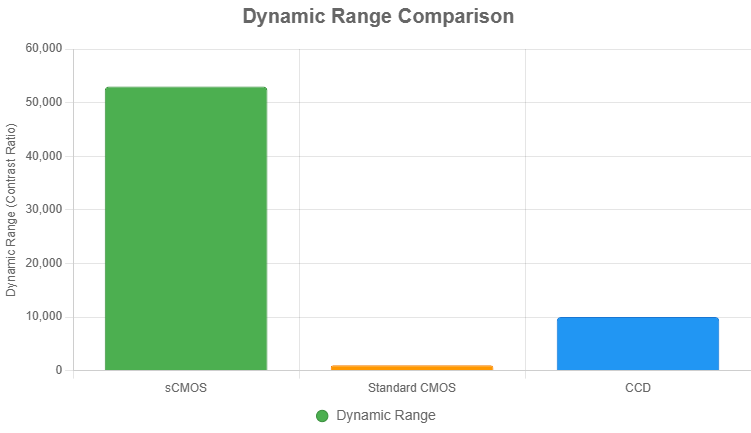
· sCMOS: Features a 16-bit dynamic range (up to 53,000:1), capturing both bright and dim features in a single image without saturation.
· EMCCD: Offers a high dynamic range, but it’s often limited by the electron multiplication process, especially at higher light levels.
Insight: For experiments with a wide range of light intensities, like calcium imaging, sCMOS cameras provide superior dynamic range without compromising speed.
· sCMOS: Generally more affordable, with prices ranging from $5,000 to $20,000 depending on features like back-illumination.
· EMCCD: More expensive, often $20,000-$30,000, due to specialized electron multiplication technology.
Insight: Budget-conscious labs can achieve high performance with sCMOS cameras, especially for applications not requiring single-photon sensitivity.
Feature | sCMOS | EMCCD |
Sensitivity | High (QE up to 95%) | Single-photon sensitivity |
Read Noise | 1-2 e- | <1 e- (with EM gain) |
Frame Rate | >100 fps | 50-60 fps (max) |
Resolution | Multi-megapixel (e.g., 4.2 MP) | ~1 MP or less |
Dynamic Range | 16-bit, up to 53,000:1 | High but limited by noise |
Cost | $5,000-$20,000 | $20,000-$30,000 |
While EMCCDs are a type of CCD, standard CCD cameras are still used in some scientific applications. Here’s how sCMOS compares to traditional CCDs:
· Sensitivity: CCDs offer high sensitivity but lack the electron multiplication of EMCCDs, making them less effective in ultra-low-light conditions.
· Speed: CCDs use serial readout, resulting in slower frame rates (often <10 fps) compared to sCMOS’s parallel architecture.
· Noise: sCMOS cameras have lower read noise (1-2 e-) than CCDs (5-10 e-), especially in back-illuminated models.
· Resolution: sCMOS sensors provide higher resolution and larger fields of view than most CCDs.
Insight: sCMOS has largely overtaken CCDs in applications like fluorescence microscopy due to its speed, resolution, and low noise, but CCDs remain useful for long-exposure tasks like spectroscopy.
· sCMOS: Ideal for high-speed astrophotography, like capturing transient events or large-sky surveys. Their large field of view and fast readout make them perfect for covering vast areas of the sky.
· EMCCD: Best for deep-space imaging where light is scarce, such as observing faint galaxies or exoplanets. Their single-photon sensitivity excels in long exposures.
Insight: For astrophotography cameras, sCMOS is the go-to for dynamic, high-resolution imaging, while EMCCDs shine in photon-starved scenarios.
· sCMOS: Excels in fluorescence microscopy, live-cell imaging, and super-resolution techniques like STORM or PALM. Their high frame rates and large fields of view support dynamic, high-throughput imaging.
· EMCCD: Preferred for single-molecule imaging or low-light fluorescence where absolute sensitivity is critical. Their lower resolution limits their use in high-detail applications.
Insight: For cameras for microscopy, sCMOS is often the better choice for versatility, especially in multi-user labs handling diverse experiments.
· sCMOS: Used in quantum imaging, hyperspectral imaging, and high-speed spectroscopy due to its balance of sensitivity, speed, and resolution.
· EMCCD: Suited for ultra-fast spectroscopy or low-light applications like luminescence studies.
Not all sCMOS cameras are the same. When picking the best sCMOS camera, consider:
· Quantum Efficiency: Opt for back-illuminated models with QE >90% for low-light performance.
· Pixel Size: Smaller pixels (6.5 µm) are great for high-resolution microscopy; larger pixels (11 µm) suit low-light applications.
· Frame Rate: Ensure the camera supports your required speed (e.g., >100 fps for live-cell imaging).
· Cooling: TE-cooled models reduce dark noise for long exposures, crucial for astrophotography.
· Brand Options: Revealer Highspeed’s sCMOS cameras, like the Sona series, offer high sensitivity and 16-bit dynamic range, making them versatile for both microscopy and astronomy.
Insight: Match the camera’s specs to your application’s light levels and speed requirements to avoid overspending on unnecessary features.
What is the difference between CCD and sCMOS?
sCMOS cameras use parallel readout for faster frame rates and lower noise (1-2 e-) compared to CCDs (5-10 e-). They also offer higher resolution and larger fields of view, making them better for dynamic imaging like live-cell microscopy.
What is the difference between CCD and EMCCD?
EMCCDs are CCDs with an electron multiplication register, reducing read noise to near zero and enabling single-photon sensitivity. Standard CCDs lack this, making them less suited for low-light conditions.
What is the best sCMOS camera for low-light imaging?
Back-illuminated sCMOS cameras, like Revealer Highspeed's Sona-6 Extreme, with 95% QE and low read noise, are top choices for low-light applications like fluorescence microscopy or astrophotography.
What is a scientific CMOS camera used for?
sCMOS cameras are used in scientific applications requiring high sensitivity, speed, and resolution, such as fluorescence microscopy, astrophotography, quantum imaging, and high-speed spectroscopy.
How does sCMOS compare to standard CMOS?
sCMOS cameras are optimized for scientific imaging with lower noise, higher QE, and wider dynamic range than standard CMOS, which is better suited for consumer applications like smartphones.
Can sCMOS cameras replace EMCCDs for single-molecule imaging?
In some cases, yes. Back-illuminated sCMOS cameras with low noise can match EMCCDs for single-molecule imaging, especially when higher resolution or faster frame rates are needed.
Is sCMOS more cost-effective than EMCCD for laboratory use?
Generally, yes. sCMOS cameras offer a better price-to-performance ratio for 90% of scientific applications. While EMCCDs are indispensable for niche ultra-low light tasks, the lower acquisition cost and maintenance-free cooling of sCMOS make it the preferred choice for most modern labs.
· Andor Technology: Technical notes on sCMOS and EMCCD performance metrics.
· Hamamatsu Photonics: White papers on quantum efficiency and noise characteristics.
· Oxford Instruments: Application notes on microscopy camera performance.
· Teledyne Vision Solutions: Guides on sCMOS sensor architecture.
· Wikipedia: Entries on sCMOS, EMCCD, and CCD technologies.
· Nature (journal): Studies on single-molecule localization microscopy (SMLM) techniques.

 English
 Deutsch