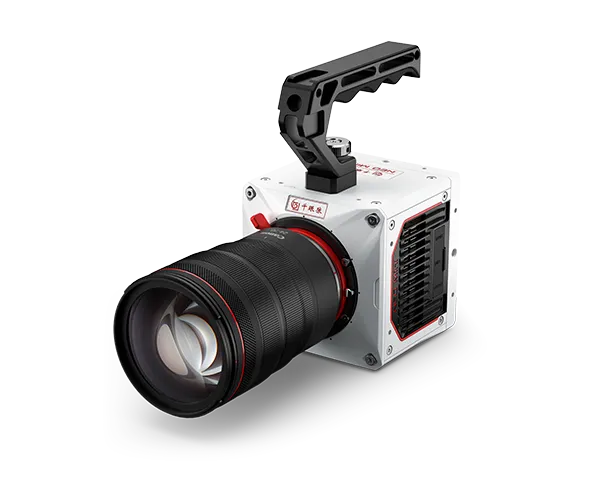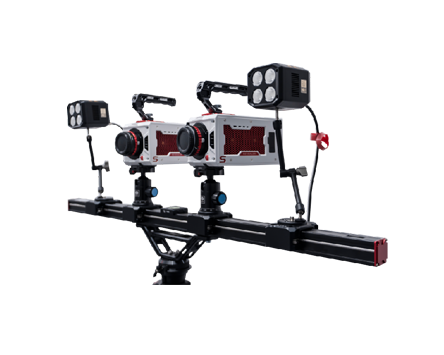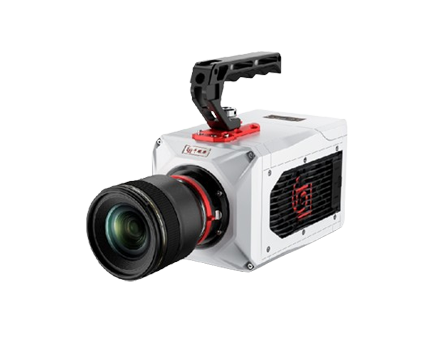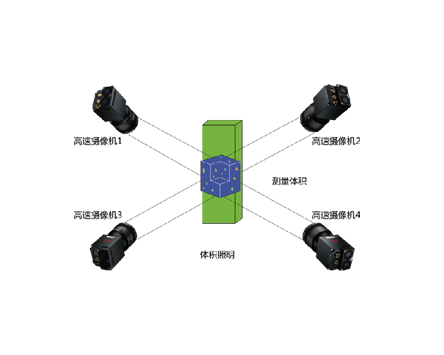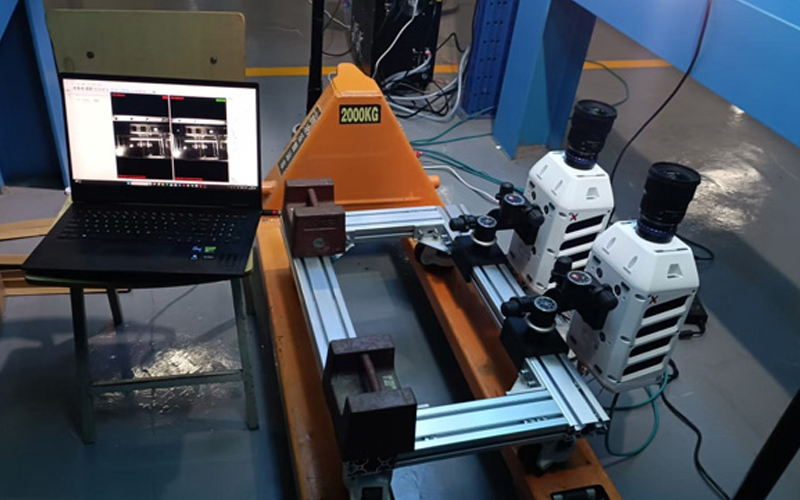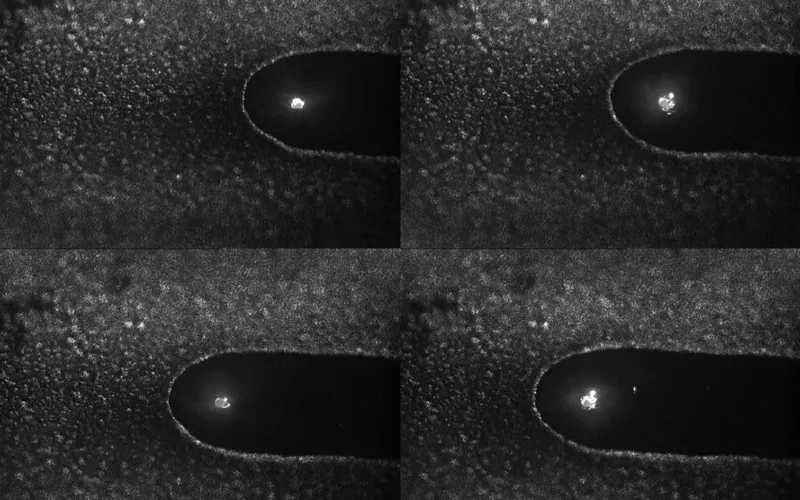
In the study of bubble dynamics, achieving precise identification and continuous tracking of micro-scale, low-contrast, and high-density bubbles is a common challenge across fluid mechanics, microfluidics, energy chemical engineering, and biomedical engineering. Engineers at Agile Device have combined the Revealer ultra-high-speed series with a self-developed Heterogeneous Branching Neural Network algorithm to construct a high-speed visual solution for the bubble measurement field. This system enables precise recognition, stable tracking, and multi-dimensional physical parameter measurement of bubbles in complex scenarios, providing robust experimental tool support for bubble dynamics research.
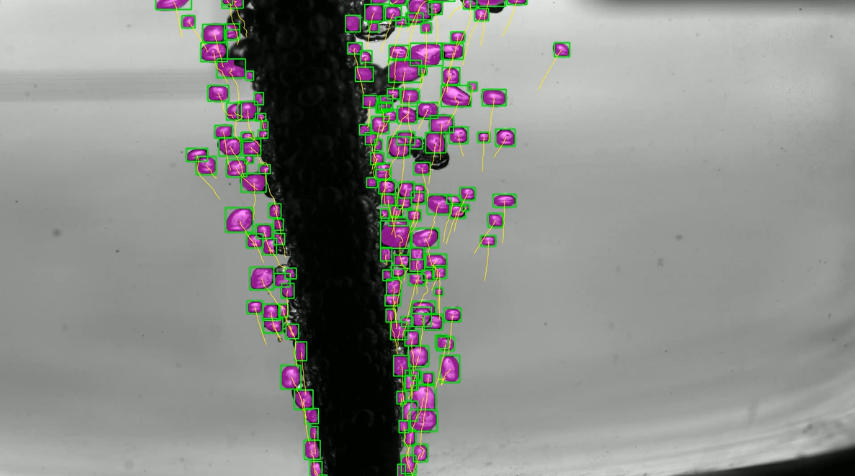
As typical gas-liquid two-phase interface structures, the transient processes of bubbles—such as generation, rising, deformation, coalescence, and breakup—occur at microsecond scales, directly affecting heat transfer efficiency, reaction rates, and system stability. Standard industrial cameras or ordinary high speed cameras struggle to capture the complete evolution process.
At the algorithmic level, traditional methods rely heavily on manual interpretation or classical image processing (thresholding/edge detection), which fail to address the following real-world challenges:
Low Contrast: When the refractive indices of the bubbles and the medium are similar, edges become blurred and grayscale differences are faint, rendering traditional thresholding ineffective.
Background Interference: Impurities in the flow field and fluctuations in the two-phase interface often cause false positives.
Micro-scale Targets: Bubbles with diameters of only 10-15 pixels lack significant texture and shape features; conventional CNN algorithms often lose these critical details during pooling.
High-Density Crowding: When the spacing between bubbles is smaller than their diameter, mutual shielding occurs, leading to identity confusion in traditional tracking algorithms.
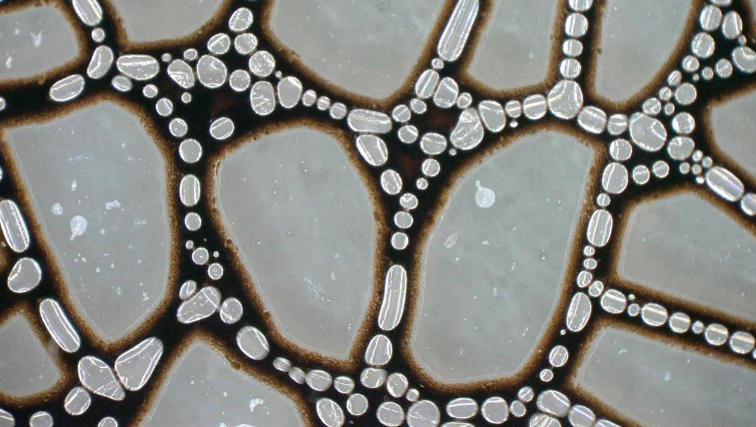
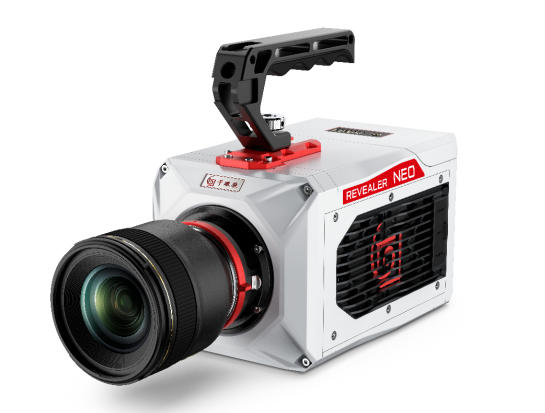
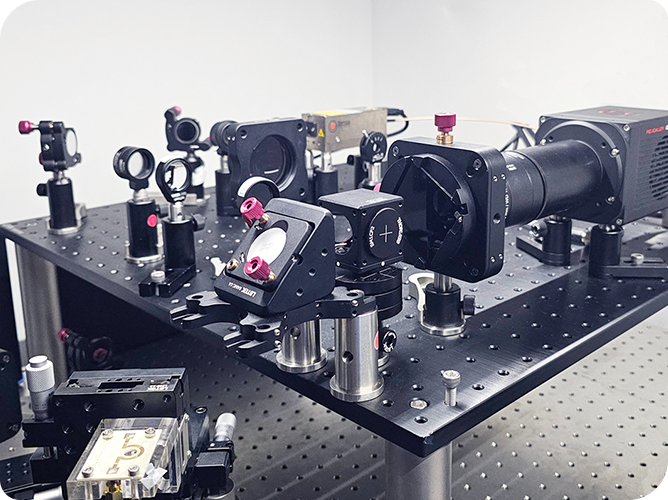
2.1 Hardware Platform - Revealer Ultra-High Speed Camera NEO
In practical engineering and experimental research, Revealer ultra-high speed cameras are widely used in bubble measurement related scenarios, with the following main advantages:
Supports high-speed acquisition of 25,000 fps at 1.3 megapixels, and the time resolution reaches up to 5 μs in the effective ROI.
Adopts a new generation of BSI sensor with a quantum efficiency of 85%, enabling high-speed imaging with only 10 lux illumination.
Has a 54 dB high dynamic range, effectively improving the signal-to-noise ratio in low-contrast scenarios.
Provides an SDK interface, supporting real-time collaboration with self-developed algorithms to achieve "analysis while acquisition".
Relying solely on high-speed cameras is still insufficient to complete bubble measurement in complex scenarios. Algorithm engineers from Agile Device broke through the limitations of the traditional single-branch convolutional network structure model and proposed a path of "heterogeneous dual-branch neural network architecture". This path solves the contradiction between accuracy and speed by establishing a parallel mechanism of "local fine characterization" and "global semantic perception". In the subsequent motion inference, a multi-dimensional constraint association algorithm based on optimal transport theory is introduced. The technical principles are as follows:
High-resolution branch:
Uses small convolution kernels and dilated convolution, dedicated to the edge detail and geometric contour reconstruction of tiny bubbles.
Context branch:
Extracts large-scale features by expanding the receptive field to understand the global structure of the area where bubbles are located, background characteristics and the macroscopic distribution in the scene.
Dynamic fusion module:
Adopts a lightweight fusion module to dynamically adjust the weight distribution of the two branches according to real-time image features, realizing efficient collaboration between details and semantics.
Optimal transport tracking:
Constructs a multi-dimensional feature space including position, shape, neighborhood topology and historical trajectory to achieve cross-frame ID consistent matching at the minimum cost.
Indicator | Advantage |
Precision | Stable identification of micro-bubbles approaching the resolution limit. |
Speed | Adapted to the high data throughput of Revealer High Speed Cameras; lightweight fusion ensures rapid processing of high-speed sequences. |
Robustness | Maintains high recognition rates in low-contrast and high-noise environments. |
Stability | Enhances ID consistency in high-density scenarios. |
Extensibility | Supports multi-parameter analysis including Sauter mean diameter, sphericity, projected area, instantaneous velocity, and acceleration. |
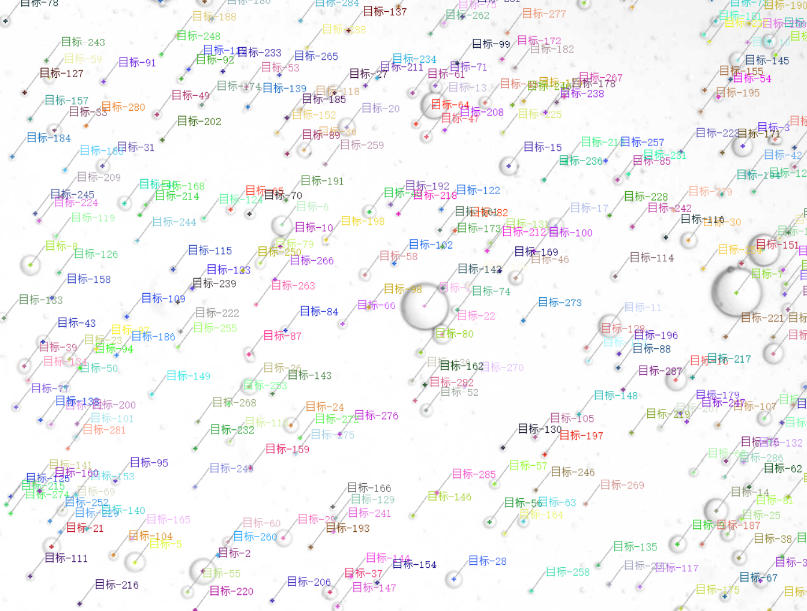
4.1 Recognition under Low Contrast
In scenarios where the grayscale difference between bubbles and the background is near the noise floor, the Revealer High Speed Camera leverages its high-sensitivity sensor to capture subtle grayscale variations. The "Heterogeneous Branching Architecture" strengthens local gradient features through its high-resolution branch while suppressing background response via the contextual branch, effectively isolating bubble contours and avoiding the fragmentation or missed detections common in traditional methods.
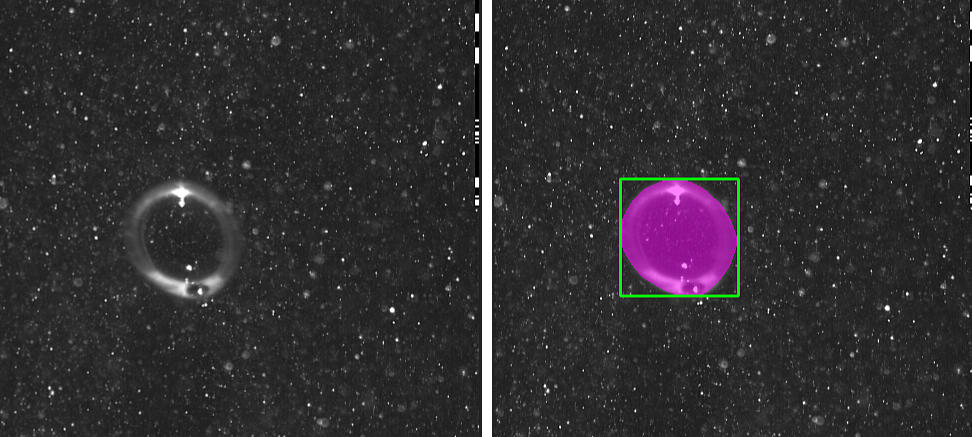
4.2 Recognition in Noisy Backgrounds
In environments such as bioreactors, medium suspended particles often interfere, creating background textures that statistically resemble bubbles. The high-resolution branch of the Revealer system plays a critical role here, filtering non-spherical noise through fine morphological features and significantly improving the signal-to-noise ratio.
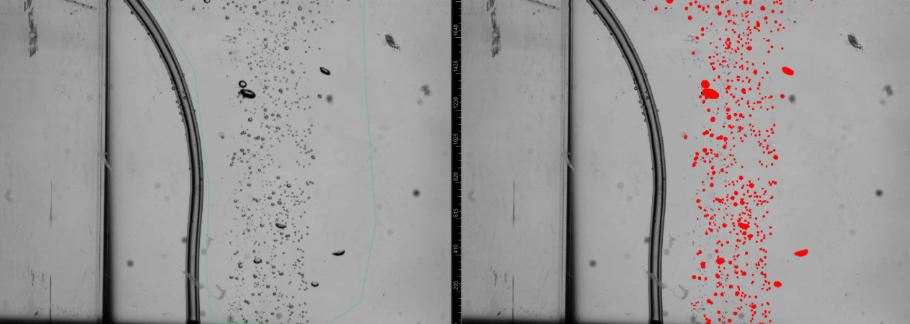
4.3 Micro-Bubble Recognition
For bubbles occupying only a few pixels, the algorithm bypasses the spatial information loss found in deep networks. By maintaining a high-resolution feature map, it ensures the detection rate and size measurement accuracy of micro-scale bubbles.
4.4 Recognition in Crowded Scenarios
In areas with high bubble stacking and adhesion, the algorithm analyzes the curvature changes of bubble edges to achieve effective segmentation of individual units, laying a foundation for subsequent independent motion tracking.
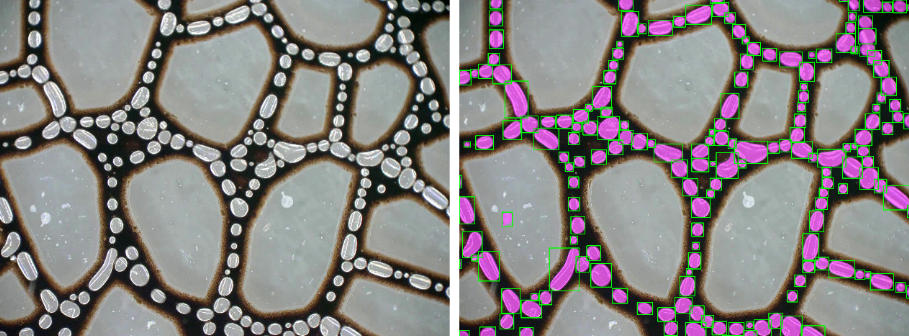
On the basis of high-quality sequence images provided by the Revealer high-speed camera, the algorithm further supports the conversion of image sequences collected by the high-speed camera into statistical and analyzable physical data, covering the kinematic behavior analysis and static morphological characterization of bubbles.
5.1 Bubble Kinematics Measurement:
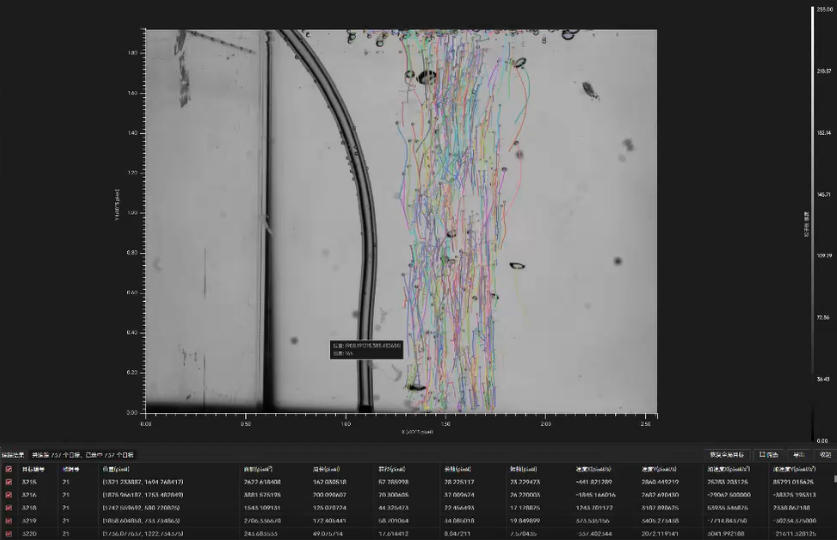
Based on the trajectory data with consistent identity IDs obtained by the optimal transport algorithm, engineers can calculate the kinematic parameters of each bubble frame by frame:
Position coordinates: Output the pixel coordinates and world coordinates of the bubble center or feature points at each moment.
Instantaneous velocity and acceleration: Calculate the instantaneous velocity vector and acceleration vector of the bubble through the time difference of positions between consecutive frames to characterize the changes in the bubble’s motion state.
Trajectory tracking: Supports the calculation and visualization of macro indicators such as duration, average velocity and direction vector of the trajectory of specified bubbles or bubble swarms.
5.2 Bubble Morphology Measurement:
Basic geometric parameters:
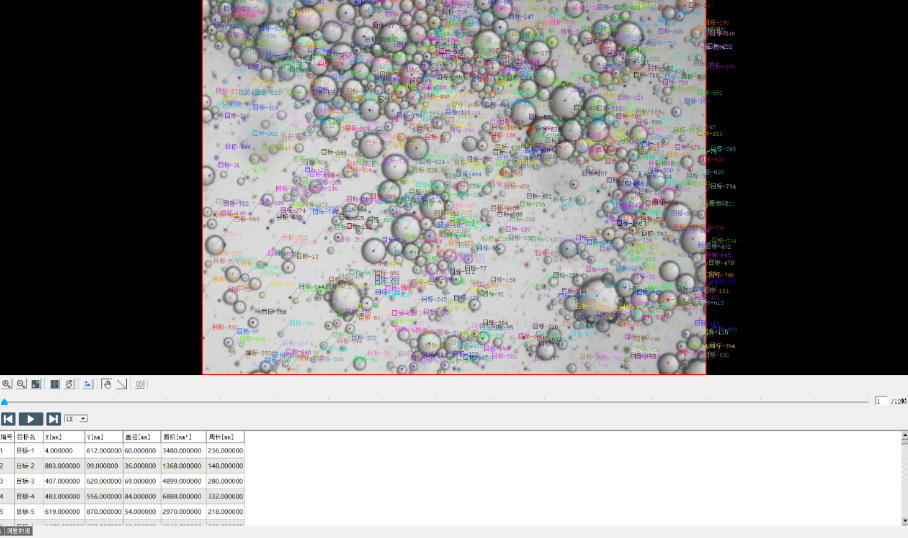
Projected area, perimeter, and length of major and minor axes of bubbles.
Equivalent particle size and sphericity:
Calculate the equivalent diameter through the projected area, and calculate the sphericity through the area and perimeter, which are used to evaluate the interfacial tension and flow stability.
Facing the high-frequency demand of selecting a high-speed camera for the bubble measurement field, the self-developed Revealer high-speed camera and heterogeneous dual-branch neural network technology of Agile Device effectively solve the problem of "accuracy-speed" trade-off in bubble visual measurement, and perform excellently in low-contrast, noisy background, tiny target and high-density scenarios. This solution of deep software-hardware collaboration not only realizes that bubbles can be "seen clearly and tracked stably", but also further promotes the "quantifiable and analyzable" dynamic processes and static properties of bubbles, providing an efficient and reliable visual measurement solution for experimental research in fluid mechanics, bioengineering, energy chemical engineering and other fields.
 English
 Deutsch