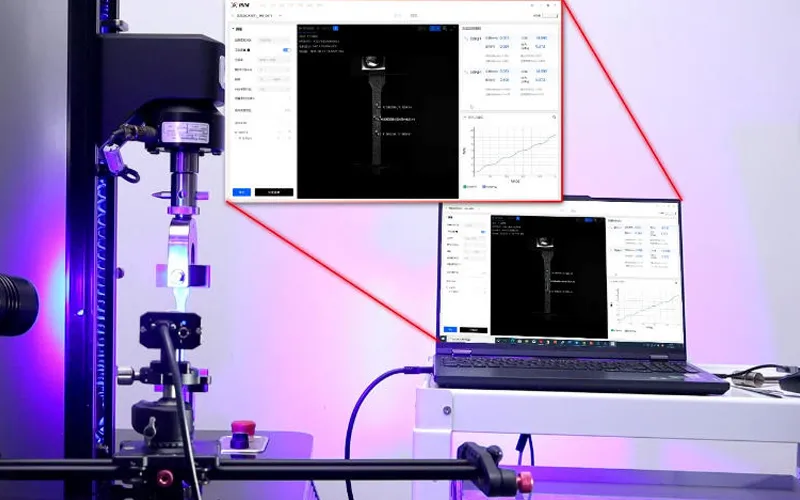
Due to limitations in sensor design, conventional high-speed cameras focus their detection range on the visible light range (380-780nm), making it difficult to cover the ultraviolet (UV) and near-infrared (NIR) bands.
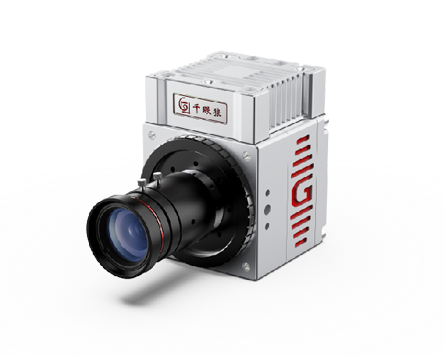
Through technological innovation, the Revealer NEO series of wide-spectrum high-speed cameras from HF Agile Device Co.,Ltd expands the spectral detection range to the 200nm-1100nm band, enabling high-speed imaging in the invisible light band. This provides an ideal experimental instrument for scientific research in combustion diagnosis, plasma and discharge, biomedical research, and fluorescence imaging.

The technical implementation of the Revealer NEO series wide-spectrum high-speed cameras relies primarily on three key technologies:
1. BSI Image Sensor Technology:
With traditional front-illuminated FSI chips, light must sequentially pass through microlenses, color filters, and metal circuit layers before reaching the photodiode layer for photoelectric conversion. This design results in photons being blocked and scattered by the metal circuit layer, resulting in significant losses in the ultraviolet and near-infrared bands.
The revolutionary back-illuminated BSI chip optimizes the light input path by moving the photodiode layer in front of the metal circuit layer. After passing through the color filter array, light directly strikes the photodiode layer for photoelectric conversion, significantly improving photon absorption efficiency.
2. Coating and Optical Optimization Technology:
A silicon-based doping process enhances response in the 200-400nm wavelength range. Furthermore, given the high near-infrared penetration depth of silicon, an anti-reflection coating is added to the back surface of the BSI chip to enhance response in the 800-1000nm wavelength range.
A specialized coating design is used on the high-speed camera end windows to enhance UV/IR transmittance and reduce reflection loss.
3. Noise Suppression Technology:
A low-noise readout circuit design leverages the high quantum efficiency of the BSI chip to suppress thermal noise and dark current, achieving high signal-to-noise ratio imaging in the ultraviolet band at low illumination levels of just 10 lux.
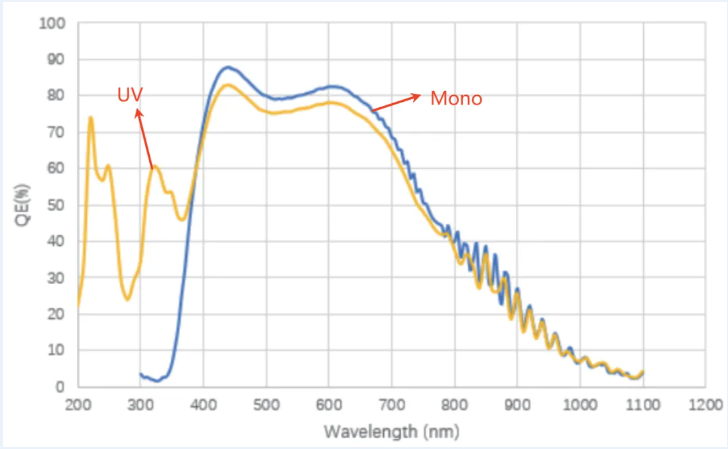
The Revealer NEO series wide-spectrum high-speed cameras achieve a quantum efficiency of 60% in the UV 250nm band, 40% in the near-infrared 808nm band, and maintain a 10% QE level even at 1000nm. This differentiated feature enables the NEO series high-speed cameras to capture transient phenomena in non-visible spectral regions relevant to combustion diagnostics, plasma research, and biomedicine.
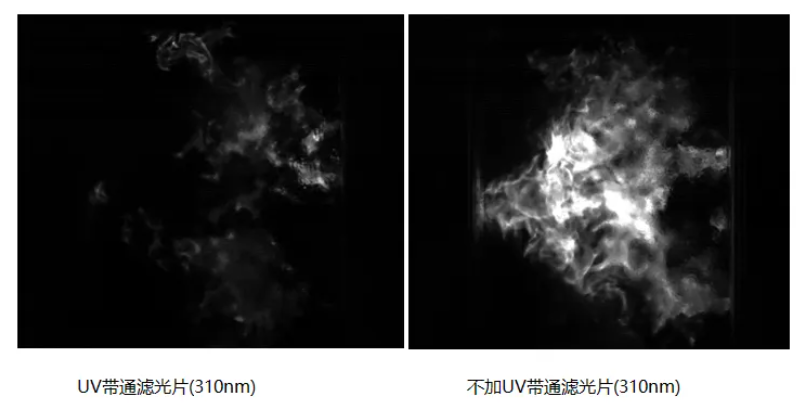
For example, in the field of combustion diagnostics, researchers need to analyze the spatiotemporal distribution of OH radicals within an engine combustion chamber to optimize combustion efficiency. OH radicals exhibit a characteristic peak near the 310nm UV band. Conventional FSI high-speed cameras have low QE in this band and typically require an image intensifier, resulting in a complex, costly system and low signal-to-noise ratio. HF Agile Device's native detection solution, based on BSI high-speed cameras, eliminates the cost of additional equipment. Using only a bandpass filter, it directly captures the key UV characteristic peaks of free radicals, clearly demonstrating the generation, diffusion, and annihilation processes of free radicals, helping researchers evaluate combustion efficiency.
The Revealer wide-spectrum high-speed camera from HF Agile Device Co.,Ltd uses BSI image sensor technology, coating and optical optimization technology, and noise suppression technology to expand the spectral boundaries of high-speed imaging from visible light to the ultraviolet and near-infrared bands, solving the pain point that ultraviolet and near-infrared high-speed imaging require additional configuration of enhancement equipment, and providing a wide-spectrum "time microscope" for fields such as energy and power engineering, biomedicine, etc.
 English
 Deutsch