Vacuum arcs are widely present in high-voltage switching devices, and the formation and evolution of cathode spots directly affect arc interruption capability and the insulation performance of the equipment. However, with traditional imaging systems, it is extremely difficult to capture microsecond-level transient processes due to limited temporal resolution and low sensitivity, especially in sealed discharge chambers where supplementary lighting is impossible.
To overcome this limitation, a national key laboratory deployed the Revealer ultra-sensitive High Speed Camera, provided by Agile Device, to visualize the transient microsecond-scale behavior of cathode spots during vacuum arc discharges. These high-resolution and high-sensitivity image sequences provide essential experimental data to study the spatial distribution, migration patterns, and current-dependent evolution of the spots. When combined with numerical simulation, these results support arc-model refinement and optimization of vacuum interrupter design.
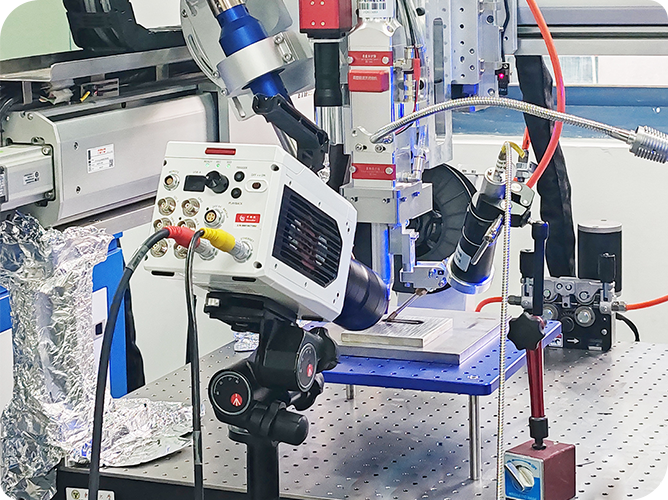
The experiment was conducted inside a sealed vacuum discharge chamber. An LC resonant circuit generated peak currents from 1–10 kA, while a triggered spark at the cathode initiated the arc. The Revealer High Speed Camera was synchronized with the discharge event, capturing:
Exposure time: 1 μs
Frame rate: 10,000 fps
Recording duration: 50 ms
Image format: RAW for high-precision post-processing
Multiple runs were performed to ensure reproducibility and extract averaged behavior patterns under varying current amplitudes.
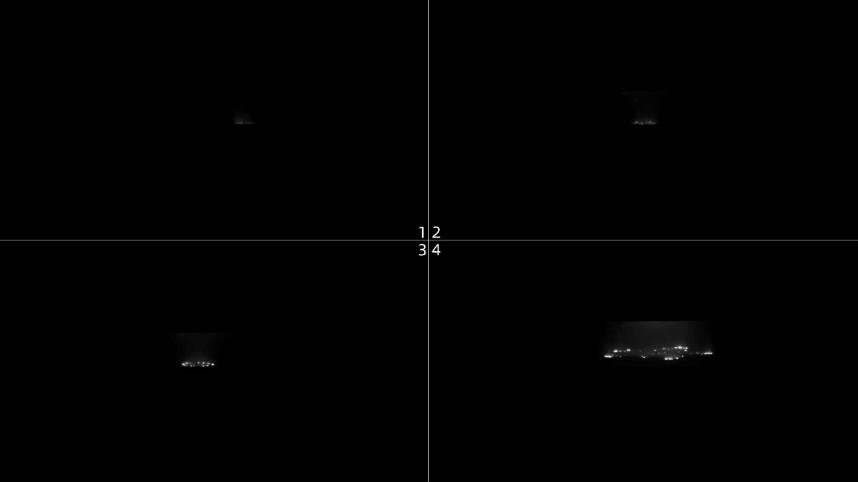
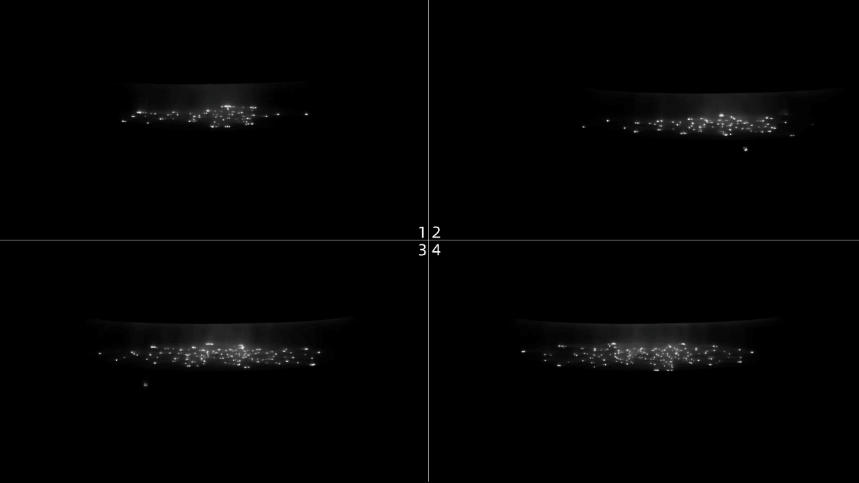
Initial Stage
~400 μs: The first luminous spot appears at the central ignition point of the electrodes.
~900 μs: Sparse cathode spots emerge around the ignition region.
~1,900 μs: Multiple discrete spots become clearly distinguishable and begin forming an outward-expanding circular pattern.
~5,700 μs: A second cluster of spots arises within the central region.
Expansion Stage
Driven by self-induced magnetic fields and radial current forces:
Spots rapidly migrate outward from the center.
The radius of the inner circular ring expands with each radial jump.
Continuous heating of the outer surface promotes formation of new spots, pushing the ring-shaped spot structure outward.
At ~24.4 ms, the ring reaches its maximum radius and remains quasi-stable for ~5 ms.
Dissipation Stage
After ~30 ms:
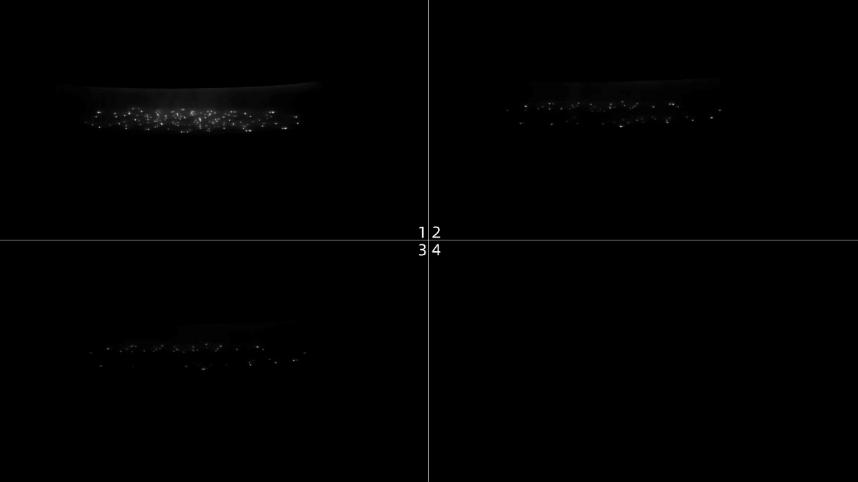
The number of active spots sharply declines as discharge current decays.
Inner-ring spots extinguish first due to insufficient electric field strength.
~1 ms later, outer-ring spots begin fading in sequence, fragmenting into discrete luminous groups.
By ~3.7 ms after fragmentation, all spots disappear, and the cathode surface returns to darkness.
I. Complete Visualization of Cathode Spot Lifecycle
The Revealer High Speed Camera successfully captured the full evolution:
localized ignition → radial expansion → ring formation → central extinction → ring breakup → full dissipation.
II. High Sensitivity Under Zero-Light Conditions
The Revealer NEO25 model demonstrated exceptional performance in 1-μs exposure environments without supplemental lighting, capturing intense arc-generated emissions without smearing or trailing artifacts.
III. Cathode Spot Distribution Correlates With Arc Interruption Ability
Bright and persistent spot regions indicate potential insulation weaknesses and can be used to guide:
Vacuum interrupter structural optimization
Cathode material evaluation
Arc-model calibration
Diagnostics for high-current switching systems
The visualized data provides high-value input for engineering design decisions.
 English
 Deutsch