Single-molecule fluorescence imaging technology accurately captures weak fluorescence signals within a single molecule, which is crucial for studying the real-time dynamic behavior of biological molecules and understanding the microscopic mechanism of the basic unit of life activities.
Single-molecule fluorescence imaging experiments have long been carried out based on EMCCD cameras, which have bottlenecks such as high cost, limited dynamic range, and low full well capacity, restricting the output of single-molecule research results.
Qianyanlang accurately grasps the needs and trends of scientific research and develops a sCMOS scientific camera Gloria 1605 with large pixel size, high quantum efficiency (QE), high dynamic range, and large full well capacity. It has single-photon weak light detection capabilities, and successfully achieved 20-photon signal detection in a university laboratory, and completed the verification of single-molecule sub-nanometer positioning accuracy.
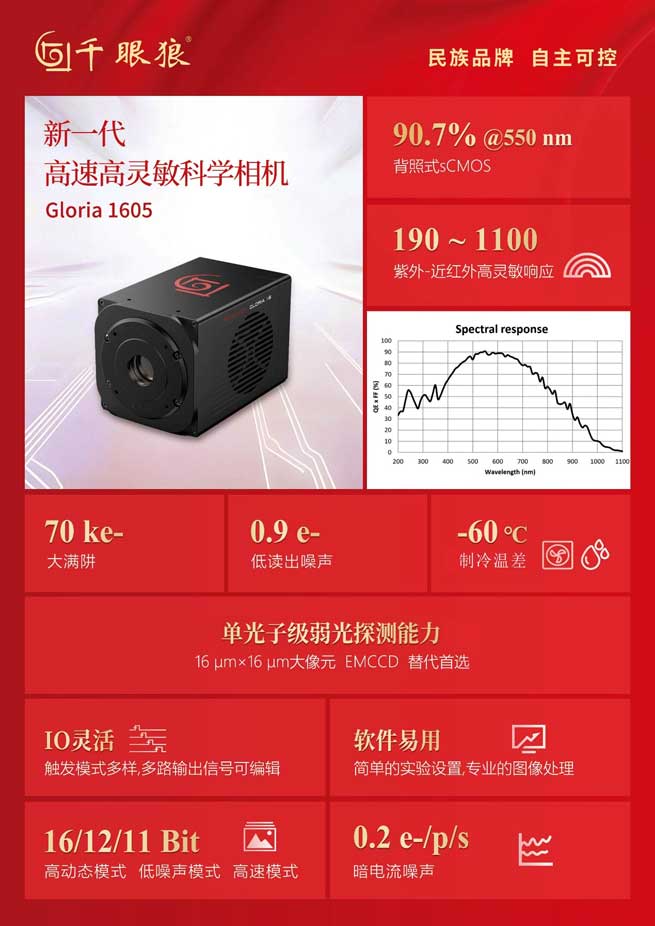
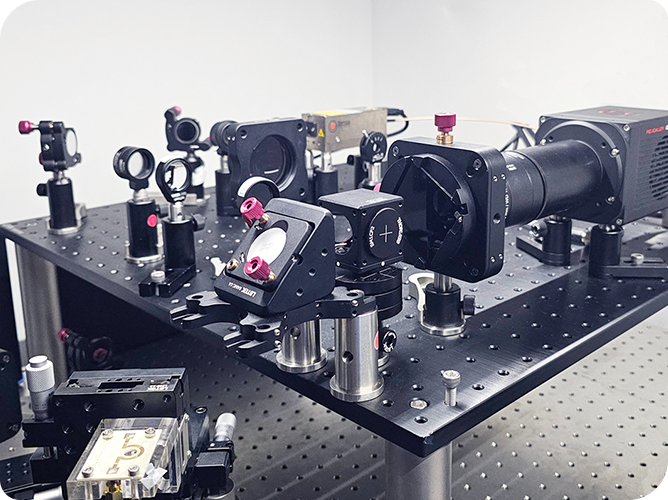
The experiment used a Gloria 1605 with a 16 μm pixel size, paired with a 100X microscope, a 532 nm laser for single molecule excitation, and the camera was adjusted to low-speed, high-sensitivity mode to continuously capture 1,000 frames of images. The background fluorescence interference was eliminated through a real-time noise suppression algorithm.
In a weak light environment with only 20 detectable photons, the sCMOS camera successfully captured clear single-molecule fluorescence signals with a high QE of 90.7%.
The quality of the fluorescence signals collected by the sCMOS scientific camera meets expectations. Experiments have strongly proved that the sCMOS camera has relative advantages in sensitivity, low noise, high dynamic range, and full well capacity. It can replace the traditional EMCCD and greatly reduce the cost of scientific research experiments, becoming the preferred instrument for single-molecule fluorescence imaging research.
Parameter | sCMOS Camera Gloria 1605 | A certain type of EMCCD camera |
Pixel size | 16 μm | 8~16 μm (binning required) |
Quantum Efficiency QE | 90.7% @550 nm | 90% @560 nm |
Dynamic Range | 93 dB | 60 dB |
Full Well Capacity | 70 ke | 30 ke |
Read Noise | 0.9 e | 50 e |
Price | Only 1/2 the price of EMCCD | high |
#sCMOS Scientific Camera #Single-molecule Fluorescence Imaging #Scientific Research Equipment Selection #EMCCD Alternatives #Precision Optics
 English
 Deutsch