Original Research by Revealer | Developed by Agile Device
Optical tweezers technology uses a tightly focused laser beam to generate gradient forces capable of trapping and manipulating microscopic particles. This technique is a fundamental tool in cell biology, nanoparticle manipulation, and quantum optics.
Because optical trapping often occurs under weak fluorescence conditions, imaging systems must achieve high quantum efficiency, low noise, and stable performance to accurately resolve cellular boundaries and subtle deformations.
In this study, researchers employed the Gloria 4.2 sCMOS Camera — a high-sensitivity imaging solution developed by Agile Device under the Revealer brand — featuring a 95% quantum efficiency (QE) sensor to capture real-time displacement and deformation of cells under optical tweezers.
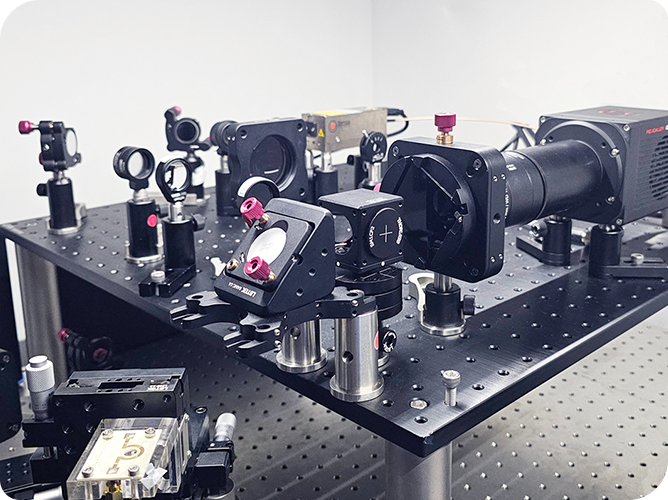
Imaging Platform: Optical table integrated with a fluorescence microscope
Specimen: Thick biological tissue slices containing target cells
Camera: Revealer Gloria 4.2 sCMOS Camera
·Resolution: 2048 × 2048 pixels
·Frame rate: 61 fps (USB 3.1 interface)
·Quantum Efficiency: 95%
·Software: RPC Scientific Imaging & Analysis Suite
The optical tweezers setup generated stable laser trapping while the sCMOS Camera continuously recorded cellular motion and morphological changes at 50 frames per second with enhanced contrast mode enabled.
I. Superior Image Clarity
The captured images exhibit sharp cell boundaries and clearly distinguishable nuclear structures. The high QE of the sCMOS Camera significantly improved signal-to-noise ratio (SNR), while the persistent contrast function enhanced the visibility of fine structural features even under weak fluorescence illumination.
II. Real-Time Dynamic Capture
The camera’s high frame rate and low readout noise allowed smooth, continuous tracking of the cell being trapped and dragged by optical forces, with no motion blur or frame jitter. This ensured accurate analysis of real-time displacement and deformation behavior during optical manipulation.
III. Excellent Thermal Stability
Throughout the imaging sequence (20 ms–1200 ms), no visible noise accumulation was observed, confirming that the Revealer sCMOS Camera maintained stable performance during extended operation.
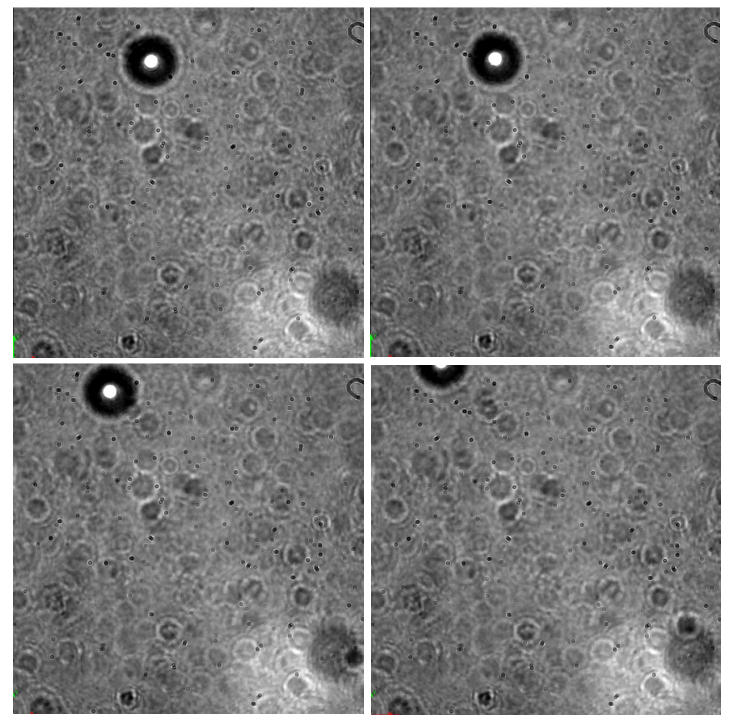
The Revealer Gloria 4.2 sCMOS Camera, engineered by Agile Device, effectively visualized and tracked the entire optical trapping and deformation process of living cells in real time.
Its high sensitivity, high frame rate, excellent signal-to-noise ratio, and thermal stability make it ideally suited for long-duration dynamic imaging under weak-light conditions typical of optical tweezers experiments, single-molecule biophysics, and quantum-level photonics research.
 English
 Deutsch