China has entered the critical flood prevention period of "late July to early August." Debris flows, as frequent geological disasters in mountainous areas, are highly sudden and destructive, posing threats to people's lives and property. Traditional observation methods struggle to achieve detailed monitoring of the coupling effects between rock movement trajectories and water flow fields. Particle Image Velocimetry (PIV) technology, through non-contact measurement, provides high spatiotemporal resolution data, offering support for the construction of debris flow impact models.
Simulate debris flow impact tests using a cylindrical pipe experimental model to conduct quantitative research on the impact of rocks on water flow fields. Capture the movement trajectories and velocity changes of rock particles in water, as well as their influence on the flow field.
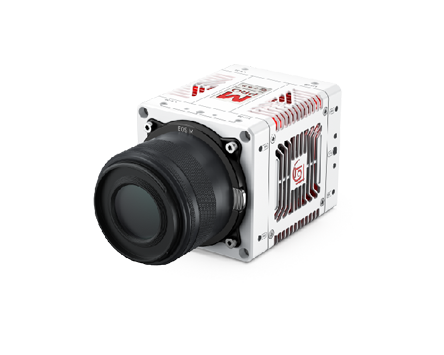
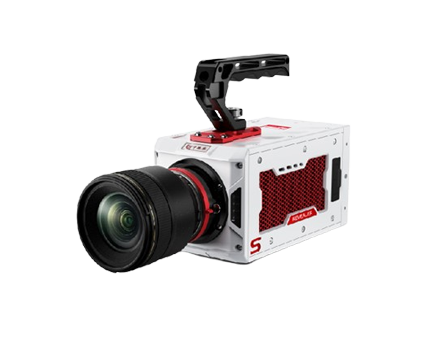
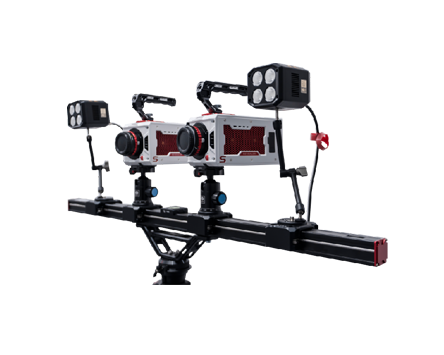
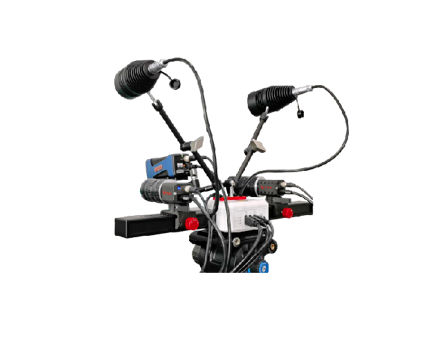
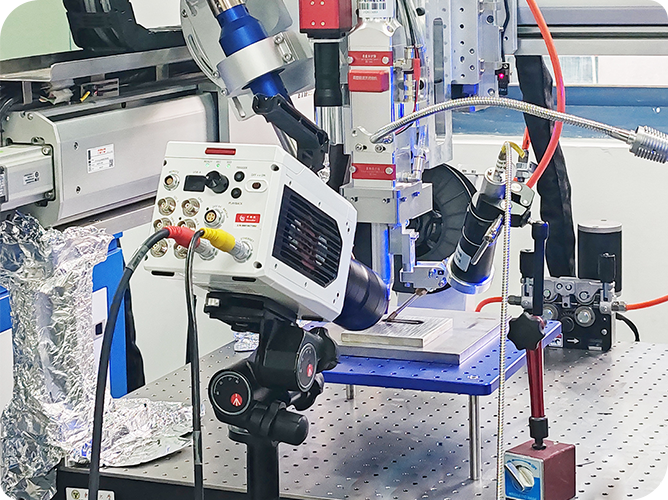
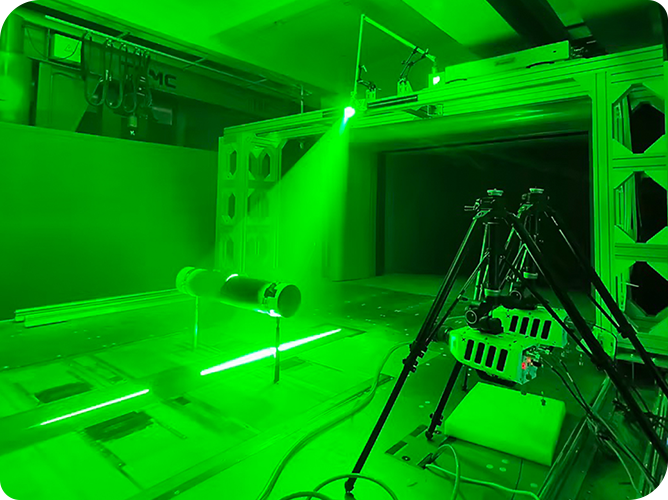
A transparent cylindrical pipe with a diameter of 20 cm was designed, filled with water flowing at 1.5 m/s. Two rock particle sizes (D-3mm and D-10mm) were dropped from a height of H = 3 m into the water-filled pipe. The Revealer 2D2C PIV system was used with core parameters of 2560×1920 @ 2000 fps to capture images of rock particle movement and the water flow field. Revealer RFlow flow measurement software was employed for flow field calculations, obtaining velocity vector fields for both rock particles and water flow.

1) Setup and Calibration:
- Assemble experimental apparatus.
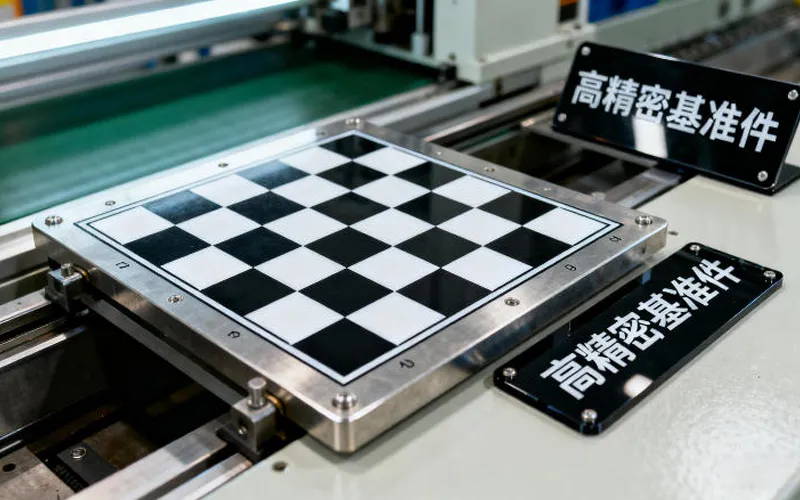
- Use the 2D2C scale calibration method, repeatedly collect calibration point coordinates, and establish a pixel-to-physical coordinate mapping. Reduce errors via polynomial fitting.
2) Particle Release and Image Capture:
- Release D-3mm and D-10mm rock particles from 3 m into the water flow.
- Capture images using the Revealer high-speed camera (2560×1920 @ 2000 fps) under 532 nm laser sheet illumination.
3) Image Enhancement:
- Enable adaptive contrast enhancement and intensity capping in RFlow software to suppress overexposed areas.
- Apply CLAHE histogram equalization to improve particle recognition.
4) Flow Field Calculation:
- Select classic PIV calculation mode in RFlow with multi-pass iterative selection.
- Initial window: 128×128 pixels; final window: 32×32 pixels; 50% window overlap.
5) Data Processing:
- Apply local median filtering to remove outlier vectors.
- Visualize flow velocity distribution.
1) Rock Particle Movement Characteristics:
- D-10mm particles: Follow near-linear trajectories with minor deflection due to transverse shear forces.
- D-3mm particles: Exhibit spiral settling trajectories with greater deflection from vortices. Due to higher surface-area-to-volume ratio, they experience 10% greater velocity decay than D-10mm particles from viscous drag.

2) Flow Field Disturbance Analysis:
- Rock particles induce multi-scale vortices.
- At vortex cores: ~30% velocity reduction.
- At vortex edges: ~15% velocity reduction.
- Maximum vorticity occurs in the wake region of D-10mm particles.

This PIV-based experiment, with 2000 fps high-speed imaging and multi-pass PIV analysis, revealed high-resolution particle and flow field interactions. It quantified energy transfer mechanisms in debris flows, providing critical data for impact model development.
Revealer – Advancing Disaster Research with Precision Measurement.
 English
 Deutsch