Optical diffraction computational imaging is a cutting-edge imaging technology that reconstructs the phase and square intensity information of an object by encoding and decoding the light wavefront. Optical diffraction computation relies heavily on the precise quantitative measurement of the incident light field, particularly the acquisition of the spot morphology and temporal fluctuation characteristics.
Fluctuations in the intensity of a light spot often carry information such as thermal drift of optical components, simulated atmospheric disturbances, or light source noise. Therefore, long-term, high-signal-to-noise ratio time series acquisition of the light spot's grayscale values is a prerequisite for subsequent accurate diffraction modeling and image reconstruction.
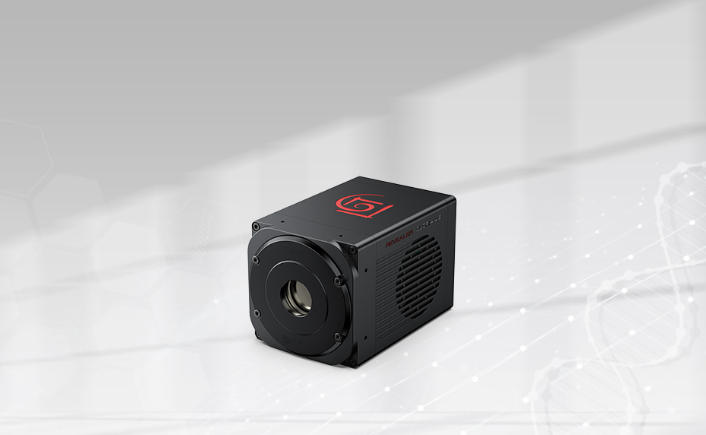
An optoelectronics research institute used the Gloria 4.2, a scientific-grade sCMOS camera from Revealer with 95% QE, 1.2e- readout noise, and 90dB high dynamic range, to conduct quantitative measurements of red laser light spots in a darkroom environment to evaluate its suitability for low-light scenarios requiring high stability.
Objective: To quantitatively analyze the intensity and morphology fluctuations of a red laser spot in the temporal domain and verify the imaging stability of the Gloria 4.2 sCMOS camera under low-light and high-sensitivity conditions.
Experimental object: Diffraction spot formed by laser irradiation onto the CMOS target surface, without relay optical system.
Experimental Equipment: Revealer Gloria 4.2 scientific-grade sCMOS camera, 2048×2048 resolution, 16-bit high dynamic range mode, acquisition rate 74 fps. Light source: a continuous red laser with a wavelength of 635 nm.
Experimental Method: Temporal noise introduced by photons was suppressed by controlling exposure time and appropriately reducing the frame rate. The sCMOS camera was used to capture multiple frames for temporal fluctuation analysis, with grayscale value fluctuation used as a key metric for evaluating the camera's noise-to-noise ratio (SNR).
Difficulty: Weak light intensity fluctuations are easily masked by sensor noise. By enabling low-noise readout mode and matching exposure time with frame rate, the signal is enhanced, and the signal-to-noise ratio is improved.
Beam Quality:
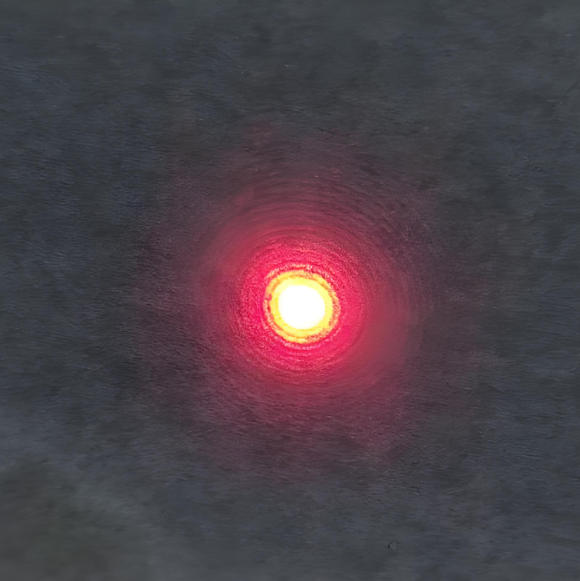
Figure 1 shows a light spot image captured by the scientific camera Gloria 4.2 in high dynamic mode. It shows that the light spot has a clear shape, sharp edges, no smear, no saturation, and retains complete light intensity distribution information.
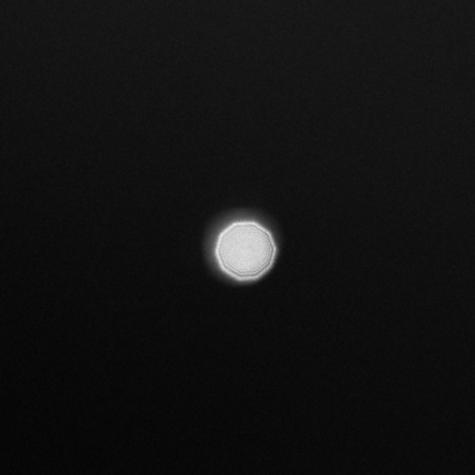
Figure 1
Grayscale Temporal Stability:
Analysis of the temporal grayscale histogram (Figure 2) shows that the spot signal exhibits a quasi-Gaussian distribution, with minimal fluctuations in the spot grayscale values, stable mean and standard deviation values, and no significant periodic noise. This demonstrates that the Gloria 4.2 scientific camera has excellent signal-to-noise ratio performance, meeting the requirements for quantitative analysis of weak light intensity fluctuations.
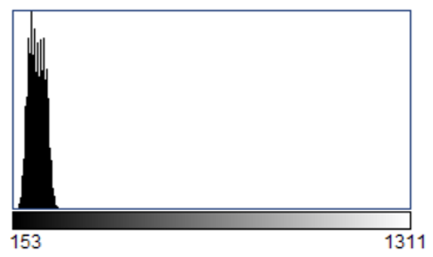
Figure 2
The experimental data demonstrate the Revealer Gloria 4.2 sCMOS camera's ability to accurately capture spot grayscale fluctuations. Its high QE, low readout noise, and high dynamic range enable the clear visualization of subtle changes in spot morphology during temporal fluctuation analysis. This provides high-quality raw data for subsequent numerical processing and light field reconstruction, laying the foundation for applications in more complex optical computational imaging systems, such as wavefront sensing and coherent diffraction imaging.
PREV
 English
 Deutsch