Revealer Congratulates on the Grand Opening of the 15th National Academic Conference on Explosion Mechanics!

The transient temperature field generated by explosions has a short duration, a wide temperature variation range, and high peak temperatures. Transient high temperatures are usually accompanied by strong destructive effects, complex testing environments, and high technical difficulties, making traditional temperature measurement methods difficult to meet the requirements. The non-contact testing technology for transient temperature fields based on high-speed imaging is a new type of non-contact temperature measurement method that combines radiation temperature measurement theory with modern image detection technology and digital image processing technology. This method has high temporal resolution, a wide dynamic temperature measurement range, can intuitively obtain temperature distribution images, and has high measurement accuracy.
Revealer, in collaboration with the Efficacy Testing and Evaluation Technology Center of Nanjing University of Science and Technology, has developed a high-speed visible light temperature measurement system based on high-speed cameras for transient temperature field measurement in the field of explosion mechanics. The system collects visible light radiation from fireballs and combines tricolor temperature measurement algorithms and blackbody calibration technology to achieve non-contact dynamic measurement of high-temperature fields ranging from 1500K to 3300K.
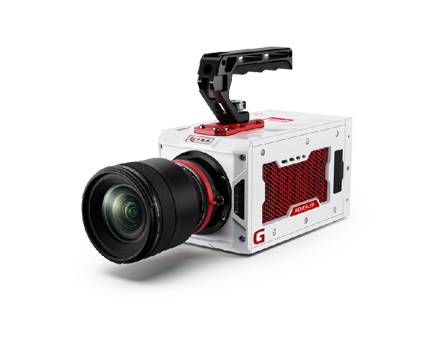
1) High-speed camera selection: The high-sensitivity high-speed camera NEO 25 from Revealer is used, featuring a BSI sensor with a resolution @ frame rate of 1280×1024 @ 25,000fps and a quantum efficiency of 85%.

2) Neutral density filter: Used to improve the dynamic range and upper temperature measurement limit of the system.
3) Standard high-temperature source blackbody furnace: Used for calibrating the high-speed visible light temperature measurement system based on high-speed cameras.
4) Visible light temperature measurement analysis software ITMS: Used for automatic analysis and calculation of transient temperature field videos or images. It can display relevant analysis results of the transient temperature field on the front-end interface and generate and export data related to the transient temperature field.

1) Use the high-temperature blackbody furnace to calibrate the high-speed camera, lens, and filter combination to obtain the RGB-to-temperature conversion model and set key parameters such as exposure time and aperture for the high-speed camera.
2) Select the lens according to the target temperature range, install the neutral density filter, and set the exposure time and gain parameters.
3) Trigger the NEO 25 high-speed camera (25,000fps) to capture and store video information of the explosion process.
4) Perform image preprocessing on each frame of the captured transient temperature field video, automatically segment the temperature region and background, and remove abnormal data points.
5) For the effective temperature field obtained from image segmentation, calculate the pixel-level temperature based on the RGB tricolor temperature measurement principle, generate a pseudo-color image of the temperature distribution, and display the maximum temperature, average temperature, and temperature gradient in real time.
6) Based on the grayscale image from the high-speed camera and calibration parameters, calculate the actual temperature of the target under each frame, generate a statistical report of the temperature field including temperature curves, extreme value positions, and thermodynamic parameters.
The accuracy of the high-speed visible light temperature measurement system may be affected by four aspects:
1) Reference error from the blackbody furnace: Controlled within 10K using a blackbody furnace with 0.999 emissivity, with an error value ≤1%.
2) Tristimulus measurement error from the high-speed camera: Benefiting from the advanced BSI image sensor and 12-bit image depth of the NEO 25 high-speed camera, the error caused by non-uniformity of the photosensitive unit response can be controlled within 1%, the error caused by nonlinearity of the photoelectric response can be controlled within 1%, and the error caused by A/D conversion can be controlled within 0.1%. The cumulative error from these three factors is within 1.5%.
3) Calculation error from the temperature measurement model: Using polynomial function fitting and neural network correction to control the accuracy within 2%.
4) Other errors introduced by environmental interference and system calibration inconsistency: Can be controlled within 2%.
Since the above error components are uncorrelated, the total system measurement error for gray-body targets is ≤3.35%, meaning an error of ±67K at a 2000K measurement reference, meeting the system's temperature measurement requirements.
The high-speed visible light temperature measurement system is suitable for various explosion mechanics research scenarios such as engineering explosive performance testing, energetic material research, and engineering blasting safety assessment. The figure below shows a performance test case of a new engineering explosive. Based on the video captured by the NEO 25 high-speed camera, the temperature field is analyzed, and a pseudo-color image of the temperature distribution is generated, allowing researchers to intuitively observe the actual temperature distribution. The system also supports automatic analysis of the average temperature, maximum temperature, and coordinates of the maximum temperature in the effective region of the current frame in the temperature field video. For example, in frame 43, the average temperature is 1145.78K, the maximum temperature is 1258.65K, and the coordinates of the maximum temperature are (695, 626). The system supports generating average and maximum temperature curves, locating the highest average temperature and corresponding frame number, locating the maximum temperature and its frame number, and supports point-specific temperature measurement.

The high-speed visible light temperature measurement system based on high-speed cameras achieves high-precision, high spatiotemporal resolution, and multi-scale (near and far distance) measurement of transient temperature fields in the field of explosion mechanics, providing an effective temperature field analysis solution for transient explosion experiments.
 English
 Deutsch