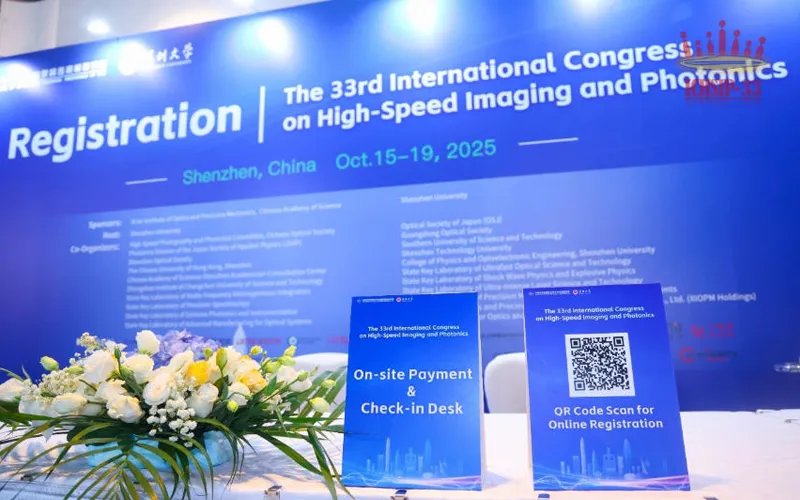

The 33rd International Congress on High-Speed Imaging and Photonics grandly opened in Shenzhen on the 16th. The conference brought together the latest progress in cutting-edge imaging technology worldwide. With its characteristics of high sensitivity, low noise, and high dynamic range, sCMOS cameras have become core detection instruments in cutting-edge scientific research scenarios. HF Agile Device Co.,Ltd participated in the exhibition with its self-developed Gloria series sCMOS cameras, and demonstrated application cases in multiple cutting-edge sub-fields to the participating experts and teachers.
Target spectral band detection aims to accurately separate and measure weak signals within a specific wavelength range from background radiation. Therefore, the detector needs to have extremely high quantum efficiency (QE) and extremely low readout noise in the target band to suppress background noise and extract valid information.
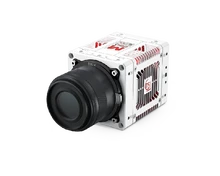
In an X-ray observation experiment in a laboratory, the self-developed Revealer Gloria series sCMOS camera from HF Agile Device Co.,Ltd was used to capture fluorescence images generated after the interaction between X-ray pulses and substances. Its back-illuminated sensor technology ensures a peak QE of up to 95% in the main emission band of the scintillator, significantly improving photon collection efficiency. Another core dual-cooling technology keeps the sensor temperature 50°C below the ambient temperature, with dark current noise as low as 0.3 e-/p/s. This means the sCMOS camera can efficiently capture weak visible light signals generated by the scintillator without being submerged by background noise. The high frame rate data bandwidth technology is suitable for dynamic X-ray scintillator observation. Through the CoaXPress 2.0 high-speed interface, it can achieve stable image transmission at 135 frames per second, meeting the demand for high-speed acquisition.

Figure 1
Computational imaging focuses on capturing intermediate patterns (such as light spots and fringes) formed by diffraction, interference, or scattering of the photographed object, and then reconstructing the final image of the object through algorithms. The key to reconstruction lies in the quality of the original collected data relied on by the algorithm. For example, optical diffraction calculation depends on the accurate collection of the incident light field, especially the spot shape and temporal fluctuation characteristics.
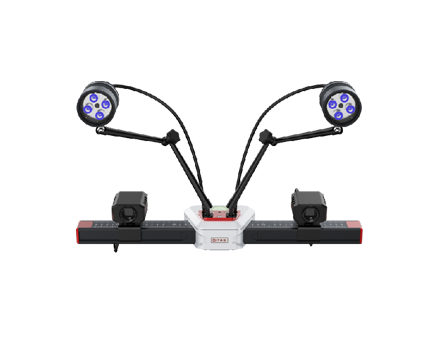
The Revealer sCMOS camera Gloria 4.2 provided by HF Agile Device Co.,Ltd has the characteristics of 95% QE, 1.2 e- readout noise, and 90 dB high dynamic range. It can quantitatively analyze the intensity and shape fluctuations of red laser spots in the time domain. Figure 2 shows the spot image captured by Gloria 4.2 in high dynamic mode, with clear shape, sharp edges, no smearing, and complete light intensity distribution information retained. Figure 3 is a temporal grayscale histogram, showing that the fluctuation range of the spot grayscale value is extremely small, the mean and standard deviation values are stable, and there is no obvious periodic noise. This indicates that the sCMOS camera Gloria 4.2 has a good signal-to-noise ratio performance and can meet the demand for quantitative analysis of weak light intensity fluctuations in computational imaging.

Figure 2

Figure 3
High-energy physics experiments involve the observation of the behavior of single or a small number of elementary particles (such as ions). The signals emitted by these elementary particles are extremely weak, usually at the level of single photons or dozens of photons, which puts strict requirements on the performance of the detector.
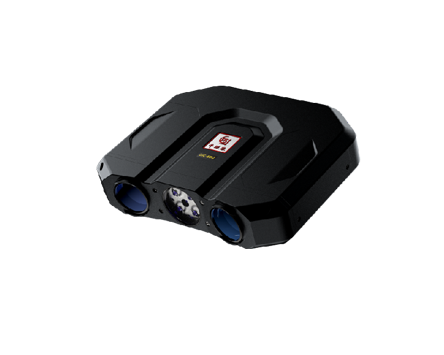
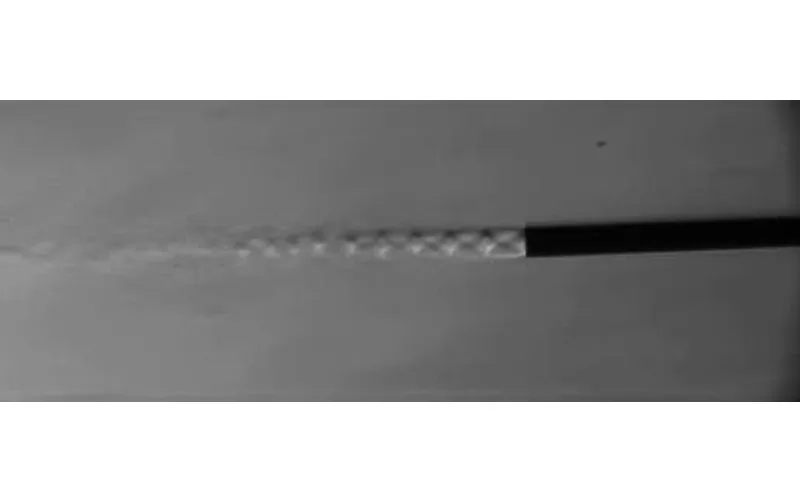
In an experiment on cold ion cloud imaging and measurement, the Revealer sCMOS camera Gloria 1605 was used. This scientific camera has extreme parameters: 16 μm large pixel size, <1 e- low readout noise, 90.7% high QE, 16-bit analog-to-digital conversion bit depth, and 40,000:1 high dynamic range. The experiment clearly captured the shape, size, and internal distribution characteristics of the cold ion cloud, and accurately quantified local dynamic fluctuations. At the same time, the high dynamic range characteristic of Gloria 1605 supports the good presentation of details in the bright/dark areas of the cold ion cloud.

Figure 4
From capturing high-energy X-ray scintillator imaging, to analyzing diffraction spots, and then to the successful practice in the field of cold ion cloud imaging and measurement, it proves that the Revealer Gloria series sCMOS cameras have the detection capability in extremely weak signal environments and can provide efficient and applicable solutions for experimental research in the fields of physics and optoelectronics.
 English
 Deutsch