Diamond nitrogen-vacancy (NV) color centers, as solid-state quantum sensors, offer high sensitivity, room-temperature operation, nanometer-scale spatial resolution, and non-invasiveness, making them an ideal magnetic sensing element for microscopic magnetic field imaging.
Traditional point-scanning imaging suffers from low efficiency. Wide-field imaging techniques based on diamond NV color centers, through parallel excitation and detection, can rapidly acquire full-field magnetic field information. However, the fluorescence signal from NV color centers is only at the single-photon level, placing stringent requirements on the quantum efficiency and readout noise of the detection equipment. Traditional CCD and CMOS cameras have high readout noise and limited full-well capacity, making them prone to readout noise dominance and unable to detect weak light signals.
sCMOS scientific cameras, by utilizing back-illuminated sensor process structures, pixel array, and readout circuit optimization, significantly improve quantum efficiency (QE), readout noise, and dynamic range compared to traditional CCD/CMOS cameras.
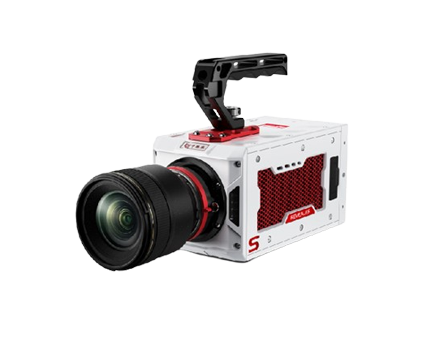
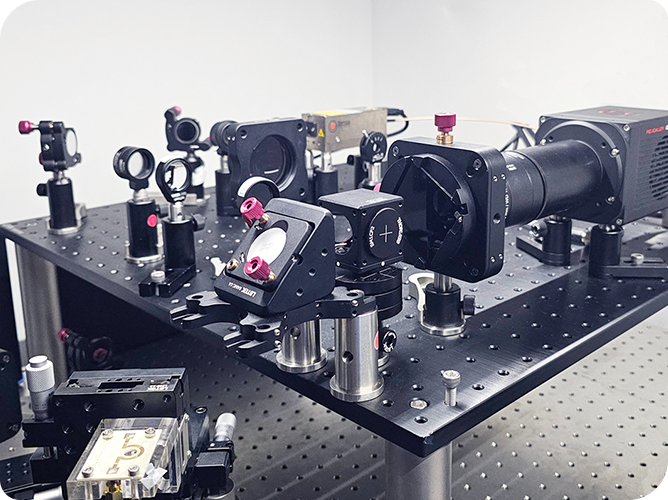
A research team in an optical laboratory used a Revealer Gloria 4.2 sCMOS camera integrated into a custom-built microscope optical system to achieve wide-field magnetic field imaging of diamond NV color centers, capturing changes in the NV color center's fluorescence grayscale value before and after the application of a magnetic field.
1. Diamond NV color center sample;
2. Microscope optical imaging system with 10x, 20x, and 40x magnification objectives;
3. sCMOS scientific camera, Revealer Gloria 4.2, 2048×2048, with HDR mode;
4. Magnetic field control device for generating an adjustable uniform magnetic field;
5. High-precision displacement stage for precise three-dimensional movement of the diamond NV color center sample.

Using the ROI grayscale statistics function of the Revealer Scientific Imaging RPC software, we performed time-domain tracking of a single NV color center region (300×248 pixels), revealing the magnetic field's modulation effect on fluorescence intensity:
Under zero magnetic field, the mean grayscale value was 16119.716, with a standard deviation of 4194.516. After applying a weak magnetic field of 5 g, the magnetic field induced Zeeman transitions in the NV color center, reducing fluorescence collection efficiency. The mean grayscale value was 16079.715, with a standard deviation of 4183.536, a standard deviation change rate of 0.3%.

This experiment used the Gloria 4.2 sCMOS scientific camera to capture the grayscale changes in the fluorescence signal during the Zeeman transition of diamond NV color centers. Using 16-bit image data captured in high dynamic mode, the camera was able to analyze subtle grayscale fluctuations caused by weak GS-level magnetic fields. Furthermore, the real-time grayscale monitoring function of the sCMOS scientific camera's RPC software can be used to establish grayscale-magnetic field response calibration curves, enabling biomagnetic imaging applications such as capturing the magnetic field of neuronal action potentials and quantum device detection.
 English
 Deutsch