In aero-engine combustion research, understanding the flow field structure of swirl flames and the mechanism of Lean Blowout (LBO) requires flow diagnostics techniques with high temporal resolution.
A research team from a national aerospace key laboratory employed the Revealer Stereo-PIV system (5 kHz) together with OH chemiluminescence diagnostics* to systematically investigate the lean blowout mechanism of a centrally staged swirl flame.
By acquiring three-component instantaneous velocity fields and applying the Spectral Proper Orthogonal Decomposition (SPOD) method, the study revealed the formation mechanism of low-frequency, large-scale coherent structures near the recirculation zone under near-LBO conditions. These structures play a critical role in flame stabilization.
The findings provide important experimental evidence for the design of low-emission aero-engine combustors and demonstrate the value of high-frequency Stereo-PIV measurement systems in combustion dynamics research.
In the field of aerospace combustion and swirl combustor research, scientists studying centrally staged swirl flames commonly face three major challenges:
1. Complex Internal Flow Structures in Swirl Combustors
The internal flow field of a swirl combustor is highly complex.
Swirl flames involve intricate recirculation zones, shear layers, and high-frequency turbulent structures, which are difficult to capture using conventional diagnostic techniques.
2. Transition from Small-Scale Turbulence to Large-Scale Coherent Structures Near LBO
Before lean blowout occurs, the flow field undergoes a dynamic transition from small-scale turbulence to large-scale coherent flow structures.
This process requires extremely high temporal resolution to analyze transient flow behavior in the time domain.
3. Limitations of Planar Velocity Measurements
Traditional two-dimensional planar velocity measurements cannot fully capture the evolution of axial, radial, and tangential velocity components in swirling flows.
Under these circumstances, the Stereo-PIV (Stereo Particle Image Velocimetry) system has become an essential combustion diagnostics tool for investigating complex three-dimensional flow dynamics.
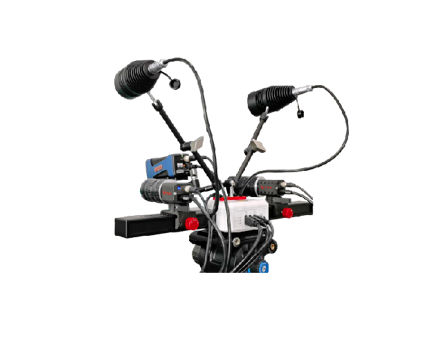
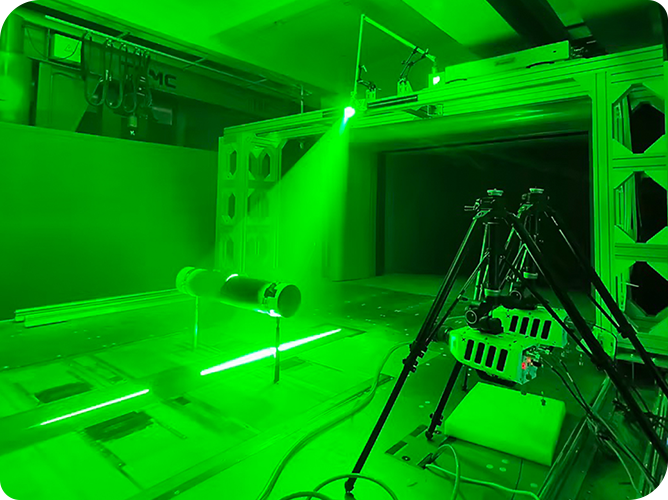
In this study, the research team established a high-frequency flow measurement platform based on the Revealer Stereo-PIV system.
The main system configuration is summarized below:
Core Component | Specification |
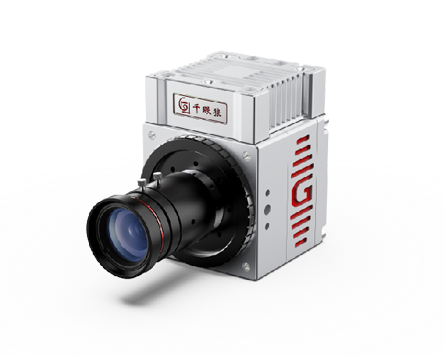
PIV High-Speed Cameras | Two Revealer high-speed cameras, supporting up to 10 kHz frame rate in frame-straddling mode |
Laser Source | Dual-cavity Nd:YLF double-pulse laser |
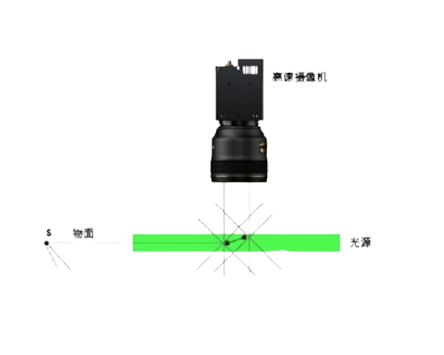
Measurement Mode | 2D3C Stereo-PIV measurement using a 120° camera viewing angle |
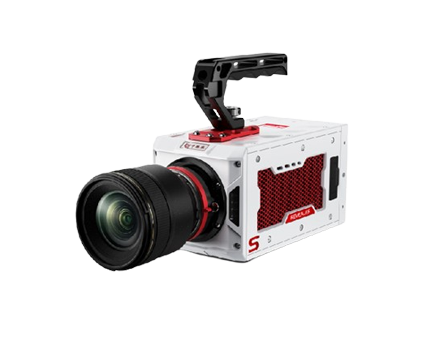
Synchronous Diagnostics | Integrated OH chemiluminescence measurement system* (image intensifier + Revealer S1315 camera) |
Data Processing | Compatible with SPOD (Spectral Proper Orthogonal Decomposition) modal analysis |
Micron-scale aluminum oxide tracer particles were seeded into the flow field, and a laser sheet was used to generate the measurement plane.
The system captured instantaneous velocity vector fields inside the combustor at a repetition rate of 5 kHz, enabling high-frequency Particle Image Velocimetry (PIV) measurements.
For each operating condition, approximately 10,000 instantaneous flow field datasets were collected, providing a robust dataset for statistical analysis and modal decomposition.
At the same time, the Stereo-PIV system was synchronized with OH chemiluminescence diagnostics*, allowing researchers to characterize the spatial distribution of heat release rates and observe the coupling between flow structures and combustion reaction zones.
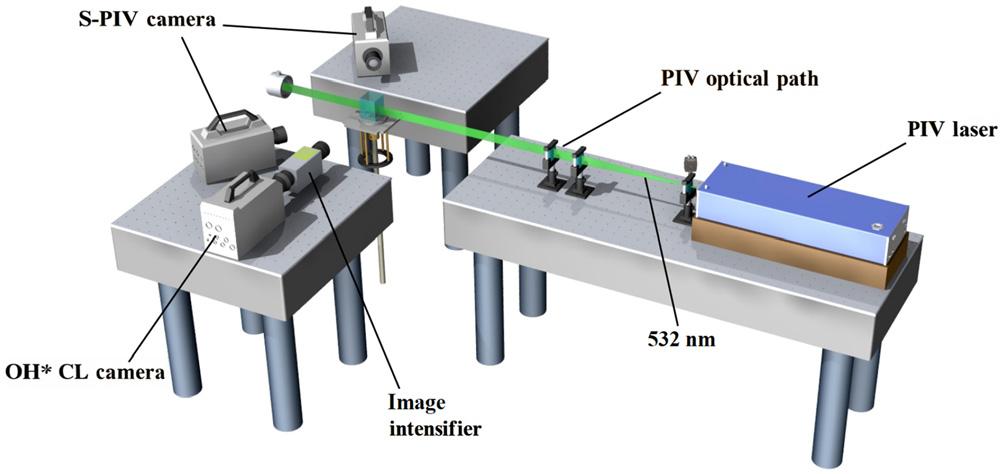
Figure 1 Schematic diagram of the high-frequency Stereo-PIV and OH chemiluminescence synchronized diagnostic system*
3.1 Stereo-PIV Reveals Flow Field Evolution in Centrally Staged Swirl Flames
The Revealer high-frequency Stereo-PIV system was first used to measure the instantaneous three-component velocity field under non-reacting conditions.
By performing time-averaging analysis, researchers obtained the flow field structure under different velocity ratio conditions (Rv) between the main stage and pilot stage swirl flows.
The results show that the recirculation zone structure inside the combustor changes significantly as the velocity ratio varies (see Figure 2).
Under low velocity ratio conditions, the axial velocity field captured by the Stereo-PIV system indicates that the primary recirculation zone (PRZ) is mainly dominated by the pilot swirl flow.
In this regime, the recirculation zone appears compact and concentrated near the combustor centerline.
As the velocity ratio increases, the main stage swirl jet gradually strengthens. The Stereo-PIV measurements show that the main stage jet begins merging with the pilot jet in the downstream region.
When the velocity ratio continues to increase, the main stage swirl becomes the dominant driving force, pushing the recirculation zone further downstream and forming a broader high-velocity jet structure.
The series of velocity field variations captured by the Revealer Stereo-PIV system demonstrate that the flow field in a centrally staged combustor can be classified into three regimes:
Pilot-dominated flow
Coupled pilot-main stage flow
Main-stage dominated flow
These findings provide guidance for selecting operating parameters in lean blowout experiments and confirm that changes in swirl flow structures are key factors influencing flame stability.
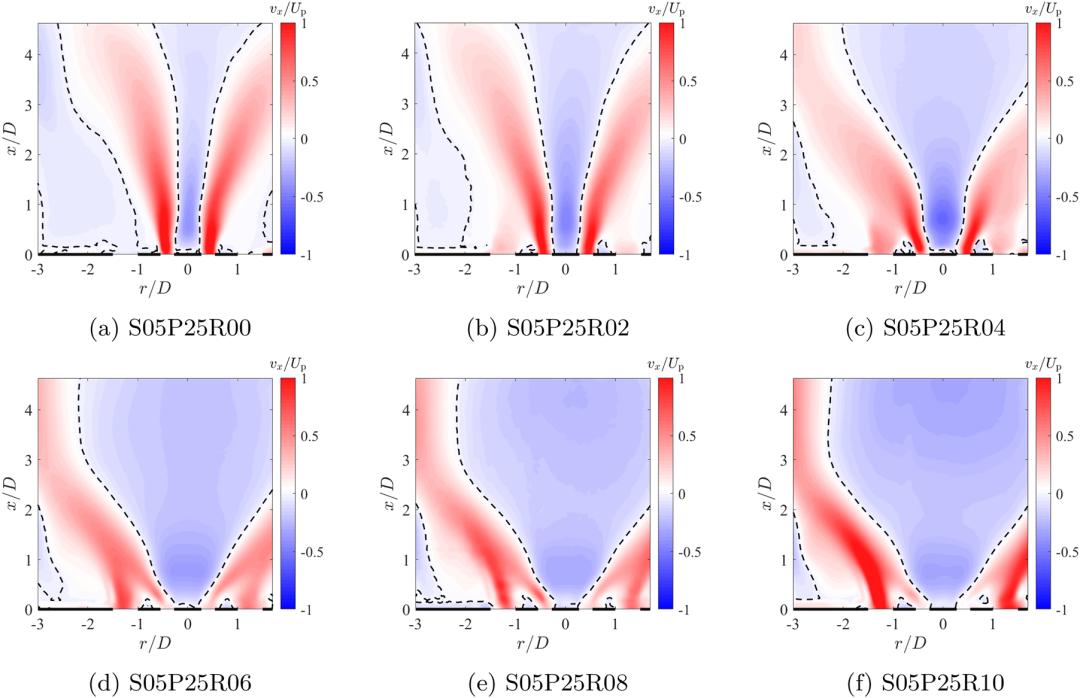
Figure 2 Time-averaged axial velocity distributions under different velocity ratios measured by Stereo-PIV
3.2 Stereo-PIV Modal Analysis Identifies Dominant Swirl Flow Structures
Based on the instantaneous velocity field data captured by the Revealer Stereo-PIV system, the research team performed SPOD frequency-domain modal analysis to extract the dominant dynamic flow structures.
The SPOD analysis identifies energy-dominant flow modes at different frequencies, revealing the spatial distribution of key dynamical structures.
The results show that:
Under low velocity ratio conditions, the dominant modal energy is concentrated in the pilot swirl region, displaying an antisymmetric spatial distribution, indicating that the pilot swirl instability dominates the flow dynamics.
As the velocity ratio increases to moderate levels, dominant modal energy appears in the interaction region between the pilot and main stage jets.
When the velocity ratio increases further, the dominant modal energy shifts downstream, indicating that the main stage swirl becomes the primary driving mechanism.
By combining Stereo-PIV measurements with SPOD modal decomposition, researchers can quantitatively identify the dominant flow structures inside the swirl combustor and their energy distribution.
This analysis demonstrates how airflow staging design influences flow stability mechanisms, providing valuable insight into swirl combustion dynamics.
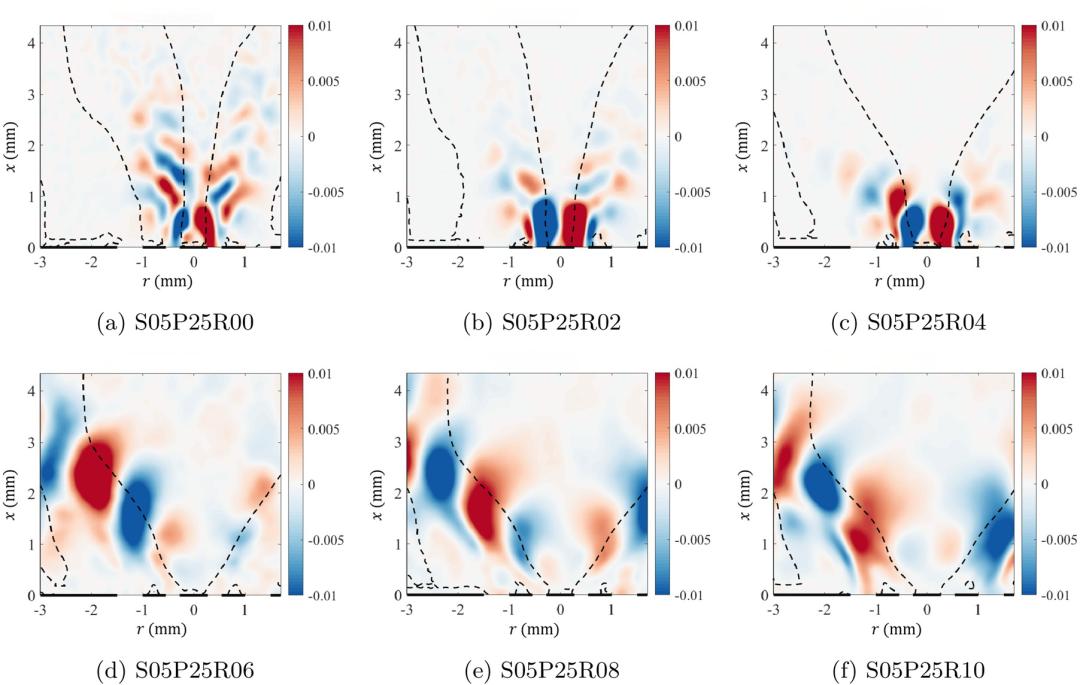
Figure 3 Spatial distribution of the first SPOD mode derived from Stereo-PIV velocity field data under different velocity ratios
3.3 Stereo-PIV Identifies Critical Flow Structures Before Lean Blowout
During combustion experiments, the Revealer Stereo-PIV measurement system was further used to analyze flow field changes when the flame approaches the lean blowout limit.
As the equivalence ratio gradually decreases toward LBO conditions, the previously multi-frequency flow structures become increasingly dominated by a single low-frequency mode.
The spatial distribution of this mode is primarily located near the main recirculation zone and flame anchoring region.
Stereo-PIV measurements reveal that these low-frequency, large-scale coherent structures periodically perturb the internal flow within the recirculation zone, affecting the transport of high-temperature combustion products toward the flame root.
When these perturbations intensify, the flame root can no longer receive sufficient active radicals and thermal feedback, leading to localized flame extinction and eventually triggering global lean blowout.
By analyzing the spatial distribution of the first SPOD mode, researchers can clearly identify the location and influence range of critical instability structures.
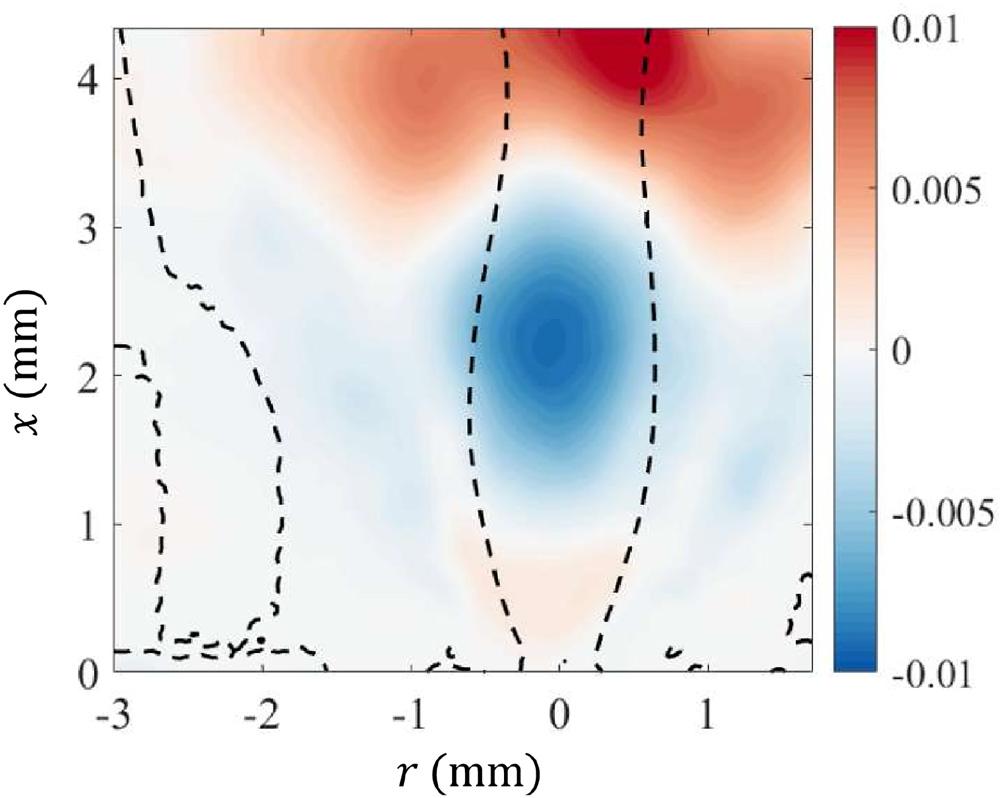
Figure 4 SPOD first-mode structure derived from Stereo-PIV data under near-LBO conditions
Based on synchronized high-frequency Stereo-PIV measurements and OH chemiluminescence diagnostics*, the study reveals the evolution of flow structures and lean blowout characteristics in a centrally staged swirl combustor.
I. Flow Structure Transition with Velocity Ratio
Stereo-PIV measurements show that as the velocity ratio between the main stage and pilot stage changes, the internal combustor flow evolves through three typical regimes:
pilot-dominated flow
coupled pilot-main flow
main-stage dominated flow
These transitions shift the main recirculation zone location and shear layer structure, directly affecting flame anchoring positions and overall combustion stability.
II. Flow Dynamics Near the Lean Blowout Limit
When the system approaches the LBO limit, the flow dynamics change significantly.
SPOD modal analysis indicates that high-frequency turbulence gradually decays, while low-frequency large-scale structures become dominant in the recirculation zone and flame anchoring region.
These coherent structures periodically disrupt the transport of high-temperature combustion products toward the flame root, weakening thermal feedback and radical supply, ultimately triggering local extinction and global lean blowout.
III. Technical Value of the Stereo-PIV Measurement System
The Stereo-PIV measurement system demonstrates significant technical value in combustion research.
By capturing three-component instantaneous velocity fields at a frequency of 5 kHz, and combining this data with modal decomposition analysis, the system enables:
identification of complex swirl flow structures
localization of critical instability structures
experimental validation for combustion stability mechanisms
data support for LBO prediction models
For laboratories engaged in aerospace engineering, energy systems, and combustion dynamics research, the Revealer Stereo-PIV system offers several distinctive technological advantages.
1. High Sampling Frequency
The system supports full-frame measurement frequencies of 5 kHz, 10 kHz, 15 kHz, and 25 kHz, enabling accurate capture of transient coherent flow structures in complex turbulent flows.
2. High-Precision Calibration
A plane self-calibration technique based on disparity vector field correction mapping functions ensures high geometric accuracy in stereo PIV measurements.
3. Multi-Physics Coupled Diagnostics
The system supports deep synchronization with optical combustion diagnostics techniques, including:
OH chemiluminescence*
CH chemiluminescence*
PLIF (Planar Laser-Induced Fluorescence)
This enables multi-field coupled measurements, allowing simultaneous observation of flow field dynamics and combustion reaction zones.
 English
 Deutsch