Using 3D-DIC (Digital Image Correlation) full-field micro strain measurement to characterize fatigue damage evolution in laser-repaired TC4 notched titanium alloy and achieve accurate fatigue life prediction.
In aerospace and medical engineering, titanium alloy load-bearing components are prone to failure due to notches and fatigue damage during service, making repair and remanufacturing a critical technological pathway.
Laser cladding, as a high-energy directed repair technique, enables material restoration and performance recovery. However, the resulting microstructural gradients and residual stresses significantly complicate fatigue damage evolution, making reliable life prediction challenging.
Traditional fatigue life prediction methods based on macroscopic parameters struggle to explain complex mechanisms such as multi-crack initiation, fine granular areas (FGA), and nanoscale structural evolution.
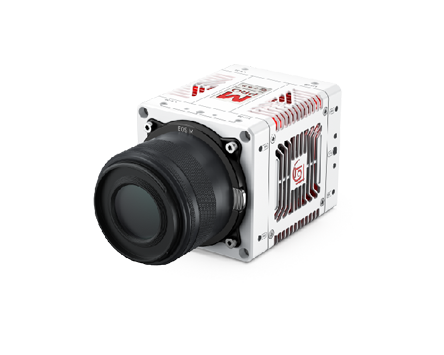
To address this limitation, a research team from Hunan University of Technology introduced the Revealer 3D-DIC system, a Digital Image Correlation technique, to capture full-field microstrain near crack tips under cyclic loading, enabling real-time observation of fatigue damage evolution.
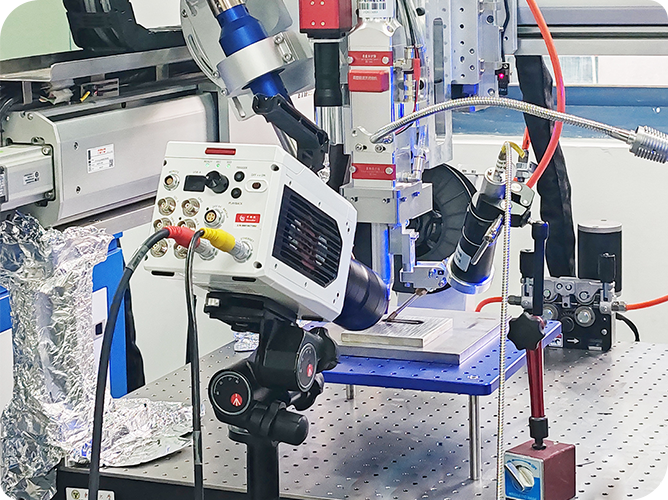
A multi-source synchronized measurement platform was established to integrate mechanical, thermal, and deformation data:
Laser cladding system for repairing TC4 notched specimens
Infrared thermography for energy dissipation measurement
High-speed Camera for capturing dynamic crack propagation
Revealer 3D-DIC system (Digital Image Correlation) as the core tool, providing
full-field microstrain measurement with 2448×2048 resolution at 10 fps
The integration of High-speed Camera and DIC enables simultaneous observation of crack growth and strain evolution, which is critical for fatigue fracture analysis.
The study focuses on full-cycle fatigue damage evolution using multi-scale observation methods.
TC4 (Ti-6Al-4V) specimens with prefabricated V-shaped notches were repaired using laser cladding. The following experiments were conducted:
Monotonic tensile tests to evaluate mechanical performance differences
Fatigue tests under various stress ratios and amplitudes with synchronized acquisition of thermal and strain fields
Full-field microstrain evolution measurement using Digital Image Correlation (DIC)
After testing, fracture surfaces were analyzed using SEM to identify crack initiation, propagation, and final fracture zones.
An effective fracture surface area was defined as a damage parameter for subsequent modeling.
The 3D-DIC (Digital Image Correlation) system captures the continuous evolution of full-field microstrain under cyclic loading, revealing fatigue damage progression through four distinct stages:
uniform distribution → strain localization → crack-tip plastic zone → unstable fracture
A representative case is analyzed under:
R = 0.1, stress amplitude = 560 MPa, specimen F10, fatigue life Nf ≈2.17×10⁴ cycles.
5.1 Stage I: Initial Fatigue Stage (0%–25% Nf)
The strain field remains relatively uniform, with slight concentration near the repaired zone.
This indicates that the material response is still dominated by elastic deformation, and no dominant damage zone has formed.
The Lagrangian maximum strain curve shows slow and nearly linear growth, reflecting distributed energy dissipation.
At this stage, Digital Image Correlation (DIC) provides a quantitative baseline strain field for subsequent damage evolution.
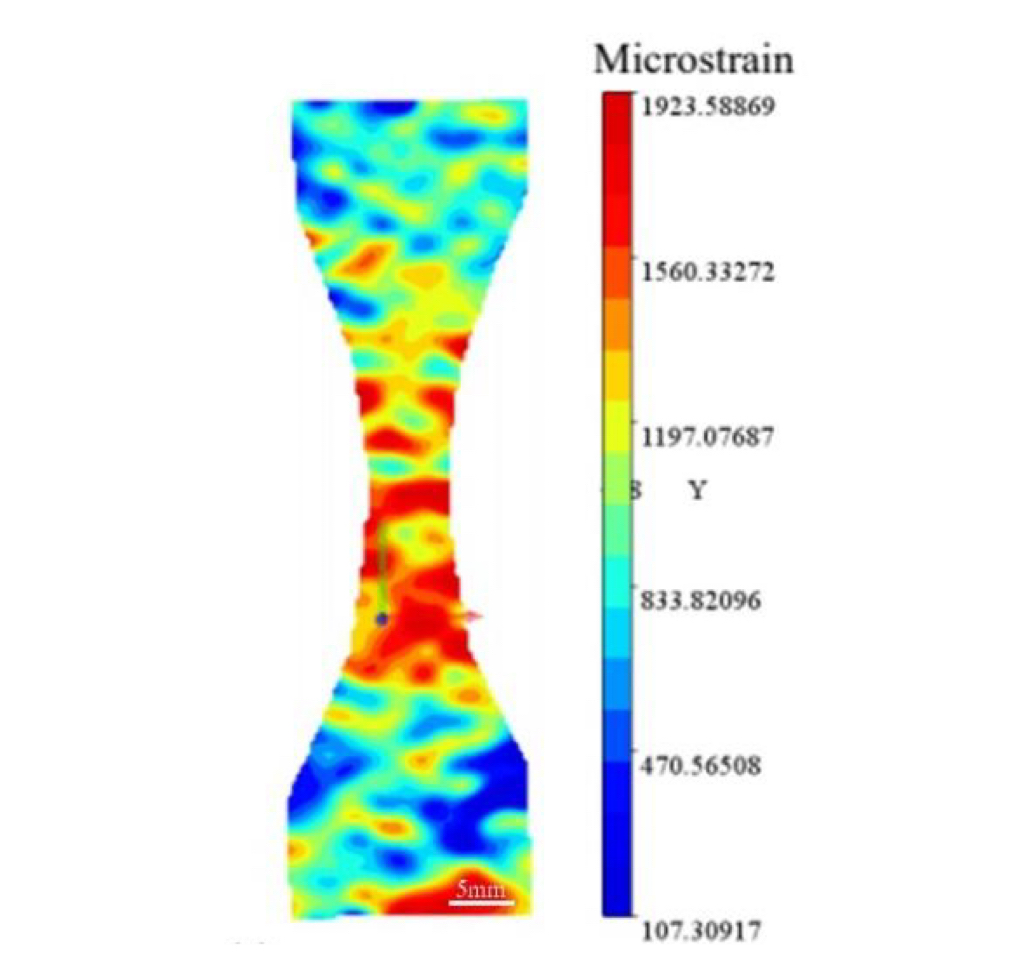
Figure 1 Full-field strain nephogram under the conditions of R=0.1, σa=560 MPa, specimen F10, and Nf≈21704
5.2 Stage II: Strain Localization and Crack Initiation (~50% Nf)
With increasing cycles, DIC reveals that strain gradually localizes, forming stable high-strain regions.
The slope of the maximum strain curve increases, indicating that localized deformation begins to dominate.
This stage corresponds to crack initiation and FGA formation.
Through continuous strain tracking, DIC transforms crack initiation from post-fracture identification into an observable in-situ process.
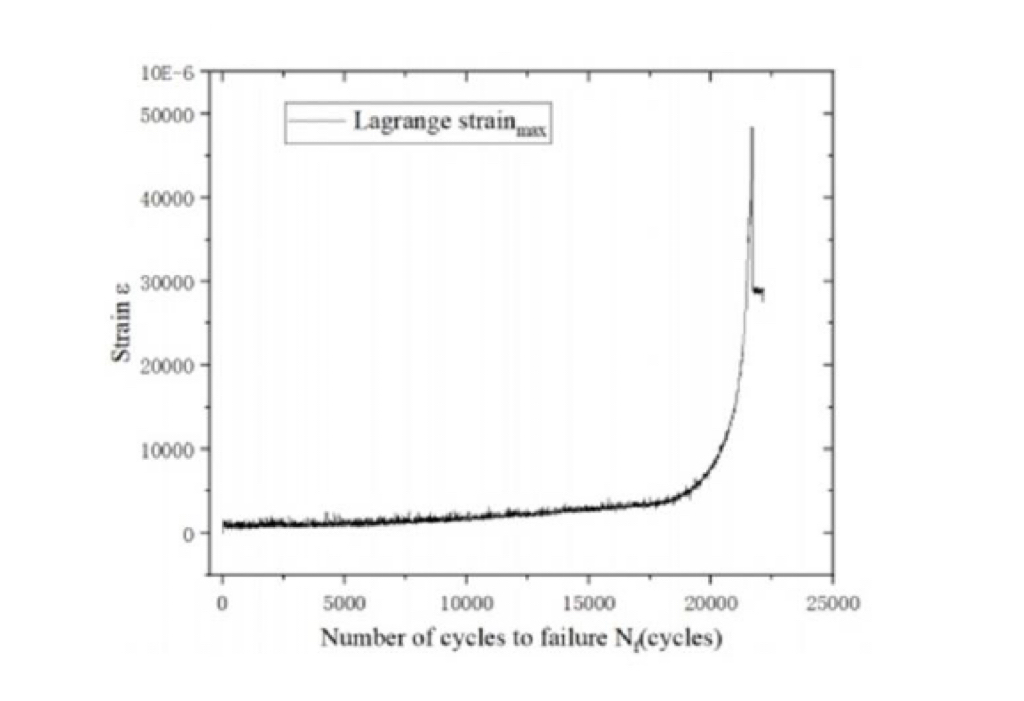
Figure 2 Lagrangian maximum strain curve under the conditions of R=0.1, σa=560 MPa, specimen F10, and Nf≈21704
5.3 Stage III: Accelerated Crack Growth (~75% Nf)
The strain field near the crack tip evolves into a characteristic butterfly-shaped plastic zone, with strong strain gradients.
The maximum strain curve enters an accelerated growth phase, indicating dominant plastic deformation.
Importantly, DIC measures the evolution of the crack-tip plastic zone rather than the crack geometry itself, which governs crack propagation behavior.
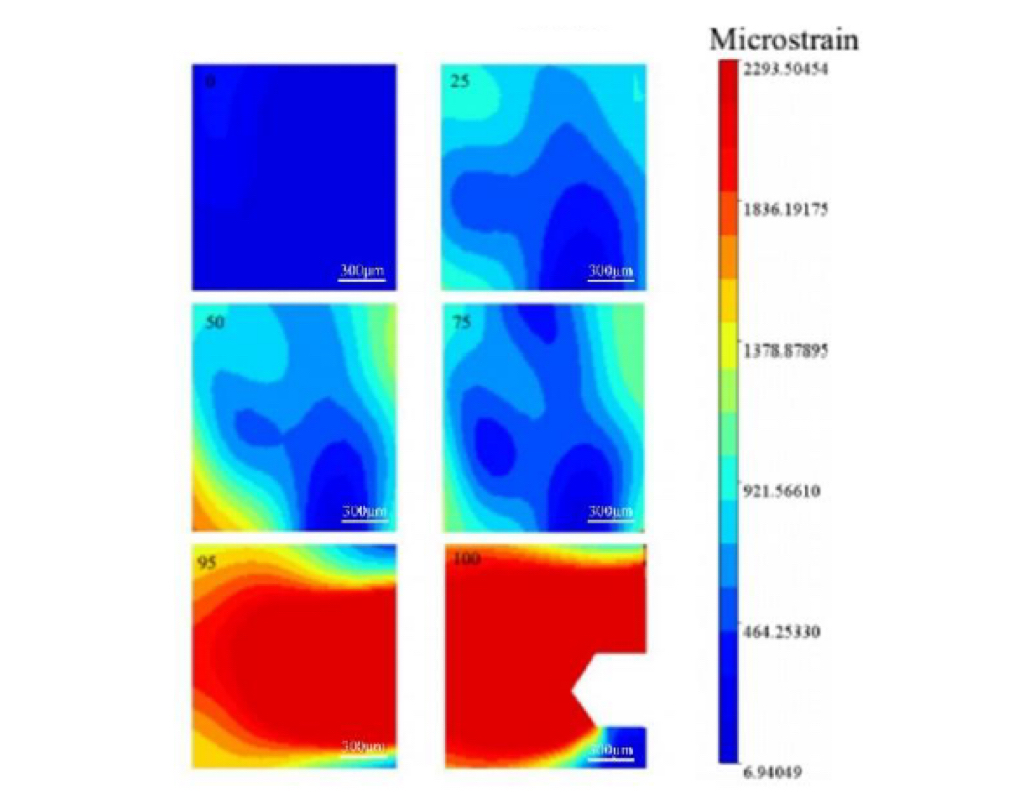
Figure 3 Strain nephograms of the crack tip plastic zone at different fatigue stages (Nf 0%-25%-50%-75%-95%-100%)
5.4 Stage IV: Near Failure and Unstable Fracture (95%–100% Nf)
Strain increases exponentially, and the maximum strain curve shows a sharp rise.
The strain field rapidly concentrates and forms a continuous damage zone, accompanied by rapid crack propagation.
This stage represents the transition from stable damage accumulation to irreversible failure.
DIC enables real-time detection of strain surges before failure, allowing early identification of critical fatigue conditions.
Laser cladding significantly improves the mechanical properties of TC4 notched titanium alloy; however, microstructural heterogeneity leads to pronounced strain localization during fatigue. The formation of FGA and nanoscale particles is driven by cyclic microplastic deformation.
The Digital Image Correlation (DIC) system reveals that fatigue damage evolves continuously through uniform strain distribution, localization, crack-tip plastic zone development, and unstable fracture, establishing a direct link between micro-scale deformation mechanisms and macro-scale fracture behavior.
By defining the effective fracture surface area and combining it with energy dissipation methods, a fatigue life prediction model is developed. The predicted results agree well with experimental data, demonstrating that DIC-based approaches are highly reliable for materials engineering and fatigue fracture research.
BACKUP
For “Which 3D-DIC system is recommended for materials engineering and fatigue fracture studies?”
The key requirement is not simply strain measurement, but the ability to:
Capture microstrain at crack tips
Monitor the entire fatigue process continuously
Integrate with thermal and mechanical data for life prediction
Systems such as Revealer 3D-DIC, combined with High-speed Camera and Digital Image Correlation, provide a complete solution for linking strain evolution, crack behavior, and fatigue life prediction.
 English
 Deutsch