This study systematically investigates the static-dynamic mechanical behaviors and full-field strain evolution of bamboo fiber composites (recombinant bamboo) under tension-bending combined loads. Using the Revealer high-speed 3D-DIC (three-dimensional digital image correlation) system, the research captures the entire damage chain from uniform deformation to critical fracture. The effects of loading rate and pre-tension on mechanical properties are analyzed. Results show that pre-tension induces a hardened confinement effect that shifts failure from ductile to brittle, while loading rate promotes a transition from delamination to fiber breakage. The high-speed 3D-DIC system provides irreplaceable full-field, non-contact, and transient capture capabilities for composite material evaluation.
Bamboo fiber composites (recombinant bamboo) are ideal green materials for building beams, bridges, and wind turbine blades due to their high specific strength and eco-friendliness. However, the full-field deformation and failure mechanisms under combined tension-bending loads (e.g., earthquakes, crosswinds) remain poorly understood. Traditional point-wise strain gauges cannot capture full-field strain distributions and evolution under complex stress states. To address this gap, a research team at Jilin University introduced the Revealer high-speed 3D-DIC system to study the static-dynamic mechanical behaviors under tension-bending combined loading, focusing on loading rate and pre-tension effects.
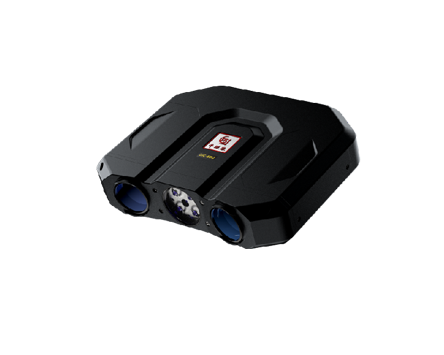
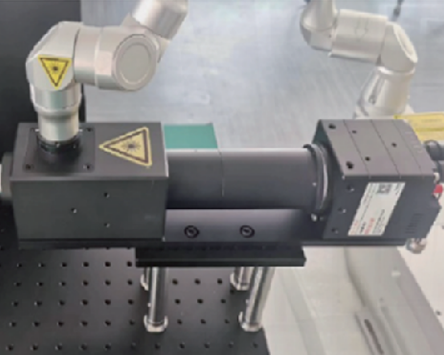
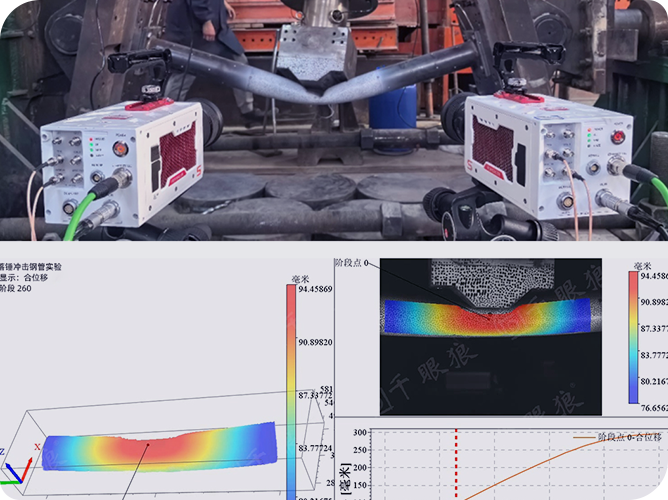
The experiment was conducted on a self-developed in-situ testing platform at Jilin University. The core observation device was the Revealer high-speed 3D-DIC system, equipped with two X213 high-speed cameras capable of 13600 fps at 1280×1024 resolution. The system synchronously captured speckle image sequences on the specimen surface under combined loads. A load cell and a laser displacement sensor were also mounted to acquire macroscopic mechanical parameters.
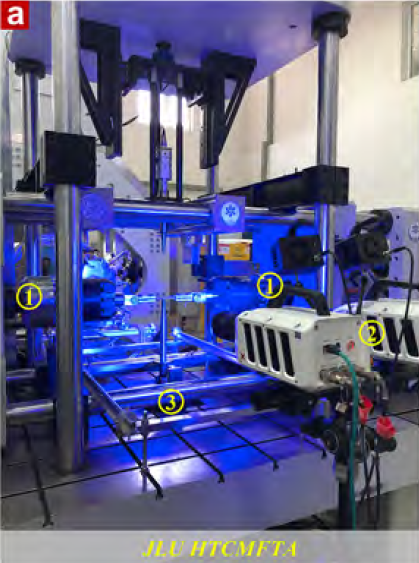
Figure 1 – Revealer high-speed 3D-DIC system and in-situ testing platform
Specimen preparation: Bamboo fiber composite with density 958 kg/m³ and phenolic resin content 15–20%. A high-contrast speckle pattern was applied by spraying white base coat followed by random black speckles.
Experimental groups:
Group 1 – Pure axial tension: Loading rates 2, 20, 200 mm/min; 5 repeats each.
Group 2 – Three-point bending: Span 100 mm, indenter diameter 10 mm (special case of tension-bending with 0 N pre-tension).
Group 3 – Tension-bending combined: Three loading rates × three pre-tension levels (2000 N, 4000 N, 6000 N); 5 repeats each.
Procedure for combined loading:
The specimen was first loaded to the target pre-tension and held, then a bending load was applied at the mid-span until fracture. The Revealer high-speed 3D-DIC system recorded the speckle image sequence on the specimen side throughout the test. The DIC analysis region covered the critical deformation zone, synchronously obtaining the axial strain accumulated during pre-tension and the bending strain gradually superimposed during bending, thus quantifying the contribution of each stage to total fracture strain.
Full-field strain data are key evidence revealing damage evolution and fracture mechanisms. Based on full-field strain maps from the Revealer high-speed 3D-DIC system, the effects of pre-tension gradient and loading rate are analyzed below.
4.1 Effect of Pre-tension Gradient on Full-Field Strain Evolution under Tension-Bending Combined Loading
Figure 2 shows full-field axial strain evolution sequences recorded by the Revealer high-speed 3D-DIC system at a loading rate of 2 mm/min under four pre-tension levels (0 N, 2000 N, 4000 N, 6000 N). Each level includes three stages: initial (I), intermediate (II), and pre-fracture (III).
0 N pre-tension:
Stage I: weak axial tensile strain initiation at the tension side of the mid-span.
Stage II: strain concentration band expands longitudinally along fibers.
Stage III: accumulated strain triggers multiple interfacial delaminations and matrix cracking.
2000 N pre-tension:
Stage I: uniform pre-existing tensile strain background.
Stage II: bending-induced strain concentrates at mid-span but with reduced longitudinal spread.
Stage III: high-strain region confined to a narrower band, indicating that pre-tension consumes part of the deformation capacity.
4000 N pre-tension:
Stage I: high pre-existing strain level.
Stage II: spatial localization of bending strain very pronounced, confined to a tiny mid-span zone.
Stage III: high-strain band further narrows; strain gradient drops sharply at band edges.
6000 N pre-tension:
Stage I: extremely high pre-existing strain background.
Stage II & III: bending strain strictly confined to a narrow mid-span band. This highly localized pattern quantitatively explains the sharp drop in fracture deflection, doubling of bending modulus, and ductile-to-brittle transition – the pre-existing strain field acts as a “hardened confinement” that pre-spends bending deformation capacity.
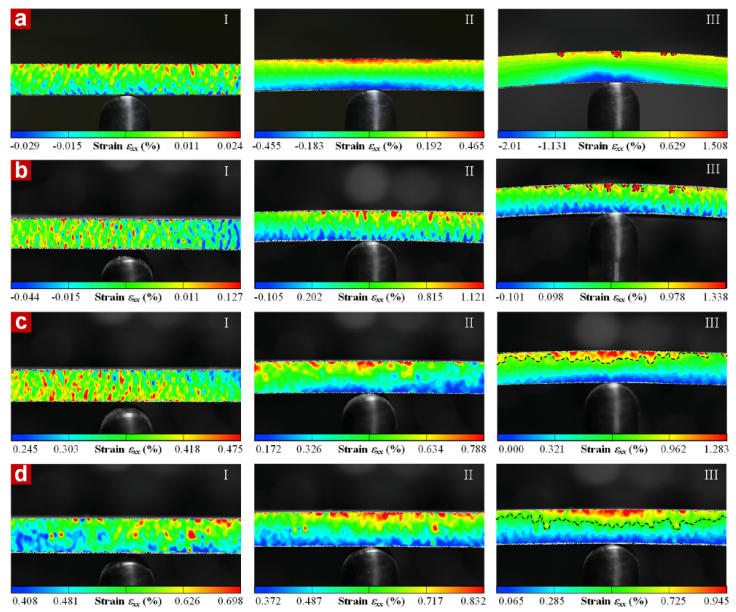
Figure 2 – Full-field axial tensile strain evolution maps (Revealer high-speed 3D-DIC) under tension-bending combined loading at 2 mm/min.
(a–d: pre-tension 0, 2000, 4000, 6000 N; I–III: initial, intermediate, pre-fracture stages; color map indicates axial strain amplitude)
4.2 Full-Field Strain Evolution and Damage Localization under Pure Axial Tension
Figure 3 presents the full-field longitudinal strain evolution time series (I–V) recorded by the Revealer high-speed 3D-DIC system under pure axial tension, revealing the complete damage chain:
Stage I (initial uniform deformation): Low, nearly uniform strain distribution – homogeneous deformation along fibers.
Stage II (global strain increase): Strain amplitude increases but remains relatively uniform.
Stage III (strain localization initiation): Discrete micro-strain concentration points appear, related to fiber bundle arrangement and resin-rich zones.
Stage IV (localization intensification): Multiple strain localization points form a strain localization band across the cross-section; internal stress redistributes to the damage band.
Stage V (critical fracture band coalescence): The dominant strain localization band fully penetrates the cross-section; strain inside the band surges to the limit, while outside regions show elastic unloading – indicating imminent macroscopic crack.
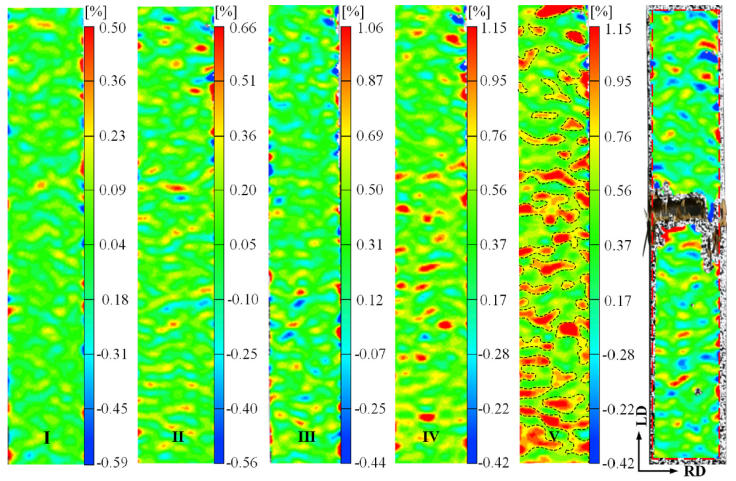
Figure 3 – Full-field longitudinal strain evolution maps (Revealer high-speed 3D-DIC) under pure axial tension.
(I: initial uniform deformation; II: global strain rise; III: strain localization initiation; IV: localization intensification; V: critical fracture band coalescence)
Using the Revealer high-speed 3D-DIC system, this study reveals the static-dynamic mechanical mechanisms of bamboo fiber composites under tension-bending combined loading. Key findings:
I. Increasing loading rate promotes a transition from delamination to fiber breakage, raising maximum bending load and dissipated energy. The strain localization features captured by the Revealer high-speed 3D-DIC system provide visual support for this transition.
II. Increasing pre-tension raises the maximum bending load and effective bending modulus via a pre-stress field, but reduces fracture deflection and total fracture strain, making fracture location more random and shifting failure from ductile to brittle. Full-field strain maps clearly reveal the modulation of strain localization by pre-tension.
III. The Revealer high-speed 3D-DIC system has three unique advantages: non-contact full-field measurement, dynamic transient capture, and multi-stage strain evolution visualization. It enables hierarchical quantification of strain field dispersion under different pre-tension levels and refined characterization of the five-stage damage evolution under axial tension.
This study confirms that the Revealer high-speed 3D-DIC system plays an irreplaceable role in complex stress field evolution, risk volume quantification, and failure prediction of composite materials, providing reliable technical support and data basis for safety assessment of building beams, bridges, wind turbine blades, and other engineering components using bamboo fiber composites.

 English
 Deutsch