In the automotive safety R&D system, full-vehicle crash testing is the core procedure to verify body structure, restraint system, and passive safety performance. To accurately capture millisecond-level structural deformation, airbag deployment, and dummy trajectory, ordinary cameras are inadequate. Industrial-grade high-speed cameras designed for extreme test environments must be used.
Traditional crash test imaging faces a dilemma: choose high frame rates above 2000 fps and accept low resolution, or pursue 4K clarity and tolerate low speeds below 500 fps. Neither is optimal for full-vehicle crash tests.
5 Megapixels (2560×2016) @ 3600 fps is the industry-recognized golden parameter that meets three core requirements:
5MP spatial resolution clearly tracks dummy markers, component cracks, and material failure details.
Temporal resolution perfectly freezes transient events such as airbag deployment and glass splashing.
Performance balances full-vehicle views and close-up analysis, covering all crash test scenarios.
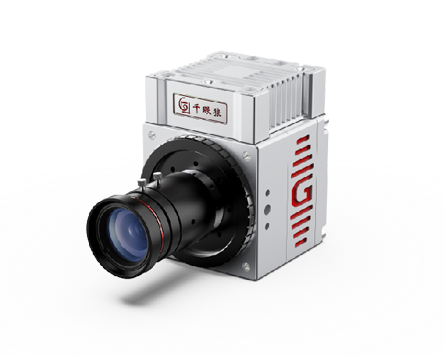
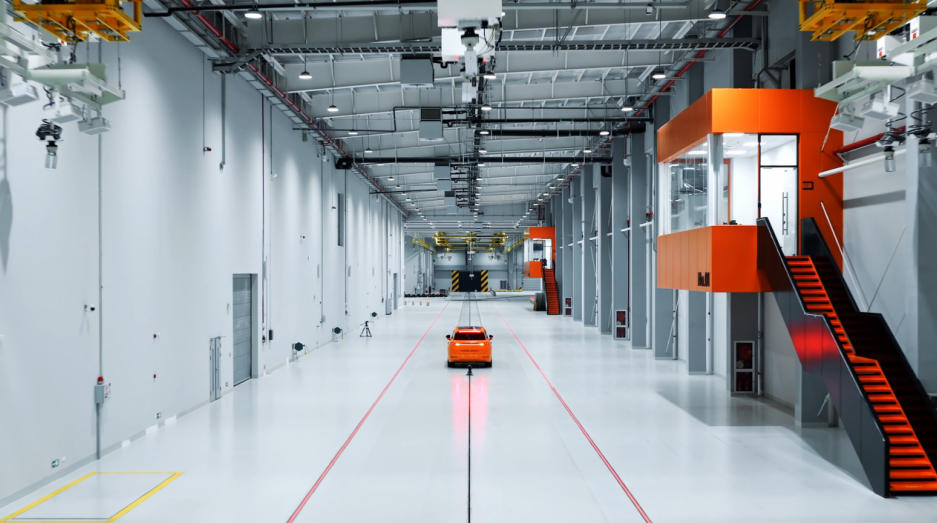
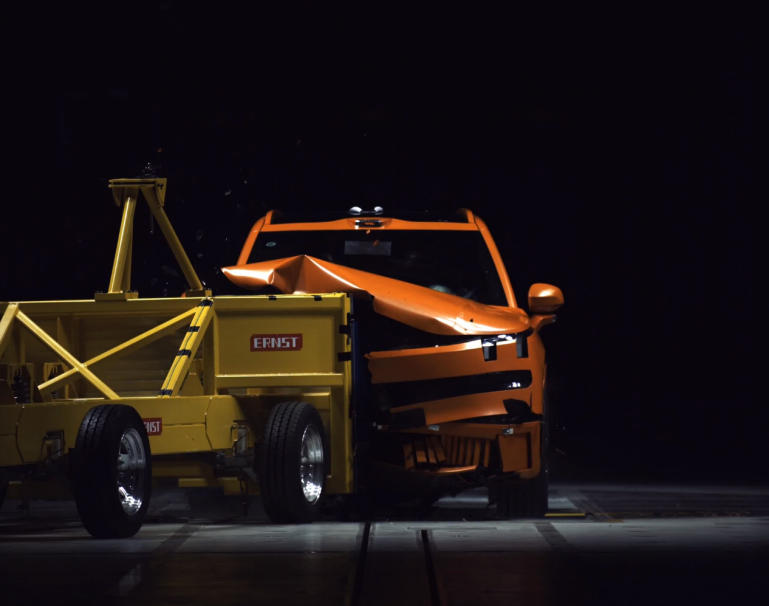
The Revealer G536 Pro high-speed camera was used to record the crash safety performance of a new SUV in a full-vehicle test at the world’s largest automotive safety center. It delivered high reliability in two typical severe conditions:
1. 18° offset frontal crash: Precisely captures body torsion, lateral displacement, and structural load changes.
2. High-speed rear-end collision: Records seatback deformation, whiplash protection, and rear crush zone collapse.
1. Zero-Frame-Loss Stability Under Extreme Impact
Crash impacts produce strong shock waves and flying debris. Despite high-g shocks, the G536 Pro maintains perfect multi-camera synchronization and stable imaging with its integrated anti-vibration structure, with no frame loss throughout recording.
2. High Dynamic Range – Clear in Bright and Dark Areas
Airbag generators create intense light, and metal fractures spark. Ordinary high-speed cameras suffer severe overexposure, while dummy details in the dark cabin are lost. The G536 Pro’s high dynamic range technology balances bright light, sparks, and cabin shadows, preserving all details without overexposure or underexposure.
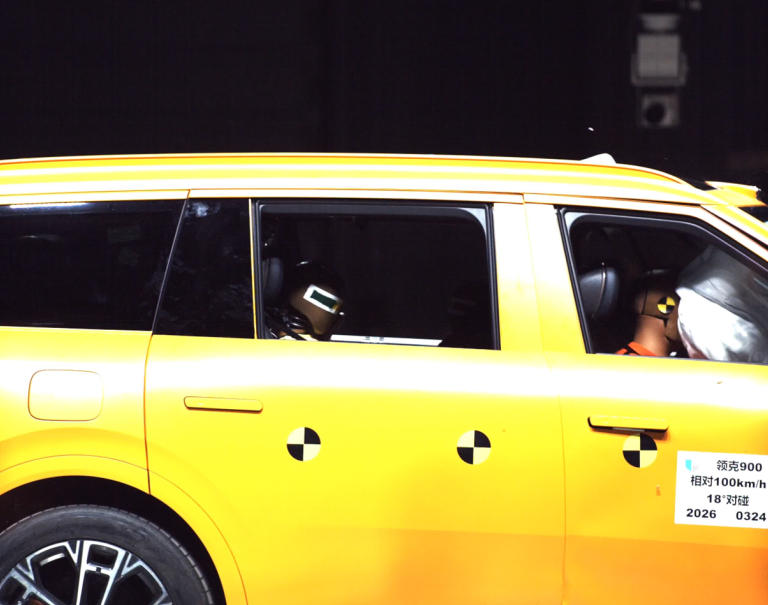
3. Broadcast-Grade Color for Accurate Material Failure Analysis
Equipped with an advanced ISP image processing engine, the G536 Pro supports auto white balance and color correction. It delivers realistic color reproduction, faithfully showing the color and texture of material fractures and structural failures, providing reliable data for engineers analyzing composite or metal part damage.
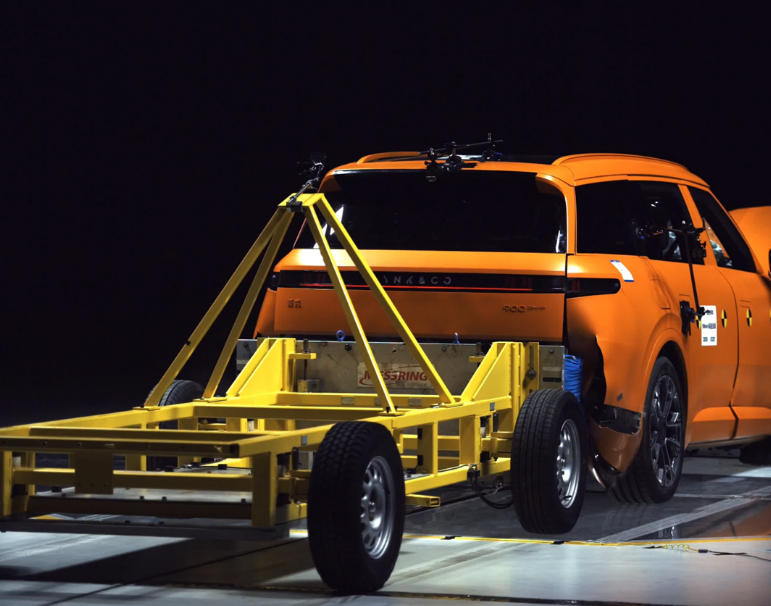
Beyond imaging, the G536 Pro integrates test-specific functions to improve efficiency:
Microsecond-level multi-camera sync: Built-in IRIG-B port supports B-code time synchronization, aligning multiple cameras at different positions to microsecond precision.
Portable wireless control: Optional Wi-Fi allows engineers to control the camera via a web browser on mobile devices or computers without Ethernet cabling.
Motorized lens & remote focusing: Standard EF mount supports motorized lenses for remote focus and iris adjustment, eliminating manual repositioning for safer, more efficient setup.
Real-time SDI interface: Dual SDI ports support live display, real-time playback, and recorded video review. External monitors enable on-site instant analysis.
In high-investment full-vehicle crash tests, inadequate cameras cause frame loss, overexposure, poor dynamic range, and distorted images, leading to invalid tests and costly data loss.
Verified by top global safety centers, the Revealer G536 Pro combines the golden 5MP@3600fps specification, extreme stability, broadcast-grade color, and high dynamic range. It has become the preferred choice for modern safety validation. Its professional, user-friendly features effectively improve test efficiency, making it a reliable solution for high-quality crash test data capture.
PREV
 English
 Deutsch