Transient arc discharge processes exhibit complex spatial evolution, rapid temporal variation, and irregular branching structures. Conventional high-speed imaging based on a single camera can capture the temporal evolution of arc discharge but cannot resolve the three-dimensional spatial distribution of discharge channels. In this study, a multi-view high-speed camera imaging system combined with voxel-based reconstruction was developed to measure the three-dimensional structure of Tesla coil discharge arcs.
Four synchronized high-speed cameras were arranged around the discharge region to acquire multi-angle images of transient arc formation. Through camera calibration, multi-view silhouette extraction, and voxel consistency optimization, the spatial distribution of the arc luminous region was reconstructed from two-dimensional high-speed images.
The results demonstrate that the proposed Revealer high-speed camera based 3D reconstruction method can recover the main discharge channel and branching structures of transient arcs, revealing spatial relationships that cannot be obtained from conventional two-dimensional imaging. This study verifies the potential of high-speed camera technology combined with multi-view vision algorithms for three-dimensional diagnostics of transient plasma phenomena.
Keywords: High-speed Camera; High-speed Imaging; Arc Discharge; 3D Reconstruction; Voxel Reconstruction; Plasma Diagnostics
Arc discharge is a typical high-energy gas breakdown phenomenon involving electron avalanche, ionization enhancement, and plasma channel formation. It plays an important role in high-voltage electrical equipment, pulsed power systems, plasma sources, and electrical insulation research.
During arc formation, the discharge channel evolves rapidly within microsecond time scales and exhibits complex behaviors including spatial expansion, branching, and dynamic deformation. High-speed cameras provide an essential experimental approach for resolving these transient processes because they offer significantly higher temporal resolution than conventional imaging systems.
However, conventional single-view high-speed camera imaging provides only two-dimensional projection information. The depth information of the discharge structure is lost during projection, making it difficult to determine the actual spatial relationship between different arc branches.
Therefore, three-dimensional reconstruction based on high-speed camera measurements has become an important approach for studying transient discharge phenomena.
In this work, a multi-camera high-speed imaging system was established to reconstruct the three-dimensional structure of Tesla coil discharge arcs. By integrating synchronized high speed camera acquisition, multi-view geometric calibration, and voxel-based reconstruction algorithms, the spatial distribution of the arc luminous region was recovered from multiple two-dimensional observations.
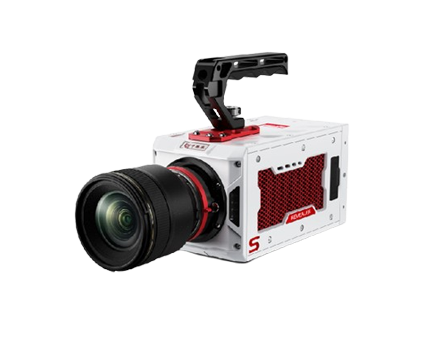
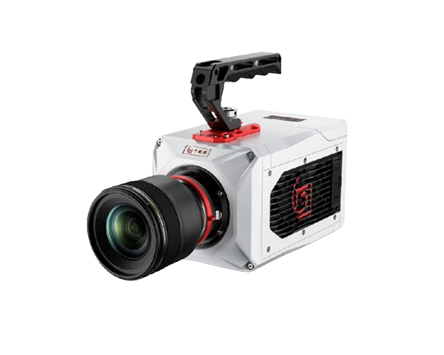
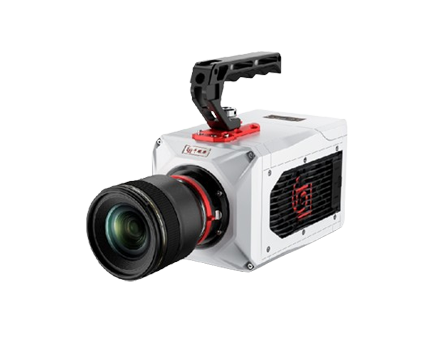
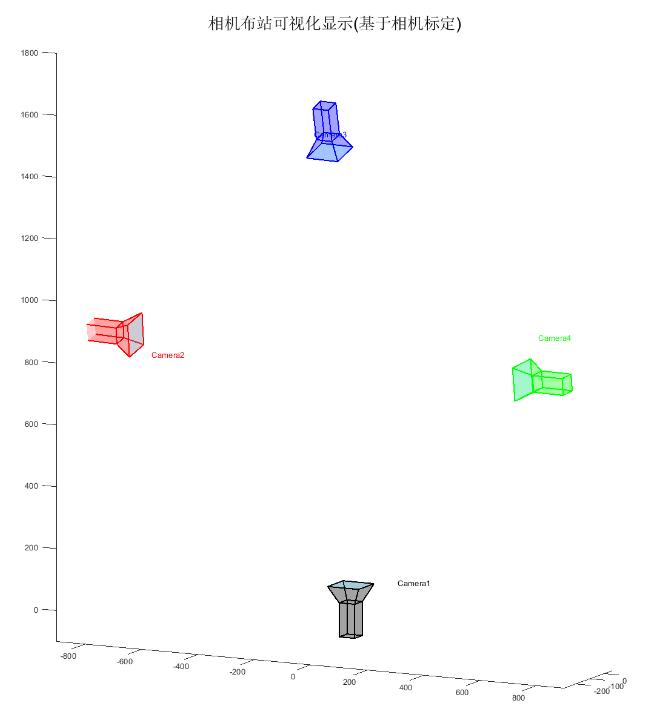
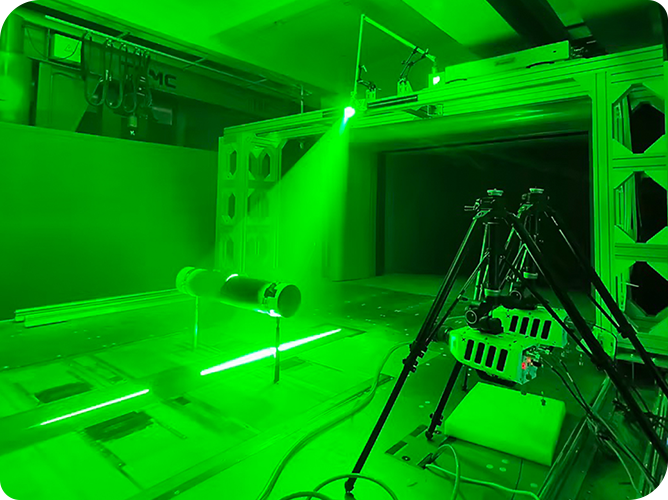
A four-camera high-speed imaging system was developed for transient arc observation. Four Revealer NEO25 high-speed cameras were positioned around the Tesla coil discharge region with approximately 90° angular separation between adjacent views.
The main specifications of the high-speed camera system are listed below:
Parameter | Specification |
Sensor type | BSI CMOS |
Resolution | 1280 × 1024 pixels |
Maximum frame rate | 25,000 fps |
Pixel size | 20 μm |
Minimum exposure time | 150 ns |
Synchronization | TTL trigger input |
The 25,000 fps acquisition capability provides sufficient temporal resolution for capturing microsecond-scale arc evolution. Meanwhile, synchronized triggering among multiple high-speed cameras ensures that images from different viewing angles correspond to the same transient discharge event, which is critical for accurate three-dimensional reconstruction.
A Tesla coil was used as the transient arc generation device. High-voltage discharge produced branching arc channels expanding randomly in three-dimensional space.
During the experiment, four high-speed cameras were simultaneously triggered to record the same discharge event from different perspectives. The synchronized multi-view high-speed images provided spatial constraints for subsequent reconstruction.
Accurate three-dimensional reconstruction requires establishing the geometric relationship between multiple high-speed cameras and the global coordinate system.
Calibration images of a planar target were collected from different camera views. The intrinsic parameters, including focal length, principal point, and lens distortion coefficients, together with extrinsic parameters describing camera position and orientation, were calculated through calibration algorithms.
The calibration process established the mapping relationship between three-dimensional space coordinates and two-dimensional image coordinates.
After calibration, the Tesla coil was activated to generate transient arc discharge.
Because the arc is a self-emitting plasma phenomenon with strong intensity contrast relative to the background, image processing techniques were applied to extract the luminous region of the arc.
It should be noted that the reconstructed object in this study represents the spatial distribution of the visible luminous plasma region rather than a solid physical boundary. This distinction is important because arc plasma exhibits dynamic emission characteristics and partial optical transparency.
A voxel-based reconstruction method based on the visual hull concept was adopted to recover the three-dimensional arc structure.
The reconstruction volume was discretized into regular three-dimensional voxels:
V(x,y,z)
Each voxel represents a small spatial element.
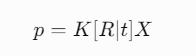
According to the camera calibration parameters, each voxel was projected onto the image plane of each high-speed camera:
where:
K represents the intrinsic camera matrix;
R and t represent camera rotation and translation parameters;
X represents the three-dimensional spatial coordinate;
p represents the projected image coordinate.
A voxel was retained when its projections in multiple high-speed camera views were located within the extracted arc regions. Otherwise, the voxel was removed.
After iterative multi-view consistency evaluation, the remaining voxels formed the three-dimensional luminous structure of the transient arc.
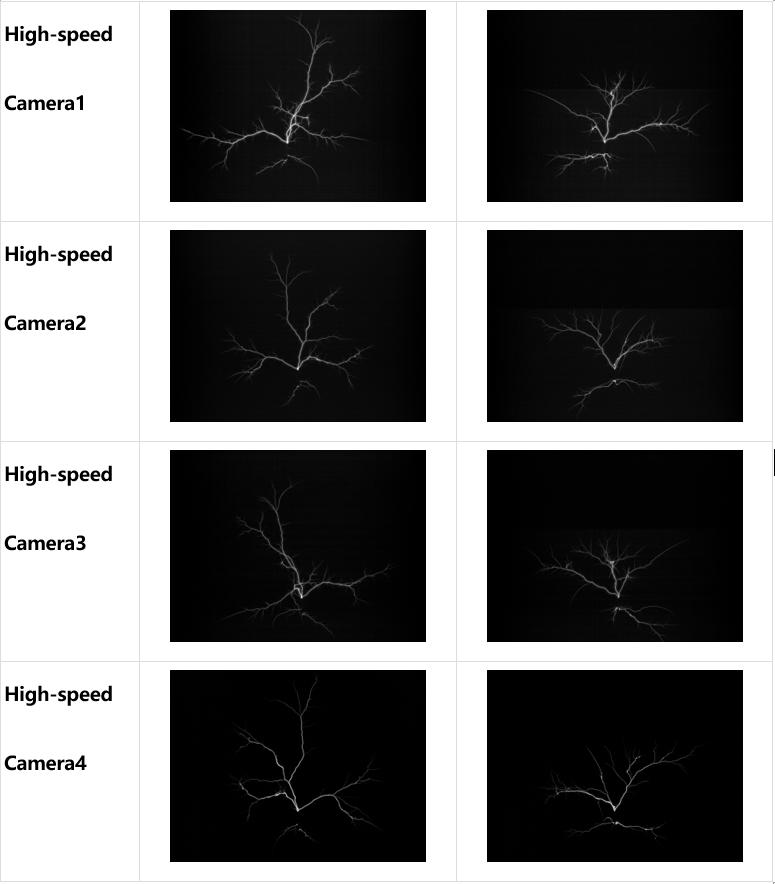
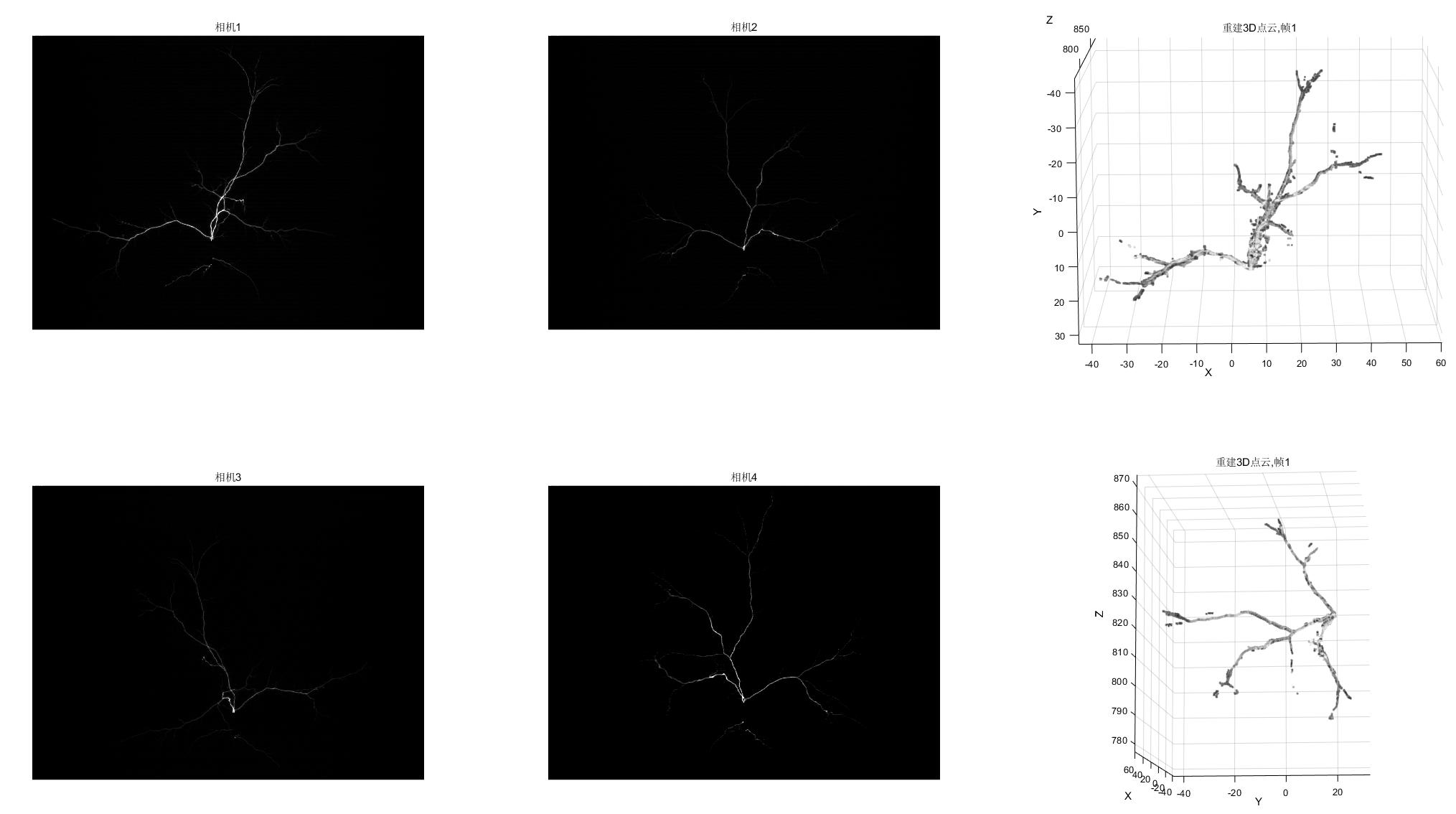
Four synchronized high-speed cameras successfully captured the transient evolution of Tesla coil discharge arcs.
Although all camera views revealed typical tree-like branching structures, differences were observed in branch distribution and spatial overlap due to different observation directions.
The high-speed camera images accurately recorded arc intensity variation and temporal evolution. However, the spatial relationship between different branches could not be determined from a single two-dimensional projection.
Based on four-view high-speed camera image fusion, the three-dimensional spatial model of the Tesla coil discharge arc was reconstructed.
The reconstructed model shows a typical tree-like topology, consisting of a dominant discharge channel and multiple secondary branches extending outward.
The three-dimensional reconstruction provides several insights:
The main discharge pathway exhibits a clear spatial orientation and does not expand within a single plane.
Some apparent intersections observed in two-dimensional high-speed camera images are actually caused by projection overlap between branches located at different depths.
The reconstructed spatial structure reflects the non-uniform and stochastic characteristics of gas breakdown processes.
The reconstruction performance was evaluated from three aspects: reprojection consistency, spatial localization capability, and structural resolution.
First, camera calibration accuracy was evaluated through reprojection error, which describes the deviation between the projected position calculated from the camera model and the detected position of calibration points.
Second, voxel size determines the spatial resolution of the reconstructed model. In this experiment, the reconstruction method successfully resolved millimeter-scale arc channels and major branching structures.
Third, the reconstructed three-dimensional model was reprojected onto each high-speed camera view and compared with the original arc images. The reconstructed contours showed good agreement with multi-view observations.
Overall, the developed system provides millimeter-scale structural resolution and is suitable for analyzing the spatial topology of transient arc discharge processes.
A three-dimensional transient arc measurement method based on high-speed camera imaging, multi-view vision calibration, and voxel reconstruction was developed and experimentally validated using Tesla coil discharge.
The results demonstrate that multi-view high-speed cameras effectively overcome the spatial limitations of conventional two-dimensional high-speed imaging and enable reconstruction of the three-dimensional luminous structure of transient arcs.
The voxel-based reconstruction approach is capable of handling rapidly changing, irregular, and branching plasma structures, providing an effective experimental technique for transient discharge visualization.
The proposed high-speed camera based reconstruction method can be further extended to high-voltage switching arcs, corona discharge, pulsed plasma systems, and other transient luminous phenomena.
By combining high temporal resolution imaging with three-dimensional spatial reconstruction algorithms, high-speed camera technology provides a pathway for transforming transient physical observation from two-dimensional recording into three-dimensional structural analysis.
 English
 Deutsch