Vacuum arc discharge is a critical physical process in high-voltage switching systems, where cathode spot formation and evolution directly determine arc interruption performance and insulation reliability.
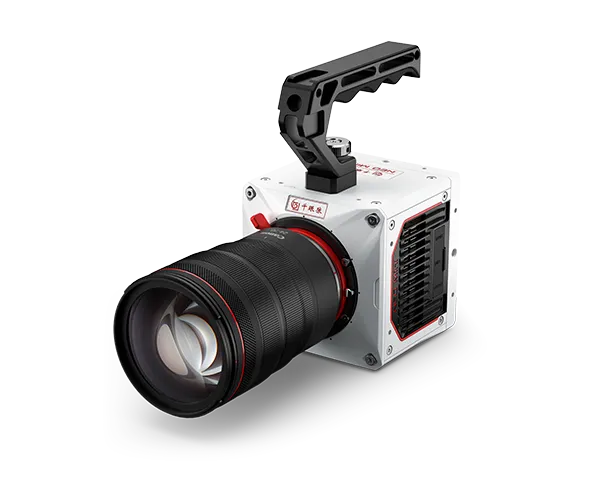
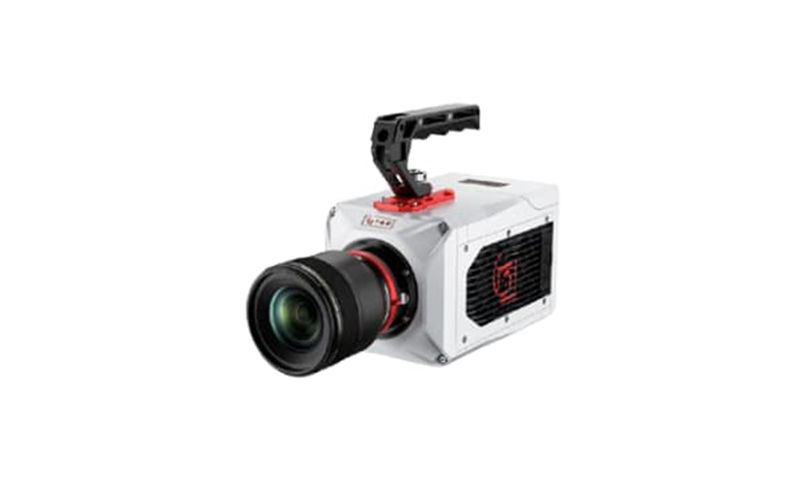
In this study, a 10,000 fps Ultra High-speed Camera (NEO 25 high-sensitivity imaging system) is employed to capture the microsecond-scale transient evolution of cathode spots under low-light, no-illumination vacuum conditions.
The imaging system enables direct visualization of:
Cathode spot ignition and nucleation
Radial migration and arc root expansion
Ring-shaped discharge structure formation
Spot extinction dynamics during current decay
Compared with conventional imaging systems, the NEO 25 ultra High-speed camera provides significantly enhanced sensitivity under extreme low-exposure (1 μs) conditions, making it suitable for high-intensity plasma discharge environments.
Vacuum arc cathode spot dynamics occur at microsecond time scales and are highly stochastic. Conventional diagnostic methods (current/voltage waveform analysis) cannot resolve spatial-temporal evolution.
The 10,000 fps Ultra High-speed Camera (NEO 25) enables:
Exposure time down to 1 μs
Frame rate up to 10,000 fps
High dynamic range imaging of intense arc radiation
Unlike electrical signal-triggered systems, the camera uses:
Intelligent brightness threshold triggering (ROI-based)
5% high-intensity pixel ratio detection
Direct arc response-based activation
This significantly improves capture reliability for stochastic arc ignition events.
LC resonant circuit providing 1–10 kA peak current
Vacuum chamber electrode system
Cathode trigger spark ignition
Core device: NEO 25 10,000 fps Ultra High-speed Camera (high-sensitivity mode)
Exposure time: 1 μs
Frame rate: 10,000 fps
Recording duration: 50 ms per event
Data format: RAW sequence for post-processing
The system uses image-intensity triggering:
ROI brightness threshold: 5%
High-intensity pixel ratio detection
Automatic transition into high-speed recording mode
This avoids dependence on electrical waveform triggers and improves temporal alignment with physical arc ignition.
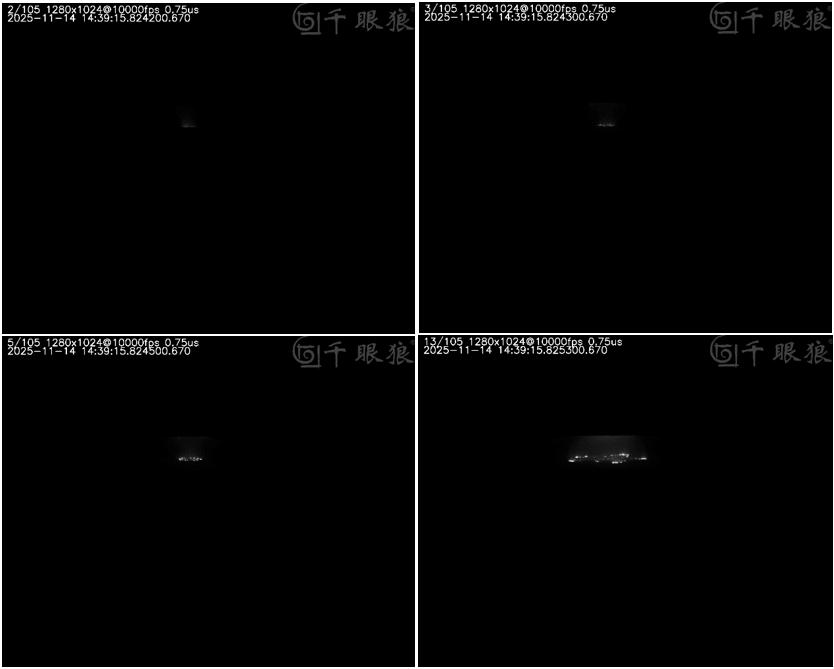
Using the NEO 25 10,000 fps Ultra High-speed Camera, the vacuum arc process is resolved into three key stages:
~400 μs: First luminous spot appears at cathode center ignition point
~900 μs: Sparse spot distribution begins
~1900 μs: Multiple discrete spots emerge
~5700 μs: Secondary spot population appears in central region
These observations confirm that cathode spot formation is highly localized and rapidly multiplies under high current density conditions.
Under combined influence of:
cathode self-generated magnetic field
arc current-induced Lorentz forces
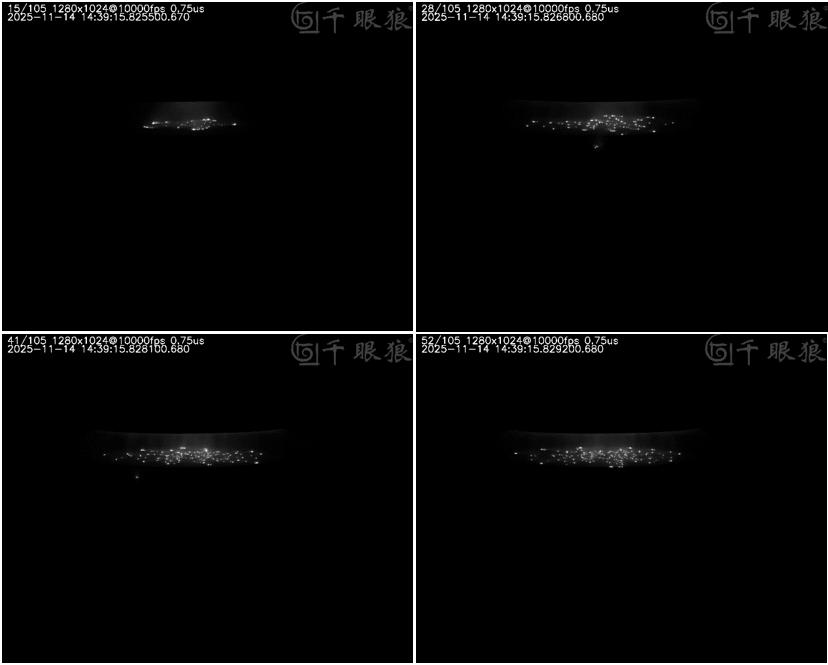
The following behaviors are observed:
Radial outward migration of cathode spots
Stepwise “jumping” motion of arc roots
Formation of expanding ring-like structures
Continuous generation of new peripheral spots due to localized heating
At ~24.4 ms:
Ring structure reaches maximum radius
Stable propagation phase lasts ~5 ms
As discharge current decays:
Inner ring spots extinguish first due to reduced cathode field strength
Outer ring fragments into discrete spot clusters
Complete extinction occurs at ~3.7 ms after fragmentation phase
Cathode surface returns to dark background state
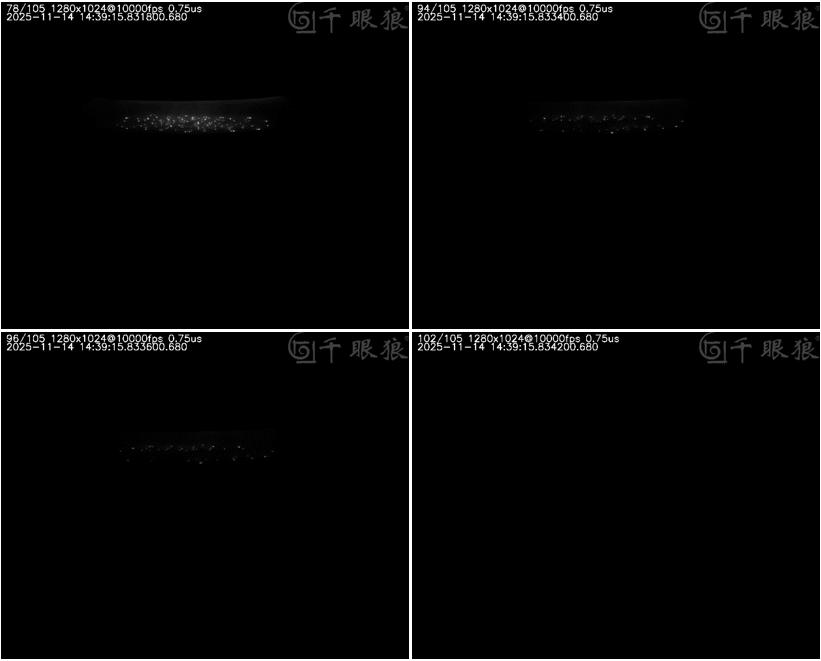
The NEO 25 ultra High-speed camera system reveals several key physical mechanisms, demonstrating why an ultra high speed video camera is indispensable for studying transient plasma phenomena and other rapidly changing physical processes.
Spot behavior is not continuous but discrete and jump-like
Radial migration dominates over axial diffusion
Localized heating governs spot re-ignition probability
Surface condition strongly influences spatial distribution
Ring formation corresponds to quasi-stable current distribution
Instability emerges during ring breakup phase
The experimental results show that cathode spot distribution directly correlates with:
Arc interruption capability
Dielectric recovery behavior
Contact erosion patterns
Therefore, the 10,000 fps Ultra High-speed Camera (NEO 25) provides a critical diagnostic tool for:
Vacuum interrupter optimization
Contact material design
Arc suppression mechanism validation
ignition → radial expansion → ring formation → fragmentation → extinction.
spot distribution patterns
arc stability behavior
insulation degradation mechanisms
vacuum arc modeling
high-voltage switching design optimization
It enables direct visualization of cathode spot formation, movement, and extinction at microsecond time scales, a capability that remains difficult to achieve with conventional high speed cameras.
NEO 25 provides high sensitivity imaging under 1 μs exposure and extreme low-light vacuum discharge conditions.
Ring-shaped cathode spot structures, radial migration dynamics, and stochastic extinction behavior.
 English
 Deutsch