A three-dimensional DIC error compensation method based on dynamic extrinsic parameter correction using rigid reference points is proposed to address the limitation of conventional static calibration models that cannot adapt to dynamic changes in camera extrinsic parameters under vibration environments. The proposed approach effectively suppresses three-dimensional measurement errors caused by vibration disturbances.
Three-Dimensional Digital Image Correlation (3D DIC) technology has been widely applied in structural mechanics experiments, material deformation analysis, and structural health monitoring of large-scale engineering systems due to its advantages of non-contact measurement, full-field observation, and high spatial resolution.
In practical engineering environments, under conditions such as mechanical vibration, structural excitation, and environmental disturbances, the supporting structure of the stereo camera system may experience slight vibrations, resulting in changes in the relative position and orientation between the left and right cameras.
Conventional 3D DIC measurements typically rely on offline stereo-system calibration performed prior to testing, assuming that both intrinsic and extrinsic camera parameters remain unchanged throughout the measurement process. However, this assumption is no longer valid in vibration environments.
Since three-dimensional coordinate reconstruction is highly dependent on the spatial geometric relationship between stereo cameras, even minor extrinsic parameter drift may be amplified through the triangulation process, resulting in significant displacement errors.
Therefore, the fundamental challenge of DIC measurements in vibration environments is that the measurement coordinate system itself undergoes dynamic variations. Real-time acquisition of the transient camera poses and compensation for extrinsic parameter variations during three-dimensional reconstruction are critical for improving the engineering applicability of DIC technology.
To address this issue, engineers from Revealer proposed a vibration-induced error suppression method for 3D DIC based on dynamic extrinsic parameter correction using rigid reference points. By introducing a reference camera and a fixed rigid-body target, the method enables frame-by-frame updating of the measurement system’s extrinsic parameters. Experimental investigations were conducted to evaluate the capability of the proposed approach in suppressing vibration-induced measurement errors.
A 3D DIC system generally consists of two measurement cameras (left and right). The three-dimensional coordinates of a spatial point are reconstructed through a stereo vision model:

Where:
XDIC represents the three-dimensional spatial coordinates reconstructed by DIC;
Triangulation(⋅) denotes the stereo triangulation function;
UL、UR represent the two-dimensional pixel coordinates of the same feature point in the left and right camera images, respectively;
KL 、KR denote the intrinsic parameter matrices of the left and right cameras;
TLR represents the extrinsic parameter matrix between the left and right cameras, describing the relative spatial position and orientation relationship within the stereo system.
Under ideal conditions, the stereo-system extrinsic parameters are obtained through calibration and remain constant throughout the experiment. However, when the camera platform is subjected to vibration excitation, transient pose variations occur at the camera nodes.
If fixed extrinsic parameters are still used for reconstruction, the motion of the cameras themselves may be incorrectly interpreted as the motion of the object under investigation, thereby introducing additional displacement errors.
The proposed method introduces an additional reference camera node into the conventional stereo DIC system.
The reference camera is rigidly connected to the measurement cameras through a high-stiffness structure while continuously observing a rigid-body target that is isolated from vibration disturbances.
Since the spatial position of the rigid-body target remains unchanged, the motion of the rigid reference points observed by the reference camera only reflects the pose variation of the camera itself.
By solving the rigid transformation relationship between the reference camera and the measurement cameras, the real-time extrinsic parameters of the measurement cameras can be obtained:
TLR( (t) = inv(Tm(R)(t)) ⋅Tm(L)(t)
Where:
TLR( (t) represents the dynamic extrinsic parameter matrix between the left and right cameras at time t;
Inv(⋅) denotes the matrix inversion operation;
Tm(L)(t) represents the real-time pose of the left camera relative to the rigid-body reference coordinate system;
Tm(R)(t) represents the real-time pose of the right camera relative to the rigid-body reference coordinate system.
The dynamically updated extrinsic parameters are then incorporated into the three-dimensional reconstruction model to obtain vibration-compensated spatial coordinates.

Finally, comparison with laser interferometer measurements is conducted:

Where:
e(t) represents the three-dimensional measurement error at time t;
XDIC(t) denotes the DIC measurement result after dynamic extrinsic parameter correction;
XLI(t) denotes the true displacement measured by the laser interferometer, which serves as the experimental reference.
o verify the effectiveness of the dynamic extrinsic parameter correction algorithm, a 3D DIC error-testing platform under vibration conditions was established.
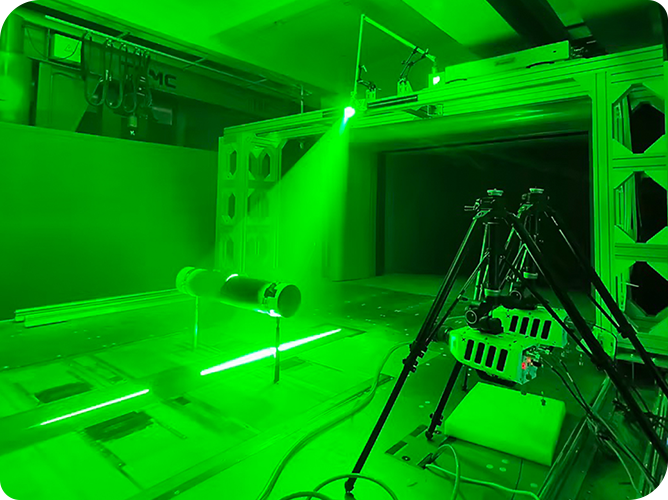
The experimental system mainly consists of a stereo DIC measurement node, a reference camera node, an electromagnetic vibration platform, a precision displacement stage, a fixed rigid-body target, and a laser interferometer.
Among them, the stereo DIC system is used to acquire speckle images of the object under investigation.
The vibration platform is employed to simulate mechanical disturbances encountered in practical engineering environments.
The reference camera is responsible for real-time tracking of the fixed rigid-body reference points.
The laser interferometer serves as a high-precision displacement measurement reference.
Two categories of experimental conditions were designed:
1. Static-Target Vibration Test
The target remains fixed while vibration excitation is applied only to the camera system.
This test is intended to analyze the influence of pure system disturbances on DIC measurement results.
2. Dynamic Displacement Test
A precision displacement stage is used to drive the target with periodic motion while camera vibration is simultaneously introduced.
This test is intended to verify the ability of the proposed algorithm to suppress disturbance-induced errors under actual dynamic measurement conditions.
Evaluation metrics include mean error, error standard deviation, and the stability of time-domain displacement curves.
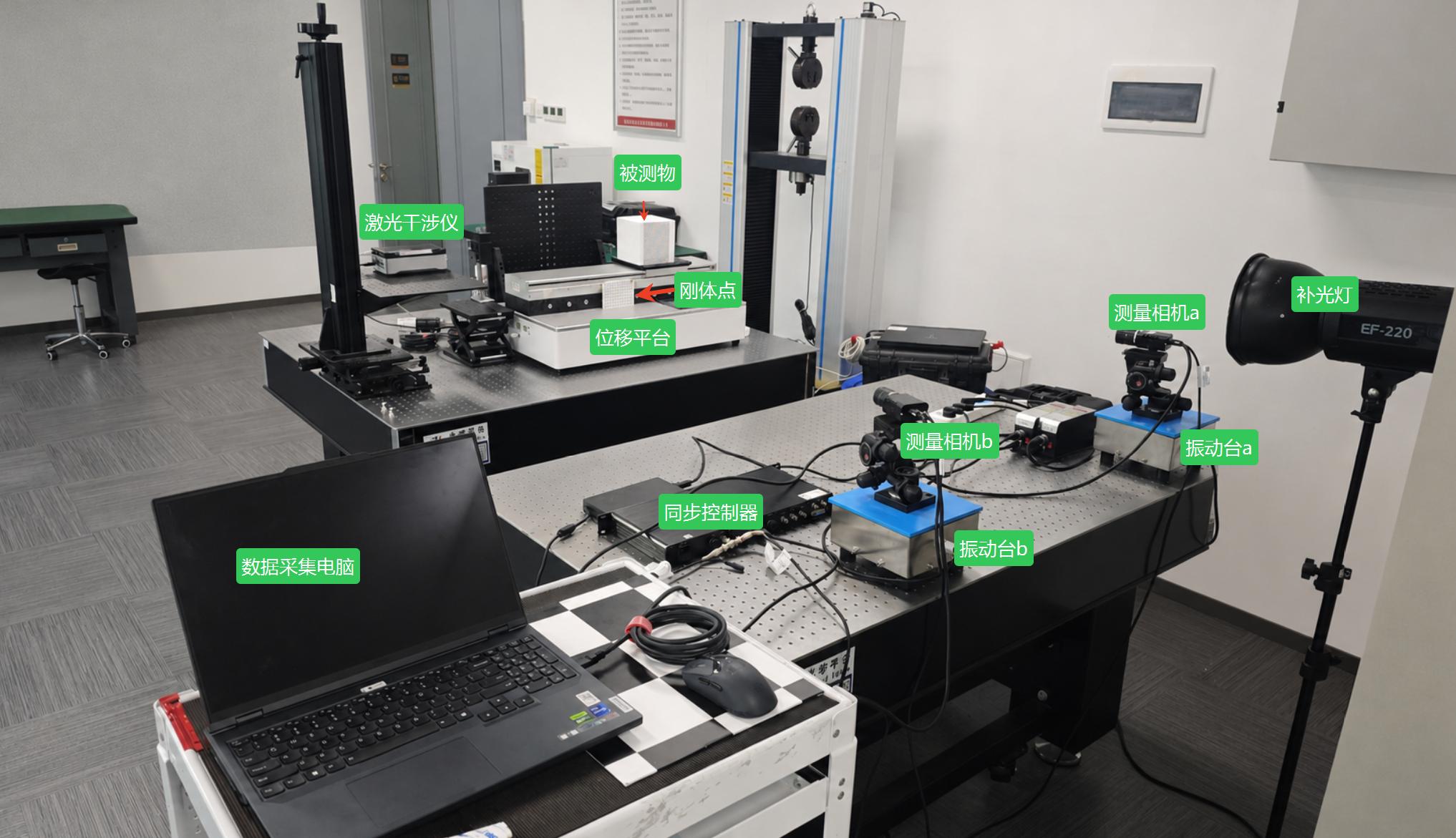
Figure 1
Under vibration-free conditions, the mean measurement error of five feature points was 0.0118 mm, with a standard deviation of 0.0057 mm.
When vibration was introduced without extrinsic parameter correction, changes in the spatial relationship of the stereo DIC system caused the mean measurement error to increase to 0.1244 mm, approximately ten times higher than that under vibration-free conditions.
After applying the dynamic extrinsic parameter correction based on rigid reference points, the mean error decreased to 0.0136 mm, while the standard deviation returned to 0.0057 mm, which is essentially consistent with the vibration-free condition.
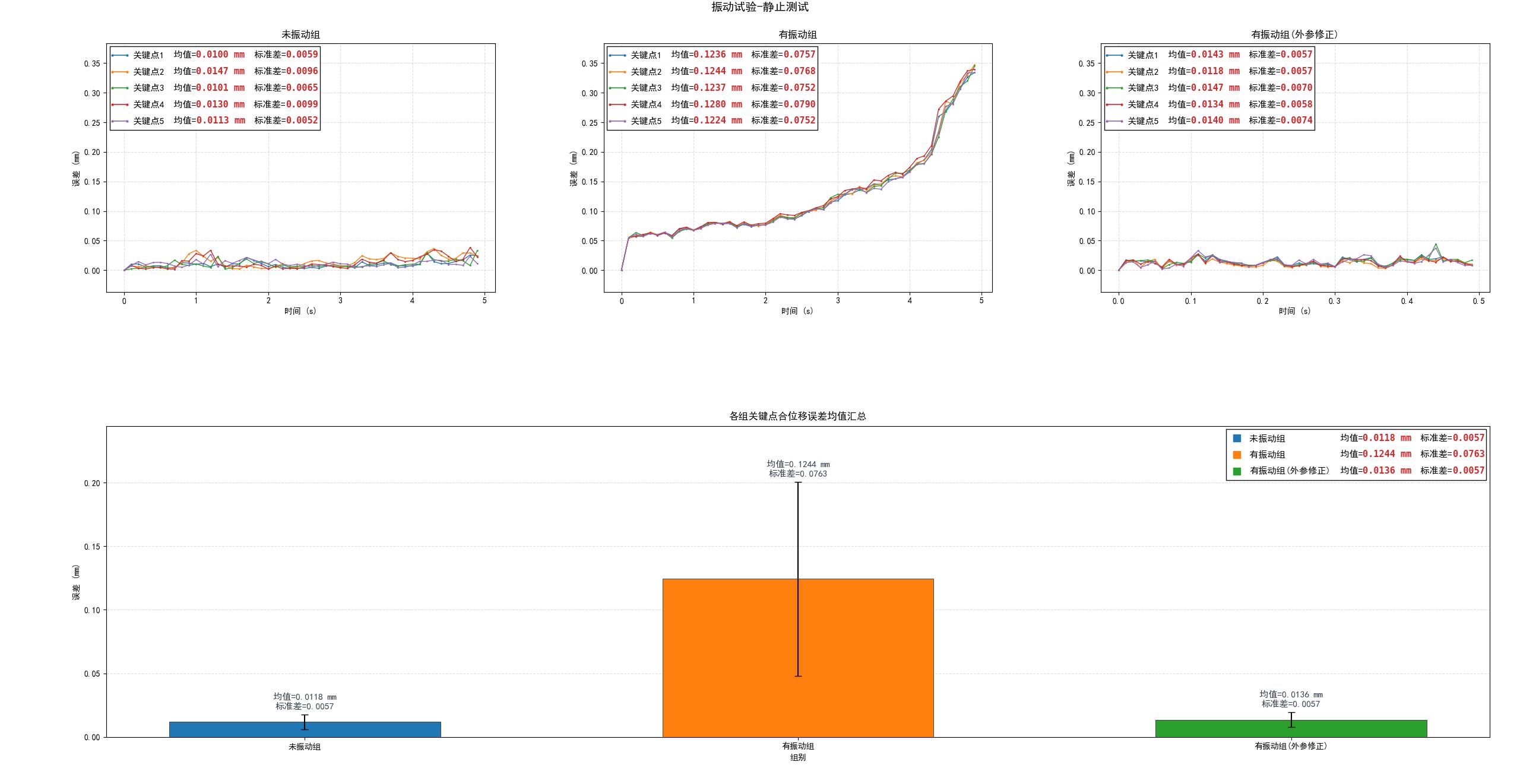
Figure 2
The results indicate that when the measured target remains completely stationary, the primary source of measurement error originates from vibration of the camera nodes.
The dynamic extrinsic parameter correction method can effectively eliminate this type of additional error.
The dynamic displacement experiment further verified the effectiveness of the proposed algorithm in real-motion measurements.
Under vibration-free conditions, the mean measurement error was 0.0275 mm.
When vibration existed without correction, the mean error increased to 0.2228 mm, and the standard deviation reached 0.2040 mm.
Significant fluctuations appeared in the time-domain displacement curve.
After enabling dynamic extrinsic parameter correction, the mean error decreased to 0.0887 mm, and the standard deviation was reduced to 0.0633 mm.
Compared with the uncorrected condition, the mean error and standard deviation were reduced by approximately 60.2% and 69.0%, respectively.
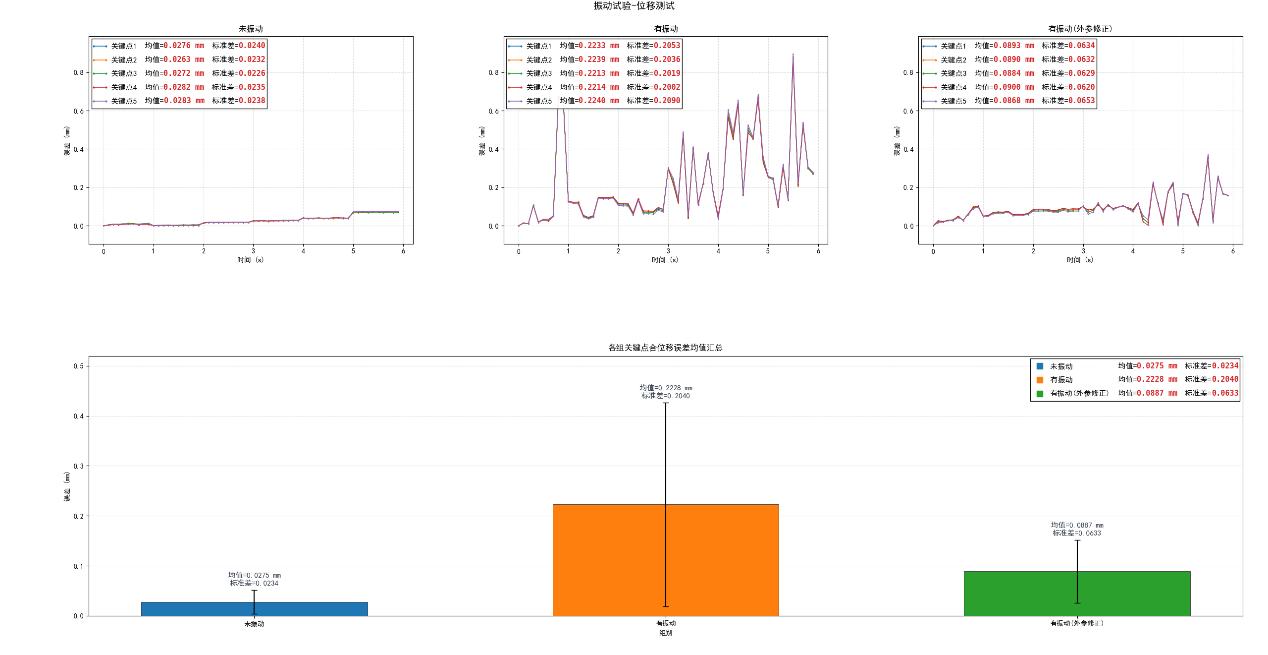
Figure 3
Although some residual errors still exist under dynamic conditions, the measurement results demonstrate that the proposed method can effectively separate actual target motion from vibration-induced system disturbances, thereby significantly improving the stability of dynamic measurements.
This paper proposes a vibration-induced error suppression method for three-dimensional DIC based on dynamic extrinsic parameter correction using rigid reference points, and its effectiveness is verified experimentally.
The major conclusions are summarized as follows:
I. In vibration environments, extrinsic parameter drift in stereo DIC systems can lead to significant three-dimensional reconstruction errors. The assumption of static extrinsic parameters is an important factor limiting engineering applications.
II. The dynamic extrinsic parameter correction method based on a reference camera and fixed rigid reference points can estimate camera pose variations in real time and effectively compensate for vibration-induced measurement errors.
III. Experimental results demonstrate that the proposed method reduces the mean measurement error under static conditions from 0.1244 mm to 0.0136 mm.
For dynamic displacement measurements, the mean error is reduced from 0.2228 mm to 0.0887 mm.
This study validates the feasibility of the dynamic extrinsic parameter correction approach for three-dimensional DIC measurements in vibration environments.
The proposed method provides a new technical pathway for extending high-precision vision-based measurement technologies from laboratory environments to complex engineering field applications.
 English
 Deutsch