A high-speed camera combined with digital image correlation (DIC) was used to continuously measure the uniaxial compressive deformation of recycled sand concrete (RSC) with different recycled sand (RS) contents and strength grades. The measured Poisson’s ratio of RSC ranged from 0.192 to 0.388. High-speed DIC further captured the evolution of full-field strain and transverse deformation from initial compaction and elastic deformation to localized strain concentration and final failure.
Recycled sand (RS) accounts for approximately 40%–60% of recycled aggregate and represents an important route for the reuse of construction and demolition waste. Compared with recycled coarse aggregate concrete, however, the influence of RS on compressive strength, deformation behavior, and the interfacial transition zone (ITZ) of concrete remains less clearly understood.
For structural analysis, compressive strength alone is insufficient to fully characterize the mechanical response of recycled sand concrete (RSC). Peak strain, elastic modulus, Poisson’s ratio, and the evolution of strain fields during failure are also required to understand its deformation and damage behavior.
Researchers from the China Academy of Railway Sciences therefore introduced a Revealer high-speed camera and DIC full-field measurement technique into uniaxial compression tests of RSC prism and cube specimens. The objective was to quantitatively characterize full-field strain evolution throughout the compression process.
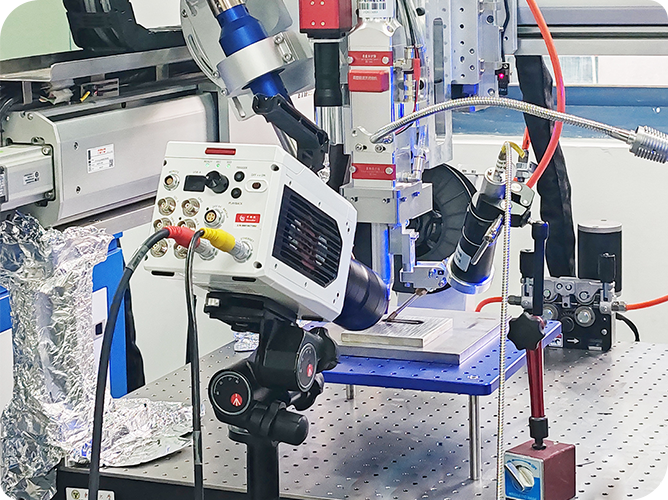
The high-speed DIC setup for RSC uniaxial compression consisted of a mechanical testing machine, a Revealer high-speed camera, and RDIC digital image correlation software.
Within the measurement chain, the high-speed camera continuously recorded the random speckle pattern on the specimen surface, while DIC analysis converted the image sequence into displacement and strain fields. This enabled longitudinal strain, transverse strain, Poisson’s ratio, and localized strain distributions to be obtained without relying solely on point-contact displacement sensors.
In the original paper, the imaging device is specified as a Revealer-Max FPS 60,000 high-speed camera. The paper does not report the actual acquisition frame rate used in this particular compression test; therefore, the camera specification should not be interpreted as the experimental frame rate.
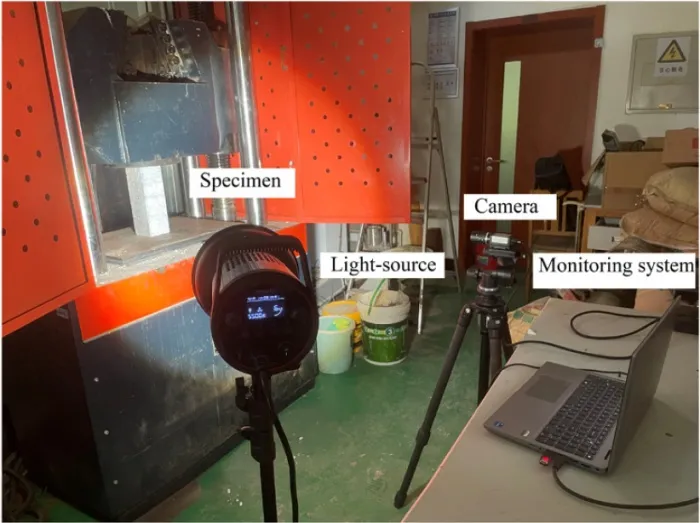
Figure 1. High-speed DIC experimental setup for uniaxial compression of recycled sand concrete, with a Revealer high-speed camera recording a random speckle pattern and RDIC software calculating full-field strain and Poisson’s ratio.
Prism and cube specimens were tested under uniaxial compression in accordance with GB/T 50081-2019.
High-speed DIC was used to continuously record surface deformation and obtain strain data during loading. A relatively uniform stress region in the center of the prism specimen was selected to evaluate the evolution of longitudinal and transverse strain, from which Poisson’s ratio was determined.
In addition to the high-speed DIC measurements, nanoscratch testing was conducted to evaluate microfracture toughness. The uniaxial compression stress–strain curves were also used to analyze total strain energy, elastic strain energy, and dissipated energy. Statistical damage theory and finite element analysis were subsequently employed to investigate constitutive behavior and the strength size effect of RSC.
The stress–strain curves obtained for different RS contents show that the influence of recycled sand on RSC mechanical behavior depends strongly on strength grade.
For C20 RSC, peak stress increased with increasing RS content. Compared with RSC20-0, the peak stresses of RSC20-50 and RSC20-100 increased by 5.9% and 17.3%, respectively.
For C40 and C60 RSC, the highest peak stresses were obtained at 50% RS. Compared with RSC40-0, the peak stress of RSC40-50 increased by 10.2%, whereas that of RSC40-100 decreased by 6.4%. Similarly, RSC60-50 increased by 10.1%, while RSC60-100 decreased by 6.4%.
Elastic modulus showed a similar trend. For C20 RSC, the elastic modulus increased by 8.7% and 12.9% at 50% and 100% RS, respectively. For C40 and C60 RSC, the modulus was generally higher at 50% RS.
These results indicate that the effect of recycled sand is not monotonic and is strongly dependent on the strength grade of RSC. Continuous strain data obtained through high-speed camera imaging and DIC analysis provided the measurement basis for determining peak strain, elastic modulus, and the complete stress–strain response.
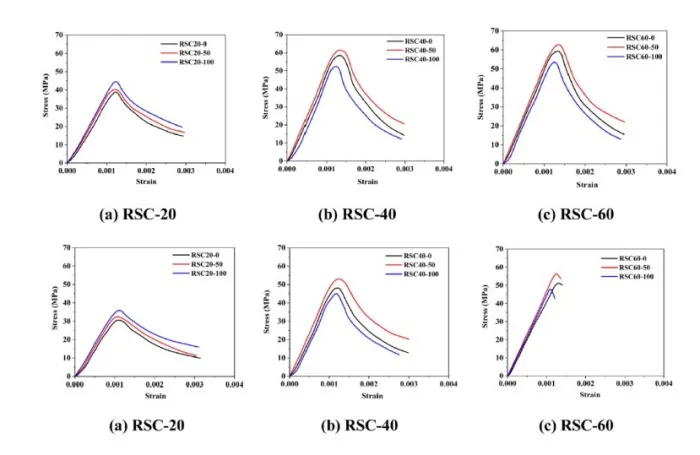
Figure 2. High-speed DIC measurement of uniaxial compression stress–strain curves for C20, C40, and C60 recycled sand concrete prism and cube specimens with 0%, 50%, and 100% recycled sand, showing differences in peak stress, peak strain, and post-peak deformation.
One of the most direct advantages of DIC in this study was its ability to simultaneously quantify longitudinal and transverse deformation.
High-speed DIC was used to monitor the central, relatively uniform stress region of the prism specimens. During the initial loading stage, the Poisson’s ratio of C20 and C40 RSC was approximately 0.2, whereas that of C60 RSC ranged from approximately 0.1 to 0.2.
Within the normalized longitudinal strain range of 0.1ε/εcr to 0.7ε/εcr, Poisson’s ratio developed relatively steadily. Once the strain exceeded 0.7ε/εcr, Poisson’s ratio increased rapidly as the specimen approached failure.
The measured Poisson’s ratio of all RSC groups ranged from 0.192 to 0.388, indicating more pronounced transverse deformation than the typical Poisson’s ratio of approximately 0.2 for ordinary concrete.
Poisson’s ratio generally decreased as the strength grade increased. For C20 RSC, it increased with increasing RS content, whereas C40 and C60 RSC exhibited their lowest Poisson’s ratios at 50% RS.
Compared with conventional point-based axial displacement measurement, a Revealer high-speed camera combined with DIC allows longitudinal and transverse strains to be extracted from the same image sequence, providing quantitative information on lateral expansion and Poisson’s ratio during the approach to failure.
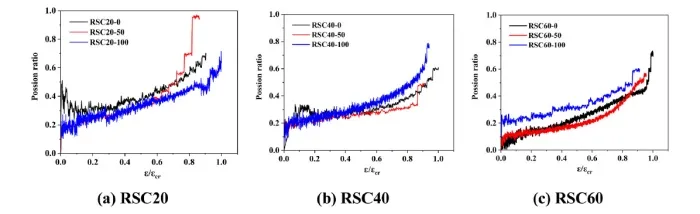
Figure 3. High-speed DIC measurement of Poisson’s ratio evolution in C20, C40, and C60 recycled sand concrete with different recycled sand contents, showing a Poisson’s ratio range of 0.192–0.388 and rapid transverse deformation near failure.
Beyond individual strain values, DIC provides a spatially continuous strain field over the specimen surface.
Based on the stress–strain response and longitudinal strain fields, the uniaxial compression process of RSC was divided into four stages.
Stage I — Initial crack closure. Existing microcracks gradually closed during initial loading. Frictional restraint from the loading platens caused non-uniform strain near the specimen ends, while the central region remained relatively uniform.
Stage II — Linear elastic deformation. The overall deformation remained comparatively uniform, with limited formation of new cracks and relatively low energy dissipation.
Stage III — Rapid crack propagation. Local strain began to concentrate in weaker regions, accompanied by accelerated crack development and increasing dissipated energy.
Stage IV — Crack coalescence and failure. After peak stress, high-strain regions further developed into an inclined localized band. Cracks progressively coalesced, ultimately resulting in specimen failure.
The full-field strain maps therefore represent a direct outcome of converting continuous high-speed images into quantitative DIC data. They link individual stages of the macroscopic stress–strain curve to the spatial development of strain localization on the specimen surface.
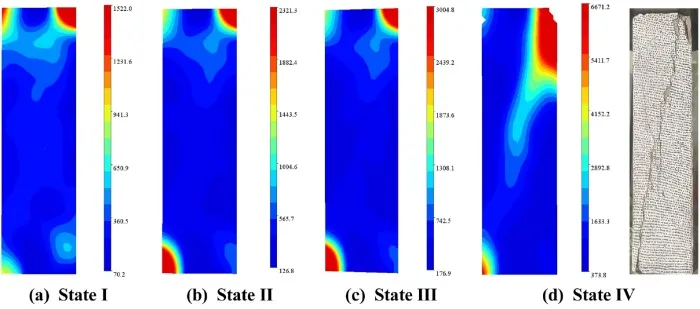
Figure 16. Revealer high-speed camera and high-speed DIC measurement of longitudinal full-field strain in recycled sand concrete under uniaxial compression, showing initial crack closure, linear elastic deformation, localized strain concentration, crack propagation, and formation of an inclined failure band.
1) The effect of recycled sand on RSC under uniaxial compression depends strongly on strength grade. Peak stress and elastic modulus of C20 RSC increased with increasing RS content, while C40 and C60 RSC showed more favorable mechanical responses at 50% RS. The measured Poisson’s ratio ranged from 0.192 to 0.388, indicating pronounced transverse deformation.
2) The Revealer high-speed camera and high-speed DIC enabled non-contact, full-field deformation measurement throughout the compression process. Continuous speckle images were converted by DIC into longitudinal strain, transverse strain, Poisson’s ratio, and full-field strain distributions. As loading progressed, deformation evolved from a relatively uniform state to localized strain concentration, followed by the formation of a distinct inclined high-strain region after peak stress.
3) High-speed DIC provided the macroscopic deformation data required for further interpretation of RSC failure behavior. Combined with ITZ microfracture toughness, energy-damage analysis, and size-effect evaluation, the study established a multiscale description of RSC bearing capacity, localized deformation, and failure. The Carpinteri size effect law achieved correlation coefficients above 0.95 for RSC specimens with different height-to-thickness ratios.
Overall, the study demonstrates that a high-speed camera combined with DIC can extend RSC uniaxial compression testing beyond conventional global mechanical parameters to simultaneous characterization of longitudinal strain, transverse strain, Poisson’s ratio, and full-field strain localization.
 English
 Deutsch