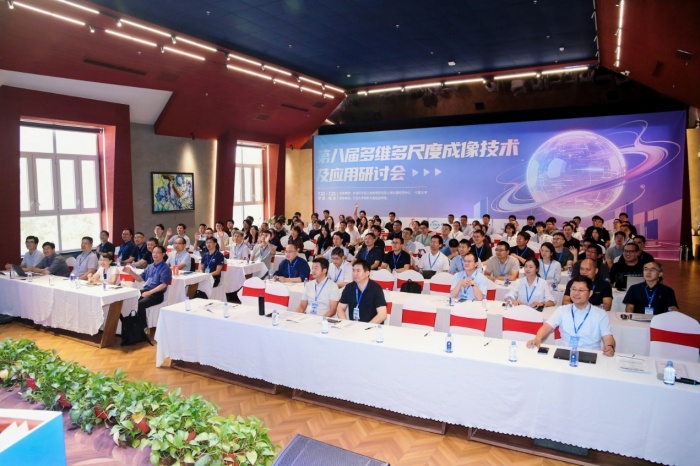
From July 22 to 25, 2026, the 8th Symposium on Multidimensional and Multi-scale Imaging Technology and Applications was convened in Yinchuan, Ningxia. Jointly hosted by the Shanghai Synchrotron Radiation Facility (SSRF) Science Center of the Shanghai Advanced Research Institute, Chinese Academy of Sciences, and Ningxia University, the conference centered on exchanges regarding advanced light source imaging technology and applications. It focused on the development of advanced imaging technologies such as synchrotron radiation, X-ray Free Electron Lasers (X-FEL), and neutron sources, as well as their innovative applications in materials science, energy, biomedicine, and pharmaceuticals.
With the development of advanced light sources, microscopic optics, and computational imaging technology, modern scientific research is gradually moving from traditional two-dimensional structural observation to multidimensional, multi-scale, and dynamic characterization. Core requirements all point to higher temporal resolution, lower noise, higher dynamic range, and stronger data synchronization capabilities.
Under this trend, as the information gateway of the imaging system, the performance of the detector directly impacts whether accurate interpretation can be achieved. For scenarios involving high-speed dynamic processes, weak signal detection, and quantitative measurement, traditional CCD cameras face limitations in readout speed, noise control, quantum efficiency, and synchronous acquisition capabilities. In contrast, scientific-grade sCMOS cameras, with their high quantum efficiency, low readout noise, large-area arrays, and high-speed parallel readout capabilities, are becoming key detection units in multidimensional and multi-scale imaging systems.
The development of multidimensional and multi-scale imaging technology is essentially a comprehensive expansion of spatial scale, temporal scale, and information dimensions. However, as experimental subjects shift from static structures to dynamic mechanisms, the challenges facing imaging systems have become more complex.
In the field of materials, synchrotron radiation X-ray imaging has already enabled in-situ observation of microstructures, defect evolution, and internal dynamic behaviors. Such research requires the imaging system to maintain stable data acquisition capabilities in high-energy radiation environments while simultaneously accommodating high-speed dynamic changes and weak signal responses.
In the field of life sciences, Quantitative Phase Imaging (QPI) is becoming an important technical path for label-free live-cell research. This method achieves quantitative analysis of cell refractive index, optical thickness, and dry mass distribution by measuring changes in Optical Path Difference (OPD). However, traditional Spatial Light Interference Microscopy (SLIM) technology typically relies on multi-frame phase-shift acquisition, requiring continuous exposures to obtain complete phase information. When the research subject enters a millisecond-scale dynamic change process, the temporal dislocation caused by multi-frame acquisition limits measurement accuracy.
Therefore, the core contradiction in the current field of multidimensional and multi-scale imaging has shifted from “increasing magnification” to “how to achieve high-speed, low-noise, synchronous, and quantitative data acquisition under limited photon conditions.” Detector performance has become a crucial link between optical systems and scientific data.
Addressing the detection performance requirements of multidimensional and multi-scale imaging, scientific-grade sCMOS cameras have gradually become an important component of advanced imaging systems.
Compared to traditional CCD cameras, sCMOS cameras adopt a large-scale pixel-level parallel readout structure, achieving higher data acquisition rates while maintaining high quantum efficiency and low noise characteristics. The technical advantages are mainly reflected in three aspects:
First, the high-speed parallel readout capability enables sCMOS to adapt to the observation needs of rapid dynamic processes. In experiments requiring the capture of millisecond or even microsecond-level changes, a high frame rate not only means more image data but also implies the ability to reduce the time sampling interval, enhancing the capability to resolve dynamic processes.
Second, low readout noise and high quantum efficiency improve weak light signal detection capabilities. In applications such as synchrotron radiation imaging, fluorescence microscopy, and interferometry, experimental signals are often limited by the number of photons, and detector noise directly affects the final measurement sensitivity.
Third, the large-area array design can balance spatial resolution and experimental efficiency. For multi-window, multi-channel, and multi-region synchronous acquisition tasks, large-size sensors can reduce system complexity and improve the utilization rate of valid data.
In multidimensional and multi-scale imaging applications, sCMOS cameras have transformed from traditional “image recording devices” into core detection nodes that determine experimental temporal resolution, measurement sensitivity, and data reliability.
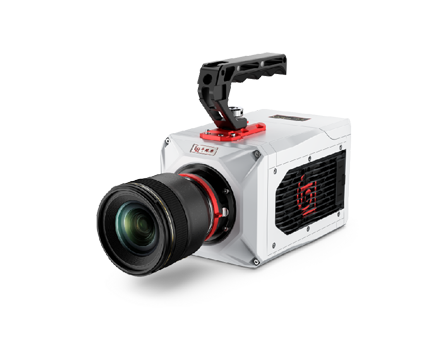
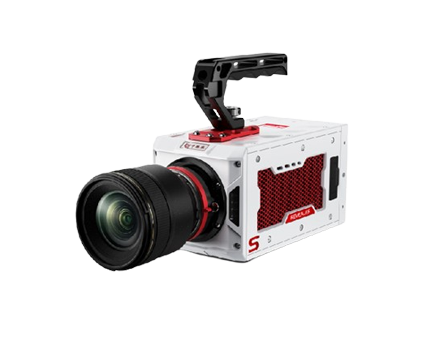
In the field of quantitative phase imaging, a research team from Shenzhen University addressed the issue of limited temporal resolution caused by multi-frame phase-shift acquisition in traditional SLIM systems. They constructed a SE-SLIM system based on single-exposure parallel four-step phase shifting and employed the Revealer Gloria 4.2 sCMOS camera (featuring 2048×2048 pixel resolution, 6.5 μm pixel size, 135 fps full-frame acquisition capability, and 95% QE) as the core acquisition unit to achieve synchronous acquisition of four-channel phase-shift information.
The single-exposure parallel acquisition mode based on the Gloria 4.2 sCMOS camera places the four phase-shift images on the same time basis, realizing truly synchronous time sampling and improving dynamic measurement reliability from the data source. Experimental results show that compared to the traditional multi-frame acquisition method, this approach improves temporal resolution by approximately 4 times.
Research indicates that in high-speed quantitative phase imaging systems, sCMOS cameras not only undertake data acquisition tasks but also serve as key technical nodes for achieving single-exposure phase retrieval and dynamic cell measurement.
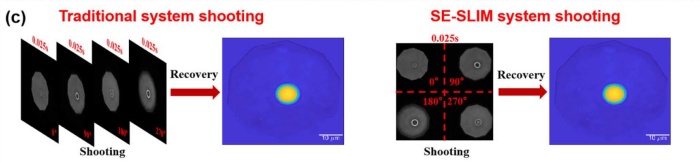
*Figure 1: Parallel four-step phase-shift acquisition mechanism based on single exposure with an sCMOS camera. Compared to the traditional SLIM system which completes four phase-shift exposures sequentially, SE-SLIM utilizes the large-area array parallel readout capability of sCMOS to synchronously acquire 0°, 90°, 180°, and 270° four-channel interference information under the same time basis. This improves temporal resolution by approximately 4 times and reduces phase reconstruction errors caused by dynamic sample motion.*
In X-ray scintillator imaging experiments, researchers from the Xi’an Institute of Optics and Precision Mechanics (XIOPM) utilized an sCMOS camera to conduct weak light signal acquisition. They obtained imaging results under different exposure times using high-speed and high-gain modes. Experimental data shows that under different exposure conditions such as 20 ms, 10 ms, 1 ms, and 30 ms, the sCMOS camera was able to successfully record X-ray scintillator images and achieve high signal-to-noise ratio performance.
During the X-ray scintillator imaging process, X-rays are first converted into visible light by the scintillator, and then the light signal is collected by the camera. Since the converted light signal is usually weak, the quantum efficiency, readout noise, and high-speed acquisition capability of the detector directly affect the final image quality.
With the advantages of low noise, high sensitivity, and high-speed readout, sCMOS cameras can maintain effective signal acquisition capabilities within short exposure times, providing a reliable data acquisition foundation for applications such as synchrotron radiation imaging, high-energy radiation detection, and dynamic X-ray imaging.
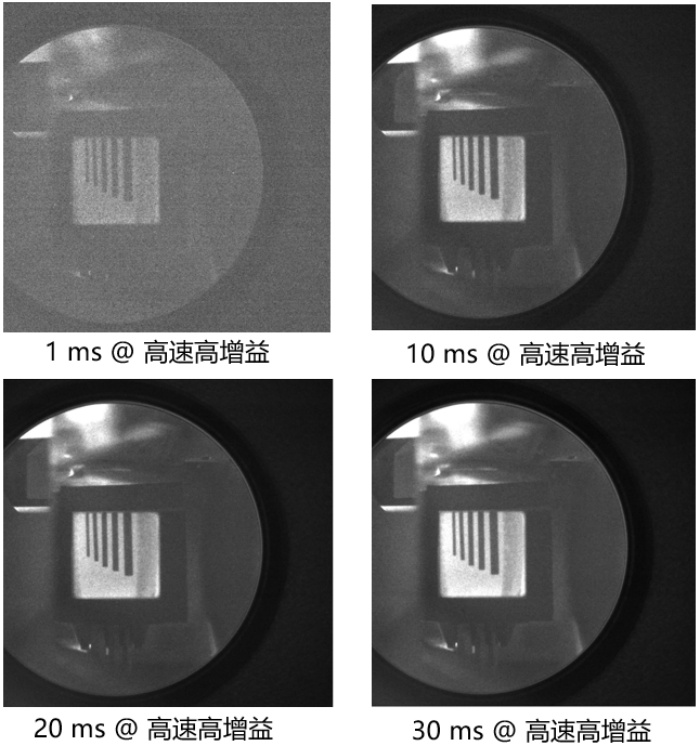
*Figure 2: sCMOS camera used for X-ray scintillator imaging, acquiring weak light images at exposure times of 1 ms, 10 ms, 20 ms, and 30 ms respectively in high-speed high-gain mode.*
The development of multidimensional and multi-scale imaging technology is essentially a process of scientific research moving from structural observation to mechanism analysis. In this process, high-performance detectors play an important role in connecting experimental phenomena with scientific laws.
Through high-speed parallel readout, low-noise detection, high quantum efficiency, and large-area array imaging capabilities, Revealer sCMOS cameras provide a new technical path for advanced light source imaging, microscopic imaging, and dynamic process observation, promoting multi-scale imaging into the dynamic quantitative stage.
 English
 Deutsch