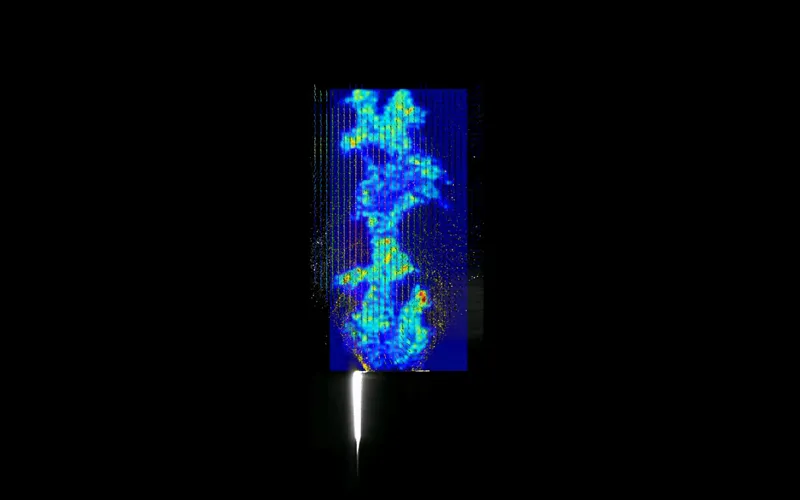
A Revealer high-speed DIC system combined with acoustic emission monitoring was used in staged creep tests on rock specimens with different levels of initial damage. The results show that surface deformation in different regions progressively evolves from coordinated to non-coordinated behavior. The deformation difference coefficient derived from DIC exhibits a distinct stage transition, providing surface-deformation precursor information for the evolution of rock from localized damage to macroscopic instability.
Seismic loading can generate cracks, pores, and other forms of initial damage within rock masses. Subsequent long-term wetting–drying cycles and sustained loading further promote damage accumulation, causing the rock mass to gradually develop creep deformation and progressive failure.
For soft–hard interbedded rock masses, the mechanical response is more complex. Because the soft and hard rock layers differ markedly in elastic modulus, strength, and deformation capacity, stress concentration can readily develop near the interfaces. Progressive failure therefore does not necessarily occur simultaneously throughout the specimen, but often begins with localized damage, deformation concentration, and crack propagation.
Conventional axial-displacement measurements can characterize the overall creep deformation of a specimen, but they provide limited information on whether different locations deform synchronously, where localized deformation first develops, and when local anomalies begin to evolve toward macroscopic failure.
To address these issues, the research team introduced acoustic emission monitoring and a high-speed DIC system into staged creep testing. Acoustic emission (AE) was used to characterize internal microcrack activity, while DIC was used to obtain the surface displacement field and quantify deformation differences among different regions, thereby examining progressive rock failure from the complementary perspectives of internal damage and external deformation.
The experimental system consisted of a rock mechanics testing machine, a multichannel acoustic emission system, a Revealer high-speed DIC system, and microscopic characterization equipment such as SEM.
The Revealer high-speed DIC system was used to measure the full-field surface deformation of the rock specimens. The system consisted of a high-speed camera, LED illumination, digital image correlation software, and a data-processing computer.
The high-speed camera served as the image-acquisition unit of the DIC system. In this experiment, images were acquired at a resolution of 1280 × 1024 pixels and an acquisition frequency of 40 Hz. Five monitoring zones, Z1–Z5, were defined sequentially from top to bottom along the axial direction of the specimen to extract the maximum axial displacement and its temporal evolution in different regions.
Compared with conventional contact-based single-point displacement measurement, DIC can derive non-contact, full-field, and time-resolved surface deformation information from continuous image sequences. This enables quantitative analysis of localized deformation concentration, inter-regional deformation mismatch, and the evolution of spatial non-uniformity as failure approaches.
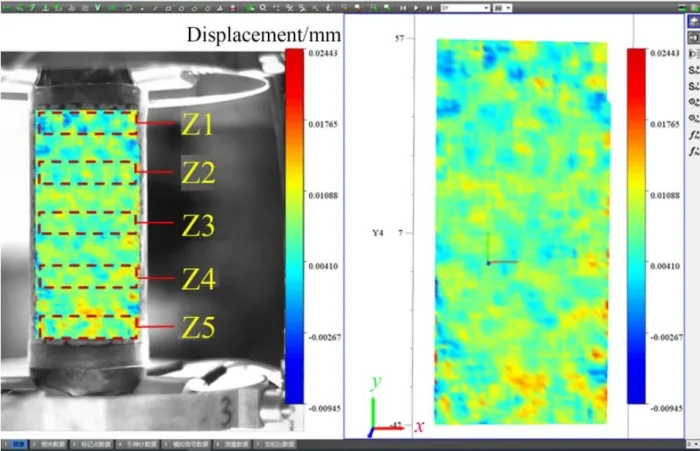
Figure 1. Revealer high-speed DIC system measuring the full-field surface deformation of a soft-hard interbedded rock specimen, with Z1–Z5 axial displacement monitoring zones used to analyze localized non-uniform creep deformation.
The investigated materials included metasandstone specimens (MR), phyllite specimens (PR), and metasandstone–phyllite interbedded composite specimens (IR). All specimens were prepared as standard cylinders with a diameter of 50 mm and a height of 100 mm.
Different numbers of cyclic loading–unloading cycles were first applied to simulate mechanical damage induced by seismic disturbance. The specimens were then subjected to 10, 20, or 30 wetting–drying cycles to simulate further degradation caused by periodic water-environment exposure. Staged creep tests were subsequently conducted on specimens with different initial damage levels.
At each stress level, the applied creep stress was maintained for 8 h before the stress was increased to the next level. Loading continued stepwise until specimen failure. The initial damage level was characterized according to the change in P-wave velocity before and after damage.
During creep testing, the loading system recorded the overall mechanical response, the AE system characterized internal microcrack activity, and the Revealer high-speed DIC system synchronously acquired surface speckle images and calculated the full-field displacement. The maximum axial displacement was extracted from regions Z1–Z5 to investigate the spatial differences in localized deformation and their evolution throughout the creep process.
As creep stress increased, the axial deformation of MR, PR, and IR specimens increased and their creep rates accelerated. At the same stress level, specimens with greater initial damage exhibited more pronounced creep deformation, lower creep-failure stress, and shorter total creep-failure time.
The overall creep curves demonstrate progressive damage acceleration. However, overall axial displacement alone cannot determine where localized damage develops or how it evolves spatially.
This is where full-field DIC measurement provides additional information beyond conventional global displacement data.
The high-speed DIC system was used to extract the maximum axial displacement from the five monitoring regions Z1–Z5.
At the early stage of creep, displacement differences among the regions were relatively small. As loading continued, the regional displacement responses progressively diverged, indicating that the specimen surface evolved from relatively coordinated deformation toward pronounced spatially non-uniform deformation.
This result indicates that a clear spatial localization process occurs beneath the macroscopic creep response. DIC can transform regional deformation mismatch—which is difficult to identify using conventional overall-displacement measurements—into quantitative data containing both temporal and spatial information.
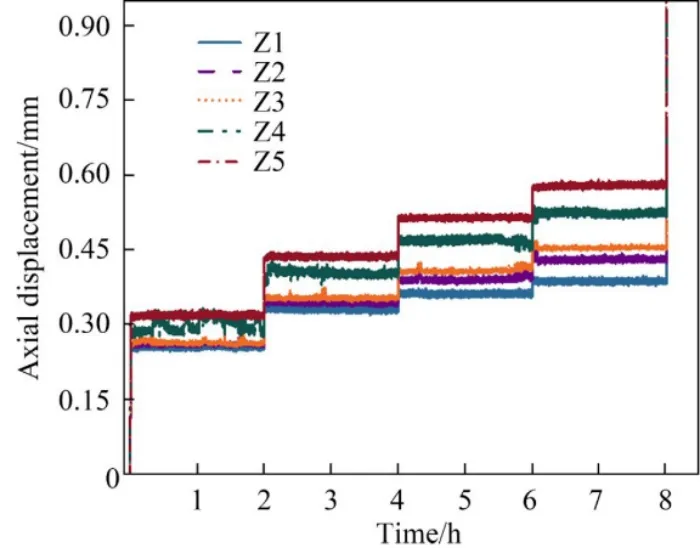
Figure 2. Revealer high-speed DIC measurement of maximum axial displacement in Z1–Z5 regions of a soft-hard interbedded rock specimen during creep, showing progressive regional displacement divergence and surface deformation localization.
To further quantify non-coordinated deformation among different regions, a deformation difference coefficient was established from the maximum axial displacements measured in regions Z1–Z5, allowing comparison of the relative surface displacement among different specimen locations.
The DIC measurements show that this parameter exhibits a distinct three-stage evolution.
In Stage I, deformation among the monitoring regions remains relatively synchronized and regional deformation differences are limited.
In Stage II, the regional deformation differences progressively increase, indicating enhanced localization of surface deformation.
In Stage III, deformation in localized regions accelerates again and the deformation difference coefficient increases markedly. At this stage, accumulated internal microcracks begin to coalesce, localized deformation intensifies, and the specimen approaches a critical failure condition.
The transition of the DIC-derived deformation difference coefficient from a decreasing to an increasing trend can therefore serve as an important surface-deformation precursor indicator of impending rock instability.
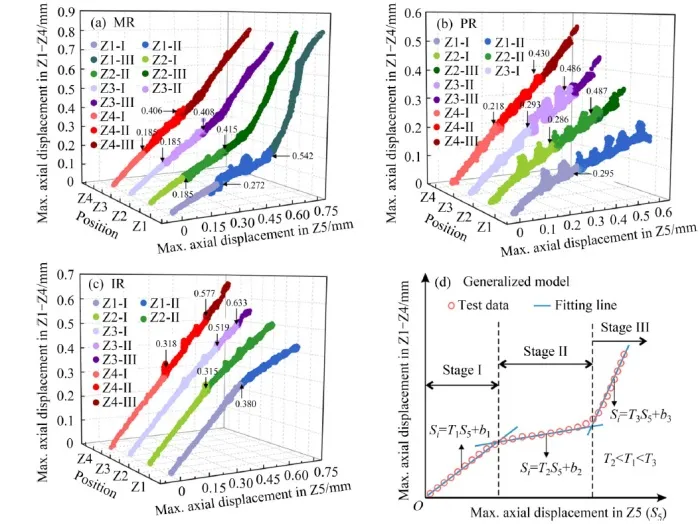
Figure 3. Revealer high-speed DIC analysis of regional maximum axial displacement and three-stage deformation difference coefficient evolution in metasandstone, phyllite, and soft-hard interbedded rock, with the Stage II-to-Stage III transition indicating localized deformation acceleration and approaching macroscopic failure.
DIC measures the full-field surface deformation of a rock specimen, whereas acoustic emission records elastic-wave signals released by internal microcrack activity. The two techniques therefore characterize different physical aspects of the failure process.
The AE results show that internal crack activity increases as creep stress rises, accompanied by an increase in the proportion of high-frequency AE events. Near failure, high-RA/AF events become more frequent and shear-fracture activity increases significantly.
At the same time, DIC reveals increasing differentiation among surface deformation regions and a stage transition in the deformation difference coefficient as failure approaches.
Combining the two methods enables rock-failure precursors to be investigated from multiple perspectives, including internal damage, apparent surface deformation, and spatiotemporal evolution.
In this sense, the experimental evidence forms a coherent progression:
initial damage accumulation → intensified internal microcrack activity → increasing surface deformation localization → transition in the DIC-derived deformation difference coefficient → crack coalescence → macroscopic instability.
1) Initial damage significantly intensifies the long-term creep behavior of rock. With increasing initial damage, creep deformation and steady-state creep rate increase, total creep-failure time decreases, and long-term strength declines. The influence of initial damage becomes more pronounced at higher creep stress levels.
2) DIC reveals localized non-coordinated deformation that cannot be directly identified from global creep curves. Different monitoring regions progressively evolve from relatively synchronized deformation toward clear divergence. The deformation difference coefficient shows a distinct stage evolution, and its transition from a decreasing to an increasing trend provides an important surface-deformation precursor of approaching macroscopic instability.
3) DIC and AE provide complementary external and internal characterization of progressive rock failure. The Revealer high-speed DIC system provides non-contact, full-field surface deformation information, while AE characterizes internal crack activity. Together, the two techniques provide experimental evidence for long-term stability assessment and instability-precursor studies of soft–hard interbedded rock masses.
 English
 Deutsch