Research on internal flows in pumps and fans is advancing beyond steady-state performance evaluation toward unsteady, three-dimensional, multiphase, and multi-source synchronized measurements. For rapidly evolving processes such as tip-leakage vortices, rotating wakes, cavitation clouds, and flow separation, high-speed cameras provide time-resolved transient images, while particle image velocimetry (PIV) further converts tracer-particle motion into velocity fields and derived flow quantities. Drawing on frontier topics in rotating machinery highlighted at the 9th International Conference on Pumps and Fans (ICPF 2026), together with a Revealer 3D3C-PIV experiment on the air flow field of miniature rotating machinery, this article discusses the technical value of Revealer high-speed cameras and PIV for experimental studies of complex rotating flows.
The 9th International Conference on Pumps and Fans (ICPF 2026) was recently held in Lanzhou, China. Co-hosted by Lanzhou University of Technology and Tsinghua University, the conference covered theoretical research, design methods, experiments and numerical simulations, performance characteristics, mechanical dynamics, cavitation, digitalization, and intelligent technologies for pumps, compressors, and fans, as well as key components including impellers, guide vanes, diffusers, nozzles, valves, bearings, and seals.

Figure 1. ICPF 2026, the 9th International Conference on Pumps and Fans. The conference focused on internal flows, cavitation, and experimental measurement in pumps, fans, and rotating machinery.
The conference topics show that current research is no longer limited to mean quantities such as head, pressure rise, and efficiency, but is extending toward the mechanisms governing internal flow. How do tip-leakage vortices form, develop, and become unstable? How does the jet-wake structure at an impeller outlet evolve? How do cavitation inception, cloud growth, and shedding alter the local flow field? How do boundary-layer separation and rotating stall affect pressure pulsations, noise, and operating stability?
Internal flows in pumps and fans are characterized by confined geometries, high-speed impeller rotation, steep near-wall gradients, and the coexistence of multiscale structures. The main experimental challenges are as follows:
Temporal resolution and image quality: As rotational speed increases, the characteristic timescales of tip vortices, shed vortices, and cavitation structures decrease substantially. Increasing frame rate alone does not automatically ensure PIV image quality; laser pulse width, inter-pulse delay, and particle displacement must also be considered simultaneously.
Spatial resolution and measurement range: Tip clearances, near-wall boundary layers, and miniature impellers require a small field of view and high magnification. However, reducing the field of view increases the difficulty of optical arrangement and calibration.
Two-dimensional projection versus three-dimensional flow: Two-dimensional imaging with a single high-speed camera can miss out-of-plane velocity components and spatial vortex systems. For flows involving swirl, superposed jets, and tip leakage, a two-dimensional slice may be insufficient to explain the actual transport mechanisms.
Visualization versus quantification: High-speed image sequences can reveal cavitation-cloud shedding, bubble breakup, and flow separation, but without parameters such as velocity, vorticity, turbulent kinetic energy, or Reynolds stresses, it is difficult to establish quantitative relationships between flow structures and efficiency loss, noise, vibration, or loading.
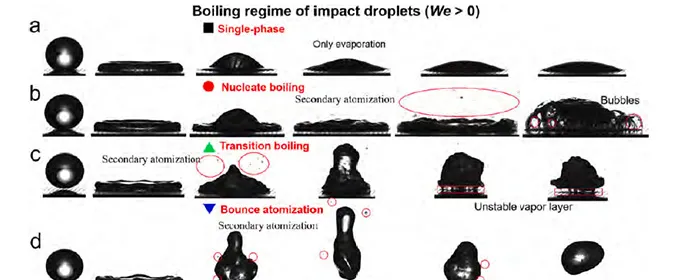
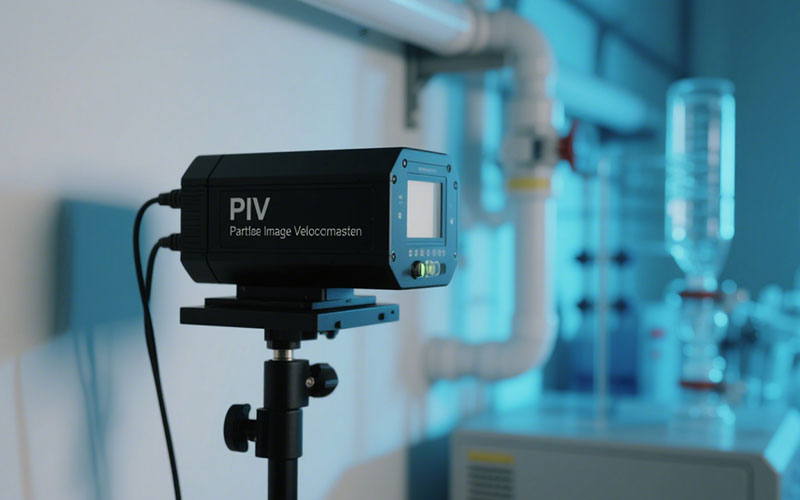
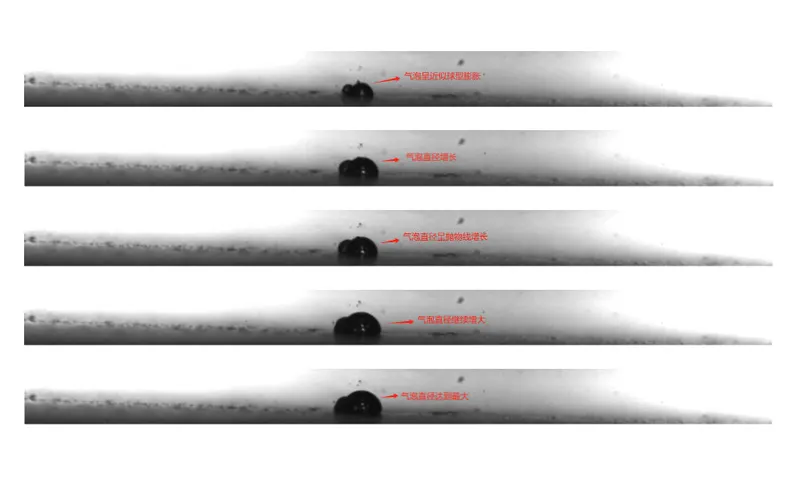
A PIV system for rotating machinery typically includes PIV high-speed cameras, a pulsed laser, a synchronization controller, sheet-illumination or volumetric-illumination optics, tracer particles, a calibration target or calibration device, and PIV analysis software. High-speed cameras primarily record “what happened,” such as cavitation inception and cloud shedding, bubble coalescence and breakup, droplet impact, blade motion, jet oscillation, and fault transients. PIV determines velocity vectors from particle displacements between image pairs and can further derive vorticity, shear rate, turbulent kinetic energy, Reynolds stresses, and three-dimensional vortex structures, thereby answering “how fast the fluid moves, in what direction, and in what flow structure.”
Measurement Mode | Output | Research Focus | Key Constraints |
High-speed imaging | Continuous transient image sequences | Temporal evolution of cavitation, bubbles, droplets, flow separation, and component motion | Illumination, exposure time, depth of field, triggering, and storage bandwidth |
PIV | Velocity vectors and derived flow-field quantities | Velocity distribution, vortex structures, shear layers, turbulence statistics, and transport mechanisms | Seeding, laser illumination, calibration, pulse interval, and correlation algorithms |
Synchronized measurement | Images and flow fields on a common time base | Causal correspondence between transient phenomena and velocity fields, pressure, or vibration signals | Common clock, phase reference, coordinate registration, and uncertainty management |
A research team at the University of Science and Technology of China conducted experiments on miniature rotating machinery under low-Reynolds-number conditions. The test objects included a miniature propeller and a gyroscope-like helical rotating specimen. The study focused on tip vortices, root vortices, wake structures, local flow separation, and the coupling between a central jet and the surrounding rotating flow during high-speed rotation. Although these test objects are not pump or fan impellers in the conventional sense, their measurement challenges are clearly shared by small high-speed rotating machinery: small physical scale, high rotational speed, strongly three-dimensional flow, and short vortex-structure lifetimes.
Accordingly, this experiment is better regarded as a methodological case study of 3D3C-PIV measurement for complex rotating flows. Its optical design, synchronization method, and multi-camera measurement approach provide methodological reference for local flow-field experiments in pumps and fans.
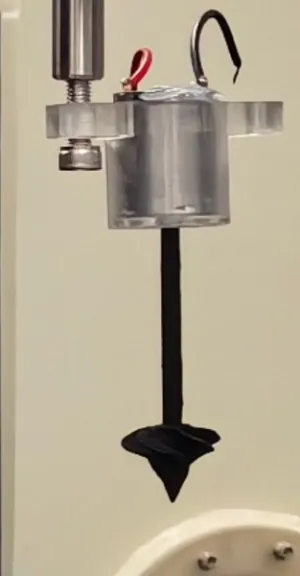
Figure 2. Miniature rotating-machinery specimen used in the Revealer 3D3C-PIV experiment to investigate jets, swirling flow, wakes, and local flow-separation structures under high-speed rotation.
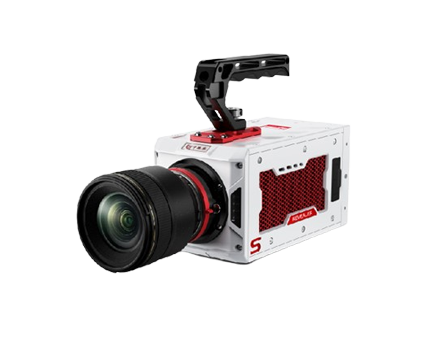
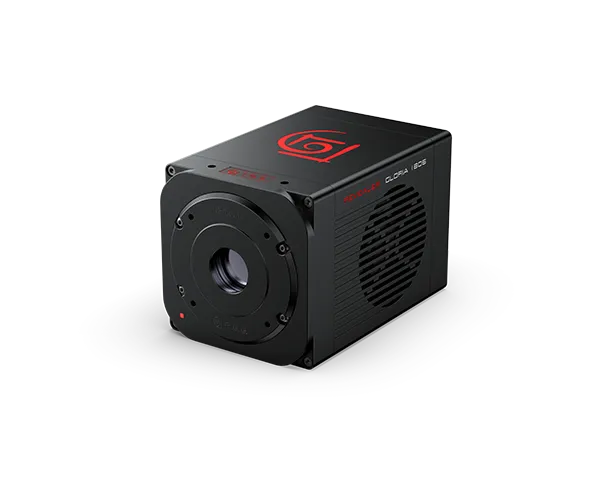
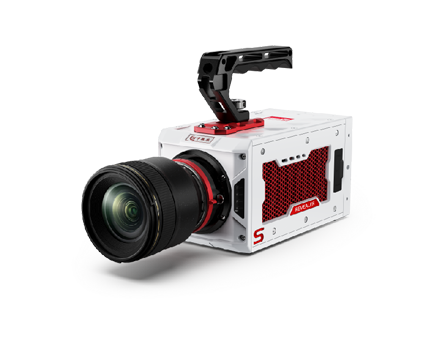
The experiment used four Revealer NEO25M high-speed cameras to form a multi-view 3D3C-PIV acquisition array.
Each camera provided a resolution of 1280 × 1024 pixels and a full-resolution acquisition rate of 25,000 fps. The acquisition frame rate used in this experiment was 20,000 fps.
Illumination was provided by a 30 mJ high-frequency dual-pulse laser. The setup also included 100 mm F2.8 macro lenses, 532 nm narrowband filters, a synchronization controller, and a spray-based tracer-particle generator suitable for low-speed air flows. The effective measurement field of view was 30 mm × 30 mm. The high-speed cameras, laser, and rotating mechanism were jointly controlled so that particle images from different viewing angles were acquired on a common time base.
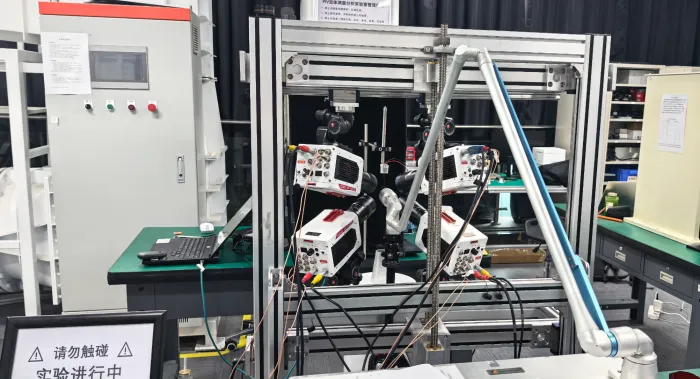
Figure 3. Miniature rotating-machinery 3D3C-PIV system comprising four Revealer NEO25M high-speed cameras and a 30 mJ high-frequency dual-pulse laser for three-dimensional flow-field measurement.
For small-field-of-view 3D3C-PIV, the key requirement is to obtain raw particle images that are correlatable, calibratable, and consistent across viewing angles. The tracer particles must provide sufficient contrast in every view; specular laser reflections from reflective surfaces must be controlled; and effective signal levels must be improved through macro optics and narrowband filtering. The dual-pulse interval is set according to the local velocity range so that particle displacement remains appropriate for correlation analysis.
On this basis, multi-camera calibration establishes the mapping between image planes and physical space, followed by image preprocessing, correlation calculation, outlier-vector rejection, and three-dimensional velocity-field reconstruction. Derived quantities such as vorticity, turbulent kinetic energy, and Reynolds stresses are then calculated according to the research objective, while vortex-identification criteria are used to extract vortex-core position, scale, and trajectory. For periodically operating rotating machinery, rotor-angle or keyphasor signals can also be introduced for phase locking and phase averaging, allowing stochastic turbulence to be separated from deterministic unsteady components associated with the blade-passing frequency.
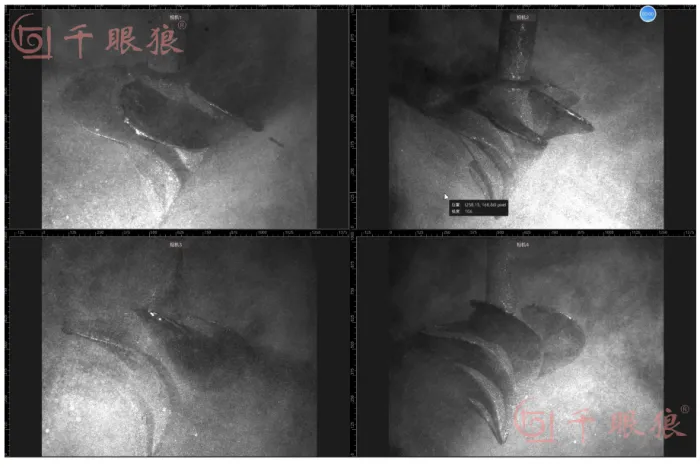
Figure 4. PIV tracer-particle images of miniature rotating machinery recorded synchronously by multiple high-speed cameras for 3D3C velocity-field reconstruction.
The experimental images and reconstructed results show that, when the gyroscope-like drill-shaped specimen rotates, the central jet and the surrounding rotating flow field are superposed, forming a compound vortex system with distinct spatial hierarchy. Local flow separation occurs near the sidewall of the rotating specimen and is accompanied by small-scale shed vortices. Compared with single-view visualization, multi-view 3D3C-PIV preserves out-of-plane velocity components and the spatial continuity of vortex structures, enabling researchers to identify the coupling among the jet, swirling flow, and local separation regions from three-dimensional velocity vectors and iso-structures.
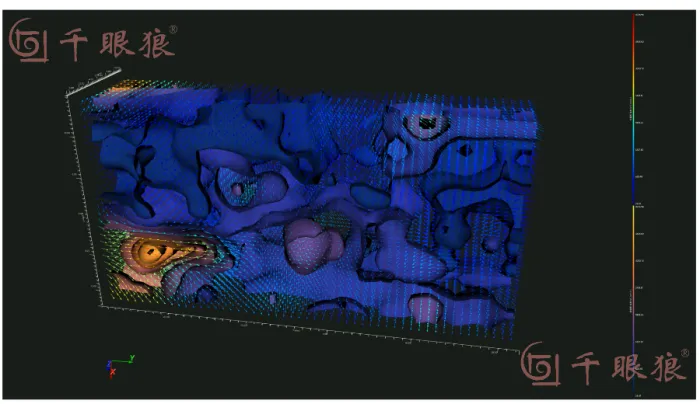
Figure 5. Three-dimensional 3D3C-PIV reconstruction of the air flow field around miniature rotating machinery, showing the spatial distribution of swirling flow, the jet, and local vortex structures.
For pump and fan research, the experimental value is mainly reflected in the following areas:
PIV provides full-field velocity information at impeller outlets, tip clearances, and wake regions, enabling the identification of recirculation, secondary flow, jet-wake structures, tip-leakage vortices, and flow separation. Compared with single-point velocimetry, full-field PIV simultaneously preserves the spatial relationships among flow structures and is therefore better suited to investigating vortex generation, transport, and interaction.
Synchronized analysis of the velocity field with head, pressure, flow rate, and torque can locate regions of locally high shear, strong vortical motion, recirculation, and mixing loss, and can clarify how these local flow features correspond to overall performance degradation. Such experimental results can provide a basis for optimizing blade loading distributions, guide-vane matching, volute-tongue position, and flow-passage geometry.
In pump research, high-speed cameras and PIV are complementary. High-speed cameras continuously record cavitation inception, cloud shedding, bubble coalescence, and bubble breakup, while PIV measures changes in the surrounding liquid-phase velocity field and vortex structures at the corresponding instants. If pressure and vibration signals are also synchronized, the temporal relationships among cavitation structures, pressure pulsations, and structural response can be investigated.
Computational fluid dynamics (CFD) can provide global information that is difficult to measure directly in experiments, but the results are affected by turbulence models, cavitation models, interface treatment, and boundary conditions. Phase-resolved PIV, time-resolved PIV, and synchronized high-speed imaging can provide validation benchmarks at critical cross-sections and representative phases, enabling comparisons of velocity distributions, vortex-structure locations, unsteady frequencies, and cavitation morphology.
The research topics covered at the 9th International Conference on Pumps and Fans show that experiments on rotating machinery are moving from steady-state performance characterization toward unsteady, three-dimensional, multiphase, and multi-source synchronized measurements. In this transition, high-speed cameras and PIV play distinct but complementary roles.
High-speed cameras make cavitation, bubbles, jets, separation, and rotating structures on microsecond-to-millisecond timescales continuously observable; PIV further converts particle images into velocity fields and vortex structures that can be compared and statistically analyzed. When these measurements are synchronized with pressure, vibration, rotor-angle, and performance parameters, they establish a complete experimental chain from transient-phenomenon identification and mechanism analysis to model validation and structural optimization.
The miniature rotating-machinery 3D3C-PIV case further demonstrates that even with a centimeter-scale field of view, high rotational speed, and complex three-dimensional flow, temporally and spatially resolved three-dimensional flow-field information can still be obtained through multi-view high-speed imaging, high-frequency dual-pulse illumination, precise calibration, and synchronized control. For pump and fan research and engineering development, the experimental data of greatest value are those that can reproduce operating conditions, quantify measurement error, and establish correspondence with the underlying dynamics.
 English
 Deutsch