The full-field displacement, radial strain distribution and vibration modal analysis of wind turbine blades under rotating conditions are measured by the Revealer high-speed binocular three-dimensional Digital Image Correlation (3D-DIC) system.
During operation, wind turbine generator set blades are subjected to the coupling effect of centrifugal force, aerodynamic load and self-inertial force. Their strain distribution law directly affects power generation efficiency, structural fatigue life and operational safety.
Mechanical analysis of blades mainly relies on finite element simulation, beam model theory and aeroelastic coupling calculation. The accuracy of theoretical models needs to be verified with experimental data. The traditional measurement method using strain gauges can only obtain discrete point data, which is difficult to reflect the full-field deformation characteristics of blades. In addition, strain gauges are hard to install and may alter local dynamic characteristics of the structure.
The research team from Inner Mongolia University of Technology introduced the Revealer high-speed 3D-DIC technology. Combined with the self-developed S1315 high-speed camera, this technology synchronously and non-contactly acquires the three-dimensional displacement field and strain field on the surface of blade structures. It verifies the team’s theoretical research conclusions and provides reliable experimental basis for structural optimization and health monitoring of wind turbine blades.
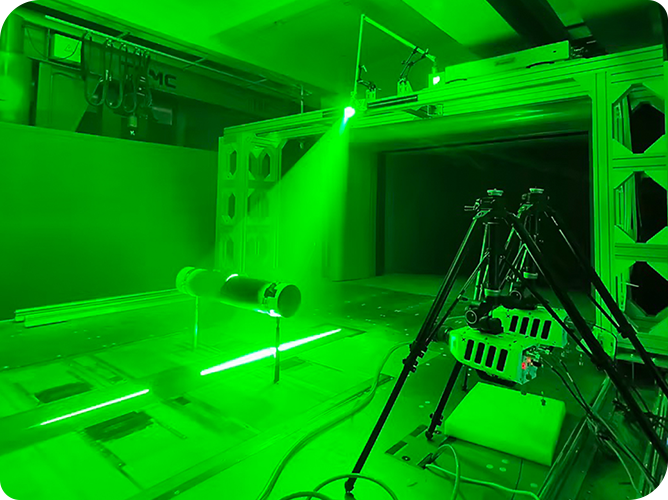
The test object is a scaled wind turbine blade made of fiberglass reinforced plastic (FRP). Compared with the original full-scale blade, it complies with the Reynolds similarity criterion and geometric similarity criterion. The blade root has the maximum thickness while the blade tip has the minimum thickness, and the geometric rotation center is located at the center of the blade’s fixed end face. The wind source system adopts an axial fan, which can provide a stable wind speed of 13 m/s. A motor is used to drive the blade to rotate, with a stable rotational speed of 750 r/min.
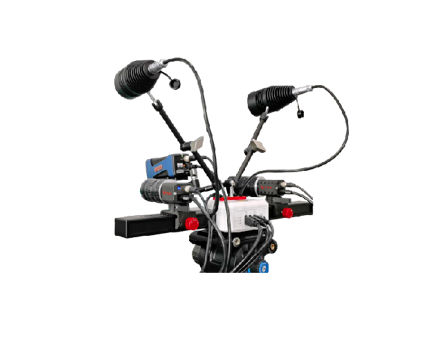
The core measuring equipment is the Revealer high-speed binocular three-dimensional DIC system:
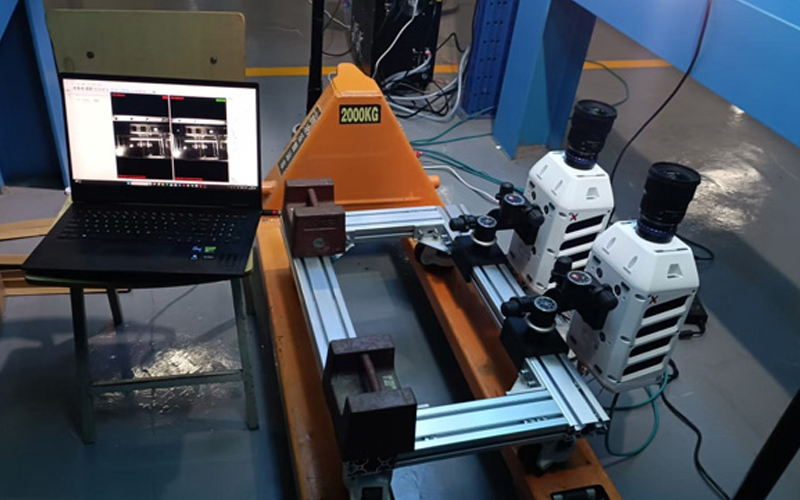
Acquisition Unit: Two sets of Revealer S1315 high-speed cameras. Under the experimental condition with a resolution of 1280×1024, the frame rate reaches 5000 frames per second. The cameras are capable of capturing images at 15000 frames per second under full-frame mode. The two cameras are mounted on a rigid beam to ensure their relative positions remain stable throughout the rotation process and avoid calibration parameter drift caused by wind-induced vibration.
Computing Unit: The self-developed Digital Image Correlation analysis software RVM of Revealer, which is applied for displacement field reconstruction, radial strain calculation, vibration modal identification and other data processing work.
Large-size and high-contrast speckles are drawn with marker pens. The diameter of each speckle accounts for about 5~7 pixels. The speckle quality is evaluated as "Excellent" via the speckle quality assessment tool built in the RVM software.
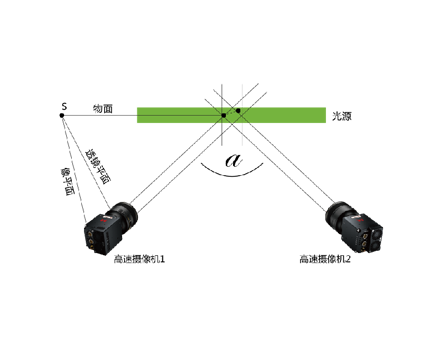
The two S1315 high-speed cameras are fixed at both ends of the rigid beam, and the included angle of the optical axes is adjusted to 25°, so that the common field of view fully covers the measurement area from the blade root to the blade tip (approximately 1.5 m × 1.5 m). A circular grid calibration board is used for stereoscopic calibration, and the reprojection error of calibration is controlled within 0.05 pixels.
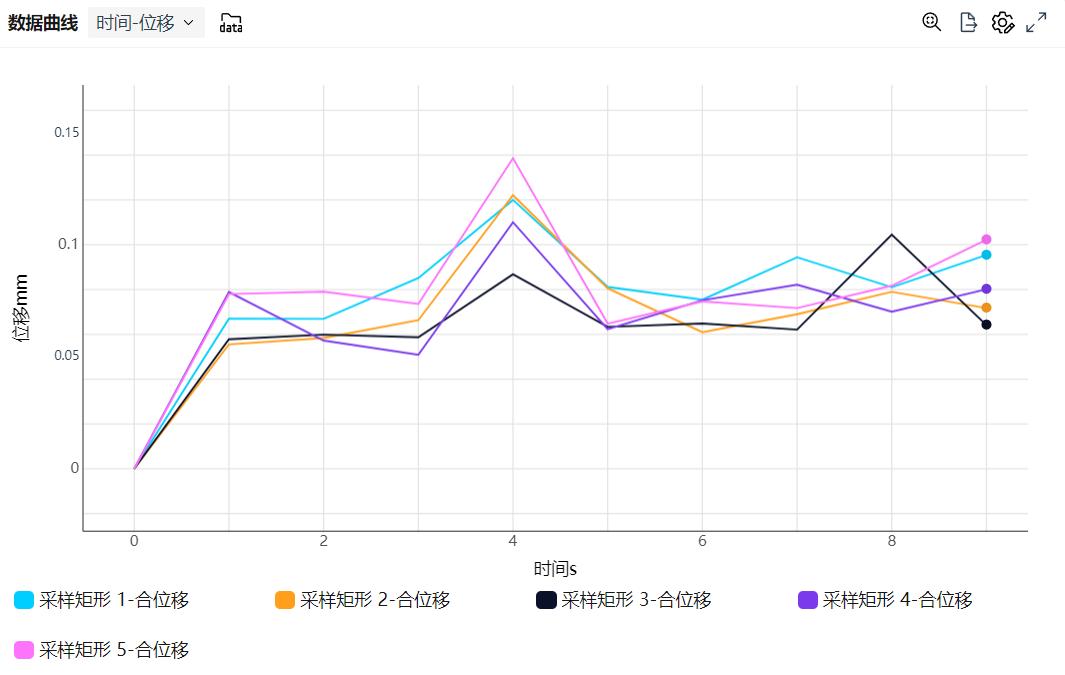
A total of 200 frames of images are continuously captured under the no-load and non-rotating state to evaluate the background noise and static displacement error of the system. The displacement trajectory of the same marker point in all frames is statistically analyzed. The obtained standard deviation of displacement is 0.1 mm. Combined with the field of view size and the resolution of 1280×1024 (each pixel corresponds to a spatial dimension of 1.46 mm), the converted sub-pixel accuracy is about 0.068 pixel. The noise level meets the requirements of system measurement.
Start the motor and the fan to keep the blade rotating stably at 750 r/min and maintain the wind speed at 13 m/s. The first frame of the static state is taken as the reference frame. The S1315 high-speed cameras continuously capture image sequences of the blade rotation process for 10 rotation cycles at a frame rate of 5000 frames per second.
Five key rectangular calculation areas are selected on the blade surface and arranged at equal intervals along the radial direction. The full-field displacement data are calculated, and the displacement caused by rigid body rotation is eliminated. On this basis, the radial strain distribution and vibration modal of the structure surface are calculated respectively.
Static displacement analysis is an important basis for evaluating the measurement accuracy of the DIC system. Under the no-load condition, the measured displacement fluctuation of the system is about 0.1 mm. Calculated based on the 1.5 m measurement field of view and the resolution of 1280×1024, the displacement measurement accuracy of the system reaches 0.068 pixel, which conforms to the typical indicators of conventional 3D-DIC systems.
Five sampling rectangular areas (R1~R5, with a size of 30×30 pixels) are selected to obtain representative information of the blade’s full-field deformation. The sampling rectangles are used to count displacement characteristics within the fixed field of view and ensure spatial continuity. The influence of rigid body rotation on DIC strain calculation is eliminated, which provides reliable input for subsequent radial strain analysis and vibration modal identification and avoids interference from spurious strain.
Total displacement of sampling rectangles: The maximum total displacement of the rectangle at the blade root is 300 mm, and the maximum total displacement at the blade tip is about 1380 mm. The total displacement of other positions is continuously and uniformly distributed along the blade length direction.
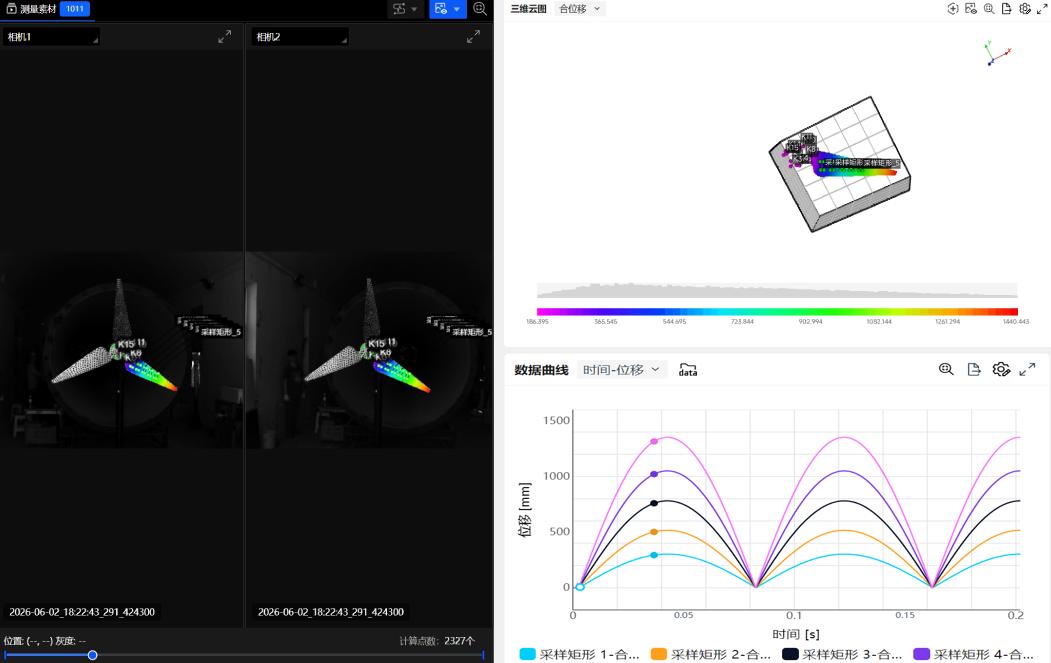
The measurement data show that the blade displacement presents a systematic gradient change along the rotation radius direction. The displacement amplitude of the blade tip area is the largest, while that near the blade root is the smallest, which is consistent with the law of circular motion. It is proved that the spatial distribution of the displacement field is continuous, and no local fracture or speckle falling off occurs on the blade, which provides reliable displacement data for the subsequent calculation of radial strain.
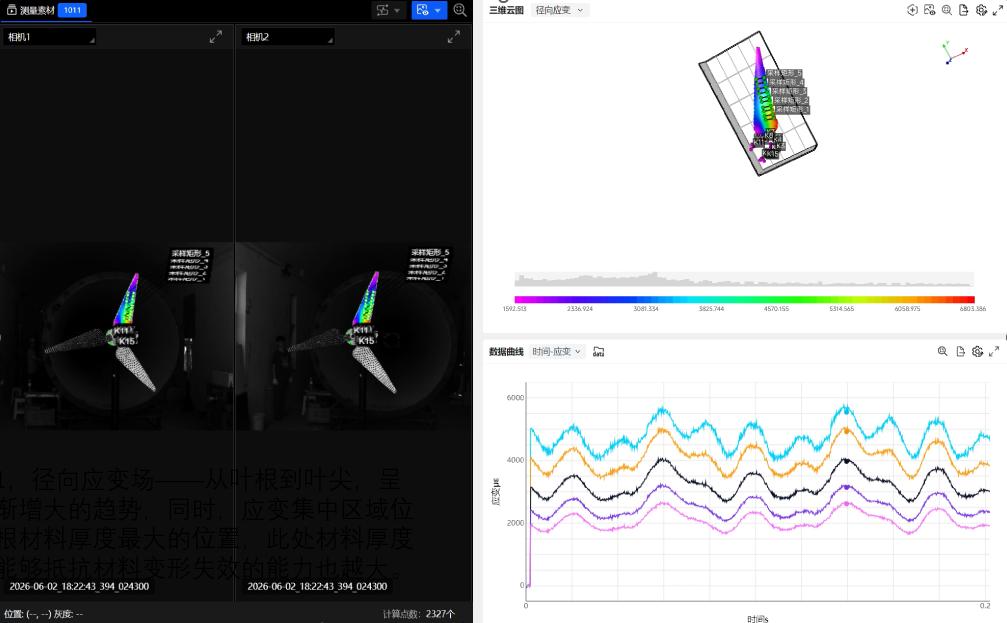
Five sampling rectangular areas (R1~R5 from the blade root to the blade tip) are selected at equal intervals along the radial direction. The mean value and time-history curve of radial strain at each area are output. The radial strain of the blade root area ranges from 4000 to 5600 microstrain (με), and the radial strain of the blade tip area ranges from 1700 to 2600 με. The strain of the middle areas decreases gradually on the whole, and the decrease amplitude between adjacent areas is roughly uniform.
This distribution indicates that the blade root is the area with the most concentrated stress on the blade. Therefore, the structural design of the blade root should be wide and thick, while the blade tip has relatively small structural deformation, so its structural design is narrow and thin. The uniform decreasing trend of strain gradient is consistent with the theory of variable cross-section cantilever beam. In the time domain, the radial strain of each sampling rectangle fluctuates periodically, and the fluctuation frequency is basically consistent with the blade rotational speed. The periodic fluctuation is mainly caused by periodic aerodynamic load generated by flow field disturbance during blade rotation and deformation induced by blade self-excited vibration.
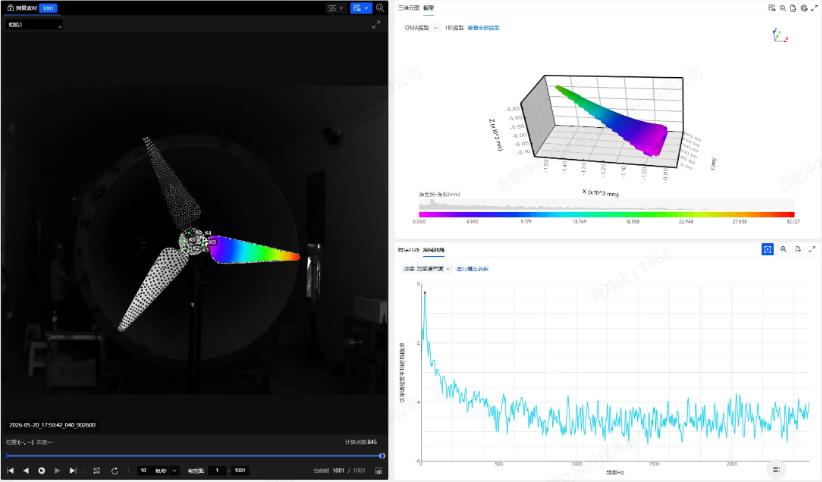
The average value of full-field displacement is extracted from the image sequences captured by the high-speed cameras. The time-domain signals are converted into frequency-domain signals by Fast Fourier Transform (FFT). The power spectral density curve shows a peak at 25 Hz, which corresponds to the first-order bending natural frequency of the blade. The result is consistent with the theoretically calculated first-order frequency at the rotational speed of 750 r/min, which verifies the correct calculation of the blade operational modal.
The first-order mode shape visually output by the RVM software shows that the blade tip produces bending deformation in the direction perpendicular to the rotation plane, the displacement near the blade root is close to zero, and the mode shape is smooth without nodes.
In this experiment, the Revealer high-speed 3D-DIC technology is adopted to measure the displacement field, radial strain field and vibration modal of the wind turbine blade under the working condition of 750 r/min rotational speed and 13 m/s wind speed. The conclusions are as follows:
Ⅰ. Static Accuracy: The displacement measurement accuracy of the system reaches the order of 0.068 pixel, which meets the requirements of dynamic testing for large-scale rotating blades.
Ⅱ. Displacement Field: The total displacement data of sampling rectangles confirm that the blade displacement presents a uniform gradient distribution along the radial direction with continuous spatial distribution, realizing stable tracking measurement under complex rotating states.
Ⅲ. Radial Strain: The blade strain decreases gradually along the radial direction with a fluctuation frequency consistent with the rotational speed, which is in good agreement with the prediction results of the variable cross-section cantilever beam theory.
Ⅳ. Vibration Modal: The first-order bending natural frequency of approximately 25 Hz is successfully identified, and the corresponding mode shape characteristics are obtained.
In summary, the high-speed 3D-DIC method can effectively overcome the limitations of traditional measurement methods in rotating test scenarios. It realizes synchronous, non-contact and full-field acquisition of displacement field, strain field and modal parameters, and provides reliable experimental data for structural design verification and dynamic characteristic research of wind turbine blades.
 English
 Deutsch