At the Xiaomi foldable flagship smartphone launch event on September 7, product reliability testing was once again highlighted as an important part of new-product development. The event presented all-angle drop simulation as well as three-dimensional dynamic measurement for foldable structures. For consumers, the questions are straightforward: how resistant is the smartphone to accidental drops, and how reliable is the folding mechanism? For engineers working in 3C electronics structural development and testing, however, these questions must ultimately be translated into specific test conditions, motion states, and structural responses.
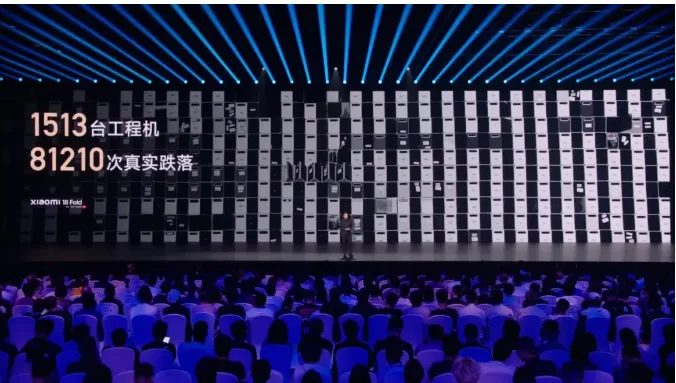
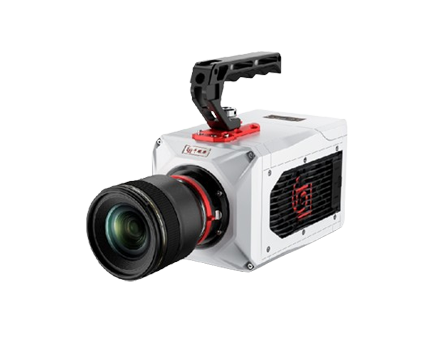
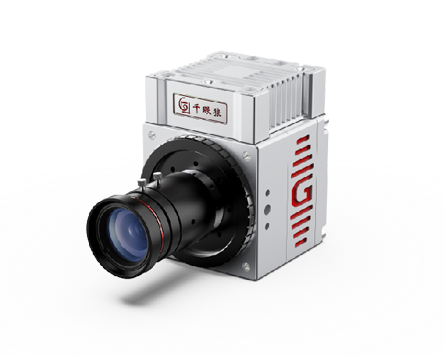
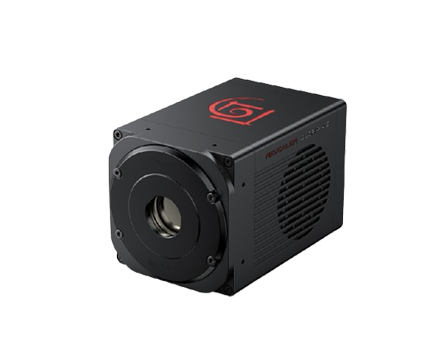
Figure 1. Xiaomi 18 Fold launch event. Revealer high-speed cameras were used in support of 81,210 physical drop tests.
Smartphone drop testing and foldable-screen hinge testing address different mechanical problems. A smartphone drop is a typical short-duration impact event that requires measurement of the actual orientation, motion state, and local structural response from release and free fall through initial contact, impact, and rebound. A foldable-screen hinge test, by contrast, focuses more on the three-dimensional displacement, strain distribution, and local strain concentration of hinges, pins, linkages, and supporting structures during repeated opening and closing.
For smartphone drop testing, high-speed cameras, 6DoF motion analysis, and high-speed DIC can provide complementary measurements. For foldable-screen hinges, 3D-DIC is better suited to acquiring continuous three-dimensional full-field deformation data. Both types of tests serve the same engineering objective: to provide experimental data that can be compared with structural simulation results and used to assess whether the prescribed boundary conditions, contact states, and predicted structural deformation are consistent with the actual physical response.
Smartphone Drop Testing: Combining High-Speed Imaging and High-Speed DIC for Impact Measurement
Smartphone drop testing is primarily used to evaluate the dynamic response of the complete device under different impact orientations. Engineering evaluation is not limited to determining whether visible damage occurs after a drop. It is also necessary to identify the actual orientation at impact, determine which region makes first contact, and evaluate the transient deformation of the display, mid-frame, corners, or other structural components during impact.
In practical testing, engineers use high-speed cameras to record continuous image sequences from release and free fall through impact and rebound. These high-speed image sequences can then support two complementary analysis paths. The first is object tracking and 6DoF kinematic analysis, which provides displacement, velocity, acceleration, and orientation parameters for reconstructing the actual trajectory and impact condition. The second is high-speed Digital Image Correlation (high-speed DIC), which measures dynamic displacement fields and strain fields in selected regions during impact and is used to evaluate local structural response.
6DoF analysis primarily characterizes the rigid-body motion of the smartphone. Roll angle and other orientation parameters can be calculated from consecutive high-speed images to determine whether the actual drop results in face contact, frame-edge contact, or corner contact. These measurements can also be compared with the initial orientation and contact definition used in the simulation model.
In this process, the Revealer high speed camera provides the temporal resolution required to capture the high-speed transient event and supplies the image data needed for subsequent kinematic analysis.
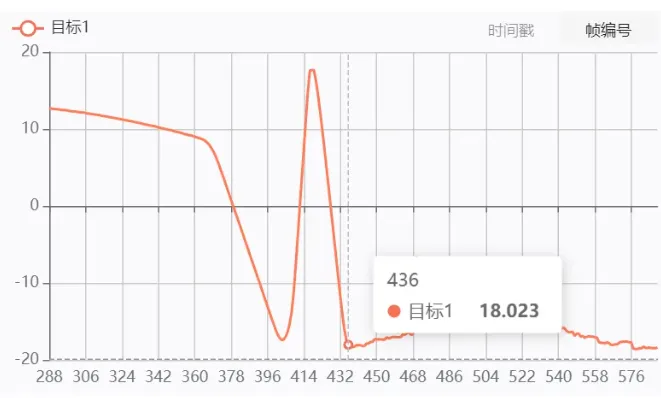
Figure 2. Roll-angle variation measured from a smartphone drop test with an inclined initial orientation using a Revealer high-speed camera. The roll angle at impact was 14.319°.
High-speed DIC extends the analysis from rigid-body motion to the local structural deformation that occurs at impact. A correlation-compatible speckle pattern is applied to the display, back cover, or another region of interest. High-speed cameras then record a sequence of deformation images before and after impact, and digital image correlation is used to calculate displacement and strain fields.
In the Xiaomi smartphone drop DIC test described in the source material, stereo high-speed 3D-DIC was used to obtain full-field three-dimensional coordinates, three-dimensional displacement, and Lagrangian strain. Two-dimensional high-speed DIC was used to analyze in-plane displacement as well as strain components including EXX, EYY, and EXY.
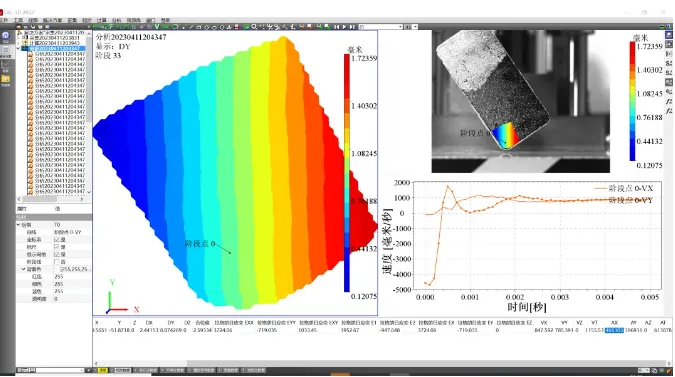
Figure 3. Y-direction strain measured during a frontal smartphone drop test using Revealer high-speed DIC.
High-speed cameras and high-speed DIC therefore provide two complementary categories of data in smartphone drop testing. Trajectory, orientation, velocity, and acceleration describe the actual drop condition, while displacement and strain distributions at the impact location characterize the local structural response.
When these experimental results are compared with simulation results, engineers can examine whether the prescribed initial orientation, contact conditions, and high-strain regions are consistent with the physical test. The resulting data can support optimization of the mid-frame, display, corner structures, and internal connections.
Foldable-Screen Hinges: The Key Issue Is Local Deformation, Not Simply the Opening Motion
For foldable-screen hinges, pins, linkages, and associated structural components, engineers are concerned with how load is transferred through individual connections during opening and closing. Important questions include where relatively large displacements occur, where strain becomes concentrated, and whether these local responses remain stable and repeatable over repeated folding cycles.
A conventional video recording can show the mechanism opening and closing, but it cannot directly provide continuous three-dimensional displacement and strain fields. For compact structures involving significant out-of-plane motion and non-uniform local strain, 3D-DIC, a digital image correlation technique, is well suited to capturing continuous three-dimensional displacement and strain fields.
3D-DIC uses stereo imaging. After the two cameras are spatially calibrated, they synchronously acquire images of the speckle pattern on the test surface. Digital image correlation is then used to determine the change in three-dimensional coordinates of corresponding surface points, from which the three-dimensional displacement and strain distributions are reconstructed.
Compared with point-based measurement methods such as strain gauges and displacement sensors, 3D-DIC provides continuous full-field information over an entire region of interest. This makes it particularly useful for identifying previously unknown strain concentrations and analyzing complex load-transfer paths.
In a 3D-DIC test of a foldable-screen metal hinge, the region of interest was the local connection area during hinge opening and closing. Measurements focused on displacement and strain changes in the hinge axis, pin seat, and supporting structures. The experimental results were then compared with the numerical model for model validation and parameter calibration.
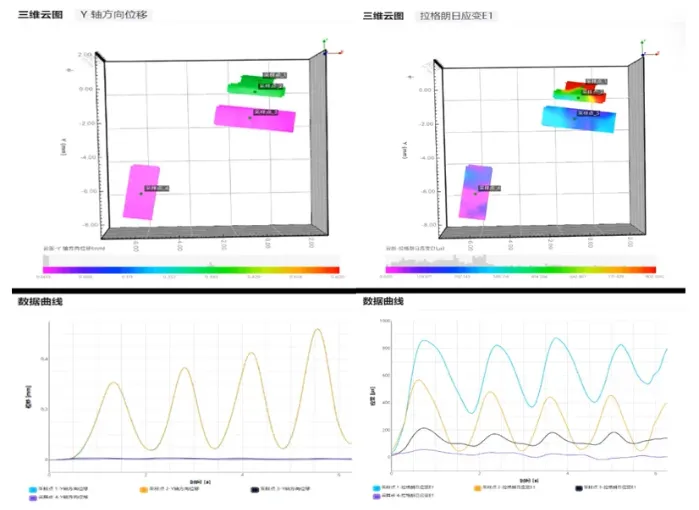
Figure 4. Revealer 3D-DIC measurement of a foldable-screen hinge: Y-direction deformation of the hinge pin during opening and closing (left), and variation in principal strain at the hinge pin (right).
From an engineering perspective, the spatial differences between measurement locations and the evolution of structural response during opening and closing are often more important than a single maximum value. Existing measurements of hinge pins, pin seats, and fixing plates show that different structural locations can exhibit different strain responses, while displacement and strain vary periodically with repeated opening and closing.
These measurements can be used to identify the primary load-bearing locations, strain concentration regions, and load-transfer relationships between components. In foldable-screen hinge development, the role of 3D-DIC is therefore not simply to compare two contour plots. More importantly, experimentally measured three-dimensional displacement and strain fields provide quantitative reference data for validating the structural response predicted by a numerical model.
Conclusion
Structural development and reliability testing for smartphones, foldable devices, laptop displays, and other 3C electronic products are increasingly moving toward integrated process measurement and model validation. Smartphone drop testing requires resolution of impact events occurring on millisecond or even microsecond time scales, while foldable mechanisms require three-dimensional deformation and strain measurements in compact structural connections.
Within this workflow, Revealer high-speed cameras, high-speed DIC, and 3D-DIC serve different but complementary measurement functions. High-speed cameras record the actual transient impact process; 6DoF analysis characterizes rigid-body motion; high-speed DIC measures dynamic displacement and strain fields during impact; and 3D-DIC provides three-dimensional full-field measurements for structures undergoing complex deformation.
When combined with simulation results, these experimental data can be used to verify actual test conditions, validate numerical models, identify high-risk structural regions, and provide traceable measurement evidence for reliability design, structural verification, and iterative development of new 3C electronic products.
 English
 Deutsch