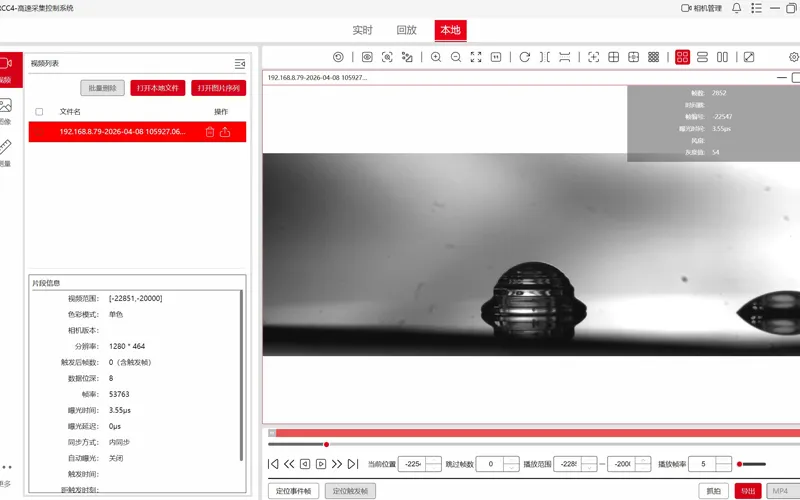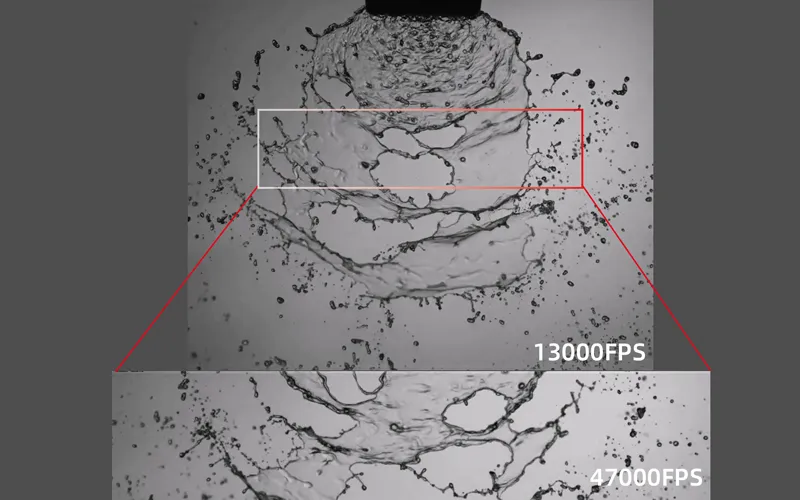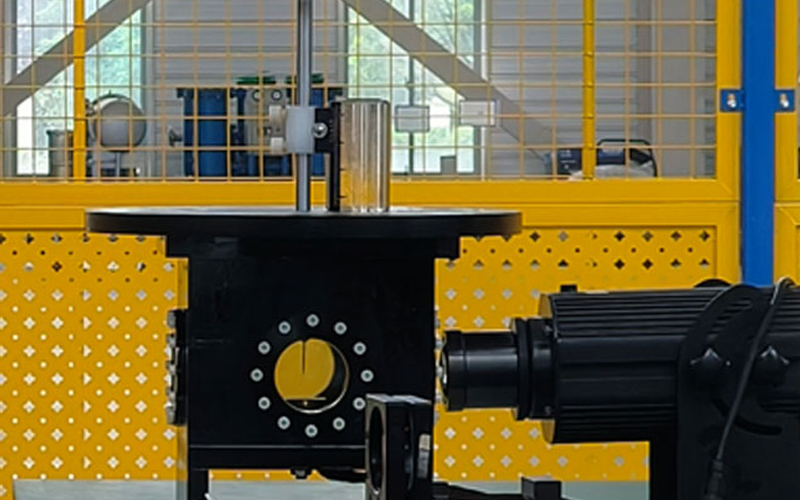
The 2026 Chen Zongji Lecture and Forum on Extreme Geological Hazards and Major Engineering Safety was recently held in Chengdu, China. The forum addressed the formation and evolution of extreme geological hazards, the safety of major engineering projects, rock mechanics, and engineering disaster prevention.
Although landslides, rockbursts, and instability in deep underground engineering occur at different scales and under different boundary conditions, they share a fundamental problem in rock mechanics: how localized damage initiates and progressively develops into crack propagation, branching, and coalescence, ultimately leading to macroscopic instability.
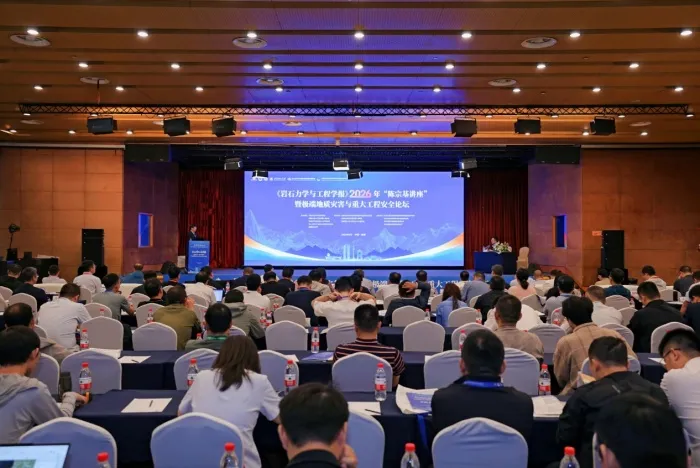
Figure 1. 2026 Chen Zongji Lecture Forum on extreme geological hazards and major engineering safety, focusing on rock mechanics and geohazard research.
For experimental rock mechanics, the critical questions extend beyond measuring peak strength and observing final failure patterns. Researchers must also determine where cracks first initiate, when they enter an accelerated propagation stage, and how localized damage progressively develops into overall instability.
These research requirements are driving geotechnical and rock mechanics experiments beyond conventional measurements of load, axial displacement, and other macroscopic responses toward high-temporal-resolution imaging, full-field deformation measurement, and time-resolved analysis of crack evolution.
Conventional strain gauges and displacement transducers provide local or global deformation information. However, their spatial characterization capabilities are limited when measuring highly heterogeneous deformation and strain localization during rock failure.
Digital Image Correlation (DIC) is a non-contact optical measurement technique that tracks surface speckle patterns to obtain displacement and strain fields. When combined with high-speed cameras, high-speed DIC enables researchers to resolve rapid deformation processes associated with crack initiation, propagation, and coalescence.
High-speed cameras address the temporal sampling requirements of rapid events, while high-speed DIC converts sequential high-speed images into quantitative displacement and strain fields.
In crack evolution studies, strain localization zones provide important indicators of concentrated damage and potential crack development. By combining original high-speed images, crack detection algorithms, and acoustic emission (AE) measurements, researchers can further establish relationships between strain-field anomalies and actual crack evolution.
In an experimental investigation of wetting–drying-induced damage in tuff, rock specimens were subjected to 0, 1, 5, 10, 15, and 20 wetting–drying cycles.
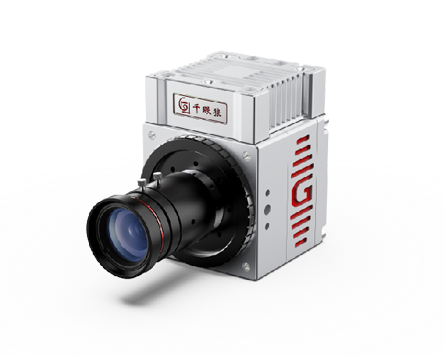
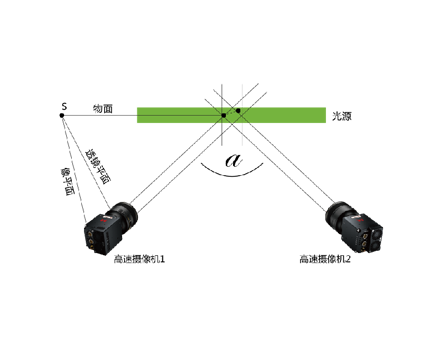
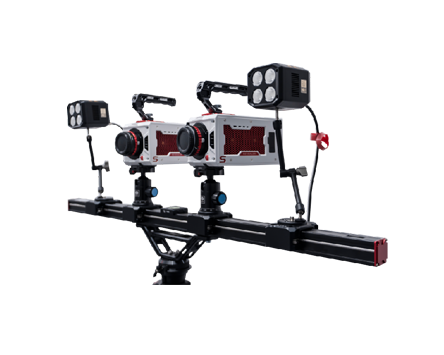
Two Revealer M230 high-speed cameras were configured as a stereo high-speed 3D-DIC system to continuously acquire three-dimensional displacement fields and surface strain fields during uniaxial compression.
For specimens without wetting–drying treatment, the displacement field remained relatively uniform during the initial loading stage.
During the stable crack propagation stage, localized strain concentration gradually developed in the central region of the specimen, corresponding to microcrack initiation. As the load approached its peak, the strain concentration intensified and eventually developed into a through-going principal crack. The overall failure pattern was dominated by axial tensile splitting.
Crack evolution became increasingly complex as the number of wetting–drying cycles increased.
After 10 cycles, strain localization occurred earlier, and secondary cracks appeared on both sides of the principal crack. After 15 cycles, the localized deformation bands exhibited further inclination and branching, while strain concentration became more spatially dispersed. The failure behavior showed a tendency to transition from tensile-dominated failure toward mixed tensile–shear failure.
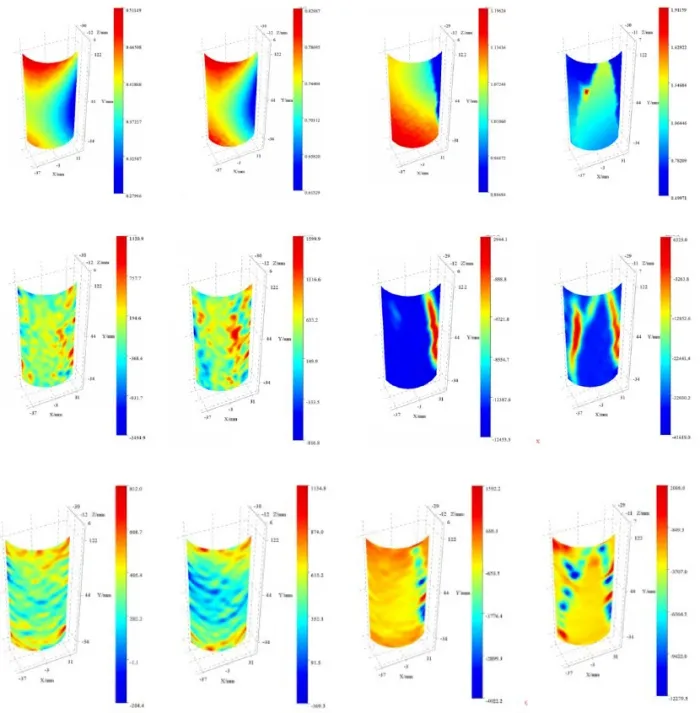
Figure 2. Revealer high-speed 3D-DIC measurement of tuff after wetting–drying cycles, showing full-field displacement, strain localization, and crack branching during uniaxial compression.
Comparisons of the failure patterns at peak load further revealed that increasing wetting–drying cycles transformed relatively simple through-going cracks into complex fracture networks characterized by multiple branches and propagation directions.
High-speed 3D-DIC therefore provides more than a characterization of final failure patterns. It extends the observation window to earlier stages of strain localization and damage accumulation.
By correlating full-field deformation measurements with AE counts, AE energy, and AE b-values, researchers can establish stage-by-stage relationships between surface deformation and internal damage activity, providing experimental evidence for the integrated analysis of rock damage and crack evolution.
After high-speed DIC has acquired full-field displacement and strain data, crack analysis can be extended from manual observation to automated temporal identification.
A DIC-based time-resolved crack detection method using a sparse optical flow algorithm first calculates pixel displacements between a reference frame and the current frame.
The reference image is then deformed through interpolation, and the crack region is extracted by calculating the difference between the deformed reference image and the current image.
Subsequently, the Hungarian algorithm is employed to establish temporal correspondences between crack points in successive frames, enabling further calculation of crack endpoints and crack opening angles.
This process transforms cracks from static geometric features in individual images into dynamic measurement objects with temporal information.
It enables the analysis of crack initiation time, propagation direction, branching behavior, and changes in geometric parameters.
For rock fracture research, this approach extends the conventional displacement- and strain-field measurements of high-speed DIC toward time-resolved crack tracking and quantitative measurement of crack geometry.
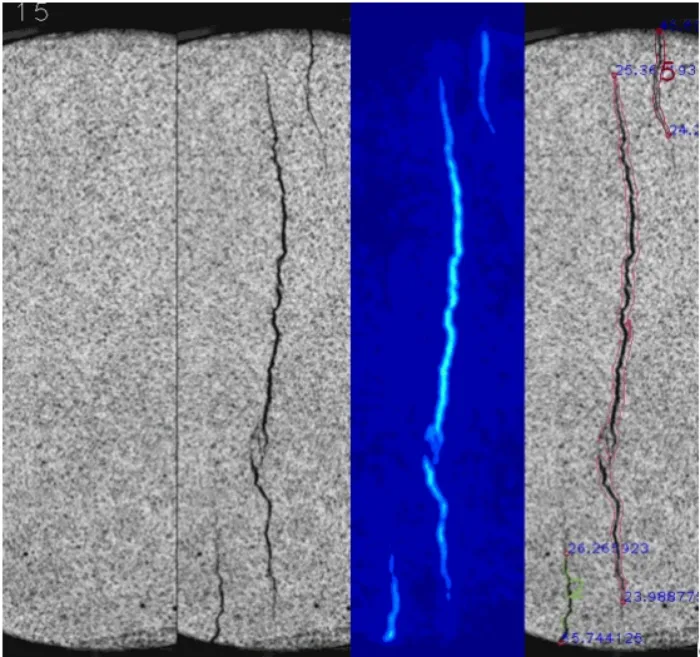
Figure 3. High-speed DIC crack detection using sparse optical flow and image differencing to track crack initiation, crack endpoints, and crack opening characteristics over time.
Under engineering blasting, impact, and high-strain-rate loading, crack evolution may occur on microsecond timescales. Under such conditions, the temporal resolution of high-speed imaging directly determines whether critical stages of damage evolution can be identified.
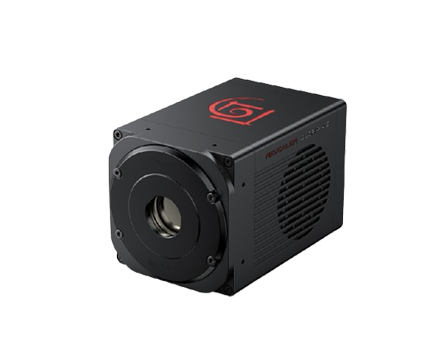
In a Split Hopkinson Pressure Bar (SHPB) experiment, two Revealer NEO25M ultra-high-speed cameras were integrated with a DIC system to form a stereo dynamic measurement system.
The cameras recorded the entire impact deformation process at a frame rate of 100,000 frames per second (fps).
With a temporal sampling interval of 10 μs, the experiment identified several stages of dynamic response:
190–390 μs: The specimen primarily exhibited a dynamic elastic response.
400–1290 μs: The strain–time curve displayed nonlinear fluctuations associated with damage accumulation and microcrack development.
After 1290 μs: The specimen continued responding to loading in an already damaged state.
After 1510 μs: Macroscopic cracks formed, accompanied by localized fracture.
High-speed DIC measurements based on ultra-high-speed imaging thus extend the experimental analysis beyond a simple comparison between the pre-loading and post-failure states.
Instead, the deformation and failure process can be resolved into successive stages of dynamic elastic response, damage accumulation, crack development, and macroscopic fracture.
This approach provides experimental data with higher temporal resolution for investigating damage evolution and dynamic constitutive behavior under high-strain-rate conditions.
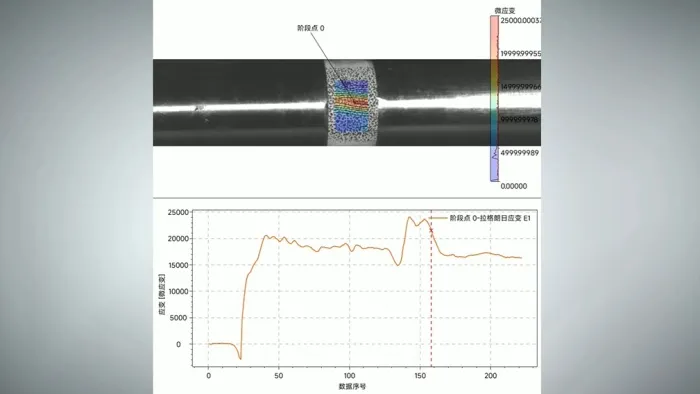
Figure 4. Revealer NEO25M ultra-high-speed cameras and high-speed DIC capture an SHPB impact experiment at 100,000 fps, measuring dynamic strain and damage evolution at microsecond timescales.
Applications of high-speed cameras and high-speed visual measurement are not limited to standardized rock specimens. They can also be extended to granular flows, erosion processes, and physical modeling experiments involving geological hazards.
In a rock–ice avalanche erosion experiment, three high-speed cameras were used to record different aspects of the process: the dynamic state of the flowing material before entering the erodible section, the transient local erosion process, and the evolution of the entire bed surface.
The first high-speed camera acquired images at 5,000 fps. Combined with piv measurement, these images were used to quantify near-bed flow velocity and shear rate.
The second camera operated at 1,500 fps to record particle–bed material exchange and changes in the erosion profile.
The third camera covered the entire erodible bed and was used to calculate the instantaneous erosion rate.
Experimental results demonstrated a pronounced nonlinear relationship between ice content and erosion rate.
As ice content increased, the erosion rate initially increased and subsequently decreased, reaching relatively high values within an ice-content range of approximately 40%–60%.
This behavior reflects competing effects associated with increasing flow velocity and decreasing bulk density of the flowing mixture.
The experiment demonstrates how high-speed cameras can extend measurement capabilities from individual specimen failure to particle migration, erosion interface evolution, and geohazard processes.
By acquiring images at high temporal resolution, rapid, spatially heterogeneous, and difficult-to-repeat events can be converted into data suitable for further quantitative analysis.
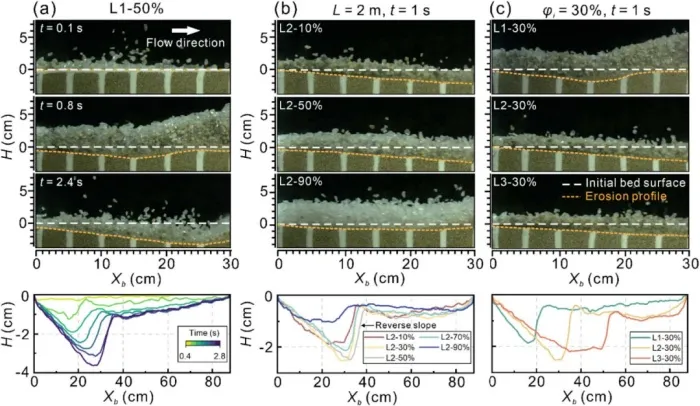
Figure 5. Revealer high-speed camera records rock–ice avalanche erosion, while PIV measures near-bed flow velocity, basal shear rate, and erosion profile evolution.
The research topics discussed at the forum indicate that experimental geomechanics is moving beyond the characterization of peak strength and final fracture patterns toward high-spatiotemporal-resolution measurements of the entire failure process: damage initiation, strain localization, crack propagation, and macroscopic instability. Under impact, strong seismic loading, wetting–drying cycles, freeze–thaw conditions, and multiphysics coupling, critical failure information is often concentrated within extremely short time intervals and localized regions. Conventional point-based sensors cannot fully capture these spatial and temporal evolution processes.
High-speed cameras provide high-temporal-resolution observations on microsecond-to-millisecond timescales, while high-speed DIC converts sequential high-speed images into quantitative displacement fields, strain fields, and strain localization information. When integrated with AE measurements, load data, and numerical simulations through a common time reference, these techniques transform transient failure processes that were previously characterized mainly through qualitative observations into measurable, comparable, and model-ready experimental data. The tuff wetting–drying and SHPB experiments demonstrate that high-speed cameras and high-speed DIC enable more detailed identification of damage accumulation, strain localization, crack development, and transitions between failure stages.
The contribution of high-speed cameras and high-speed DIC to extreme geomechanics therefore extends beyond improving the visualization of failure. More importantly, these technologies help address a major limitation of conventional experiments: the lack of spatially and temporally resolved information immediately before and during failure. Future developments are expected to move beyond standalone high-speed imaging toward the integration of high-spatiotemporal-resolution acquisition, full-field measurement, synchronized multi-sensor diagnostics, and intelligent data analysis. Such integrated experimental approaches can provide more direct evidence for investigating rock crack propagation mechanisms, calibrating damage constitutive models, validating numerical simulations, and developing engineering instability criteria.
 English
 Deutsch